Boise State University researchers found that traffic noise alone — without vehicles, exhaust or a physical road — reduced the number of migratory birds on an Idaho mountainside by 31% across two field seasons, according to results from the university’s “Phantom Road” experiment conducted in 2012 and 2013.
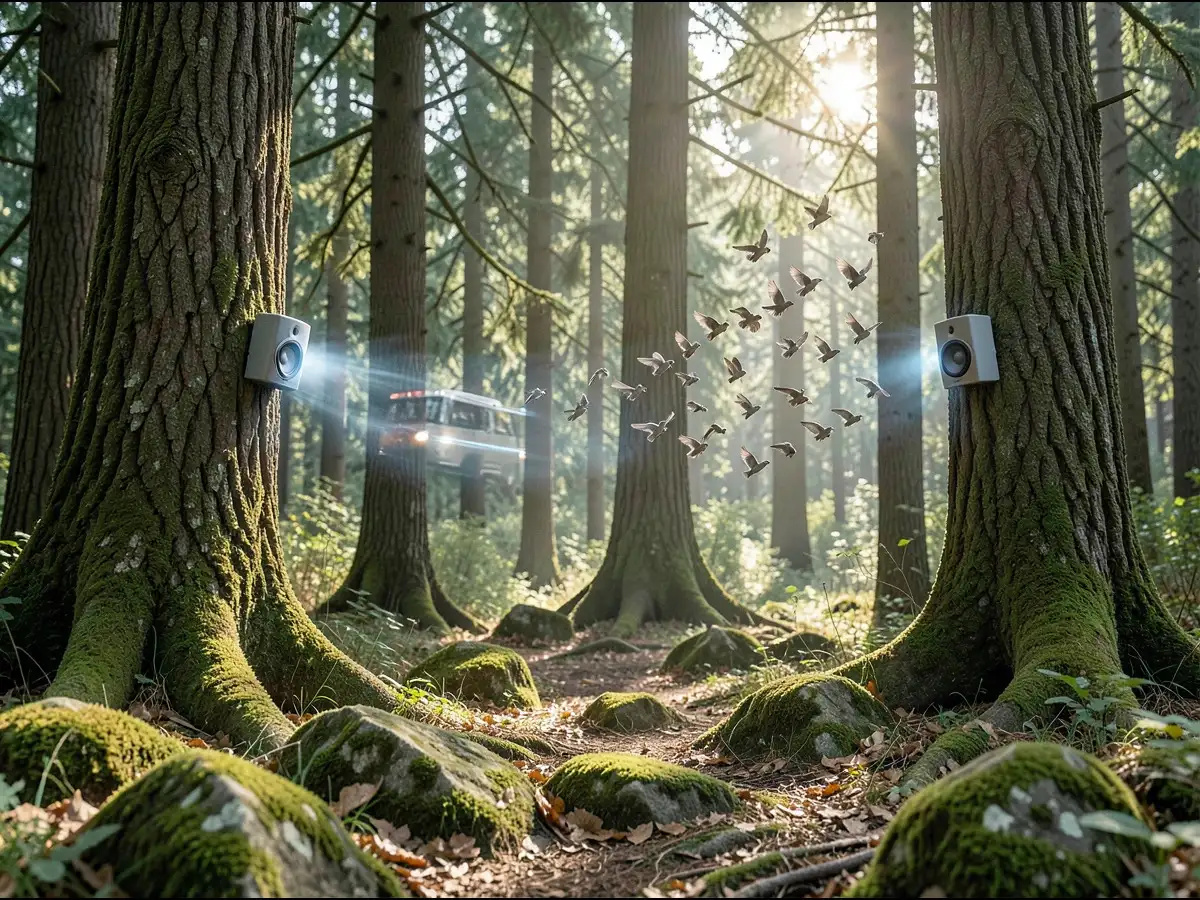
The study, run by the university’s Sensory Ecology Lab in partnership with the Idaho Bird Observatory, created a half-kilometre “invisible highway” on a ridge top near Lucky Peak using 15 pairs of tree-mounted speakers that broadcast recordings of fast-moving vehicles and car horns.
Speakers ran in four-day on-off cycles so scientists could compare bird activity during noisy periods with adjacent quiet periods and with a nearby control site in Lucky Peak that received no playback.
“The ‘Phantom Road’ investigation found that the number of birds in an area reduced by over a quarter in the noisy period,” the research summary says. The initial 2012 season showed a 28% decline; combined analysis across both years yielded the 31% overall reduction. Species such as Yellow Warblers and Cedar Waxwings avoided the noisy area, and very few birds were observed during playback periods generally.
Birds that remained in the noisy zone showed poorer body condition or were less efficient at gaining weight at a critical migration stopover. Laboratory follow-up indicated those birds spent more time being vigilant for danger and less time feeding, a behavioral shift that can reduce the energy available for migration.
Follow-up laboratory analysis showed that birds exposed to traffic noise spent more time scanning for danger and less time eating, a shift that can cut the energy available for migration. The finding comes from the Boise State team that ran the Phantom Road experiment.
Researchers said the birds that stayed in the noisy zone either arrived in poorer condition or gained weight less efficiently at a critical stopover. The behavioral change observed in the lab helps explain the weaker body condition measured in the field.
The study compared the ridge-top playback area with an adjoining site in Lucky Peak where the Idaho Bird Observatory conducts regular monitoring. Birds in Lucky Peak were not subjected to the generated noise, providing a quiet reference for the four-day on-off cycles.
Scientists from Boise State designed and implemented the Phantom Road in the Lucky Peak area in 2012.
The research team included Boise State professor Jesse Barber, post-doctoral research fellow Chris McClure, and Heidi Ware, a graduate student and Idaho Bird Observatory outreach expert, supported by scientists and volunteers conducting field work.
Related reading

Wyoming Family Sells Home Near Cheyenne With Custom Indoor Slide
A Wyoming family is selling a six-bedroom home near Cheyenne that features a custom-built indoor slide spiraling from...

BGE Customers, Officials Criticize $156M Rate Hike and City Surcharge
Baltimore Gas and Electric customers and city officials criticized a proposed $156 million rate increase and a separate...

DOJ Awards Nearly $150 Million to Hire Over 1,000 Law Enforcement Officers Nationwide
The Department of Justice has announced nearly $150 million in grants to hire over 1,000 law enforcement officers...

Army QB Cale Hellums Faces Rice in Houston for Bowl Eligibility
Army quarterback Cale Hellums faces Rice on Saturday in Houston with a chance to make the Black Knights...