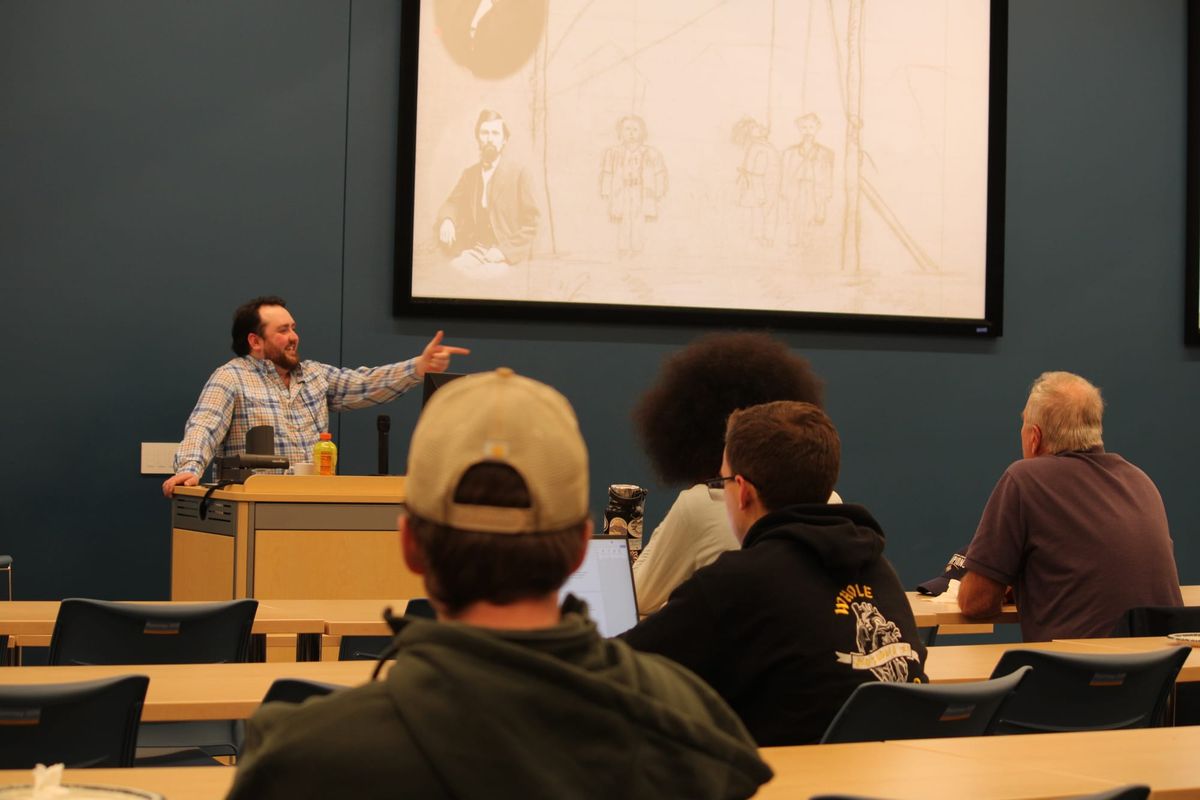
“I think it’s important for both groups of these kids to understand a little bit of the background of this place and its people,” Austin Haney said.
The Burton K. Wheeler Center brought that argument to life on Nov. 12 in Romney 008 with “Politics and Pizza: Montana Before Statehood,” a talk spanning the territory’s formative quarter-century from 1864 to 1889.
Haney, born in Billings and now the education and programming director at the C.M. Russell Museum in Great Falls, traced his own obsession to hours in a pickup truck with his grandfather. “We used to go around all over the place, to historic sites and battlefields and museums, and just got obsessed with it from a young age,” he said.
“Whenever I was down in Billings, the best times I ever had was hopping in the truck with my grandpa. We’d go to Pompey’s Pillar, we’d go out to Little Bighorn and we would just talk.”
The presentation covered territorial formation, railroad expansion, the Montana Gold Rush, the role of steamboats, and Indigenous history, The MSU Exponent reported. For students like Fiona Kuntz, a freshman film major, the lecture complicated a narrative she absorbed growing up in the state. “I mean, growing up in Montana, [with] their education system, I think it’s very easy to fall into a single story of Montana,” she said.
She attended initially for an Honors Presents assignment but stayed for the details — bowling alleys, ice cream and soda shops, and an image from the Blackfeet massacre. “[In the presentation] there was an image of [a] guy’s head chopped off. It’s not talked about enough,” she said.

Tabay Atkins, a freshman studying paleontology, came because he believes campus engagement matters regardless of major. “I feel like you get the most out of your college experience by engaging heavily in the programs that campus has to offer. Even if it’s something that’s not relevant to your degree path or personal interest,” he said.
The sweep of change surprised him. “I’m relatively new here, and I’m always fascinated by history and learning more about the past. But to see all the change that has happened over the course of that time period, and how each event has led up to where we are now was really fascinating,” said Atkins.
Haney pointed students toward a resource a short drive away. “You guys are right down the road from the Montana Historical Society. Any kid here who wants to learn more, go up there, take a drive to that museum. It’s free to go,” he said.
“They are great partners and friends. They have amazing artifacts, interpretation and things that tell the story of the people, the places, the things that happened here — and it’s such a great resource in your backyard.”

Keep reading
East Lansing Board Plans ‘Screenagers’ Screening; Approves Paving, Audio Contracts
"We are encouraging our audience [of] students, community members, families, and parents alike to engage with our panelists...
No. 3 South Carolina Equestrian Heads to UT Martin for Split-Squad Doubleheader
No. 3 South Carolina equestrian heads to Martin, Tennessee this weekend for a split-squad doubleheader against UT Martin...

Class Action Lawsuit Challenges SNAP Food Restrictions in 18 States
A federal lawsuit filed Wednesday challenges USDA's imposition of identical SNAP food restrictions across 18 states without required...

Union Opens Playoffs vs. Revolution; Blake Out, Rick Starts
The Philadelphia Union open their MLS Cup playoff series against the New England Revolution at Gillette Stadium on...