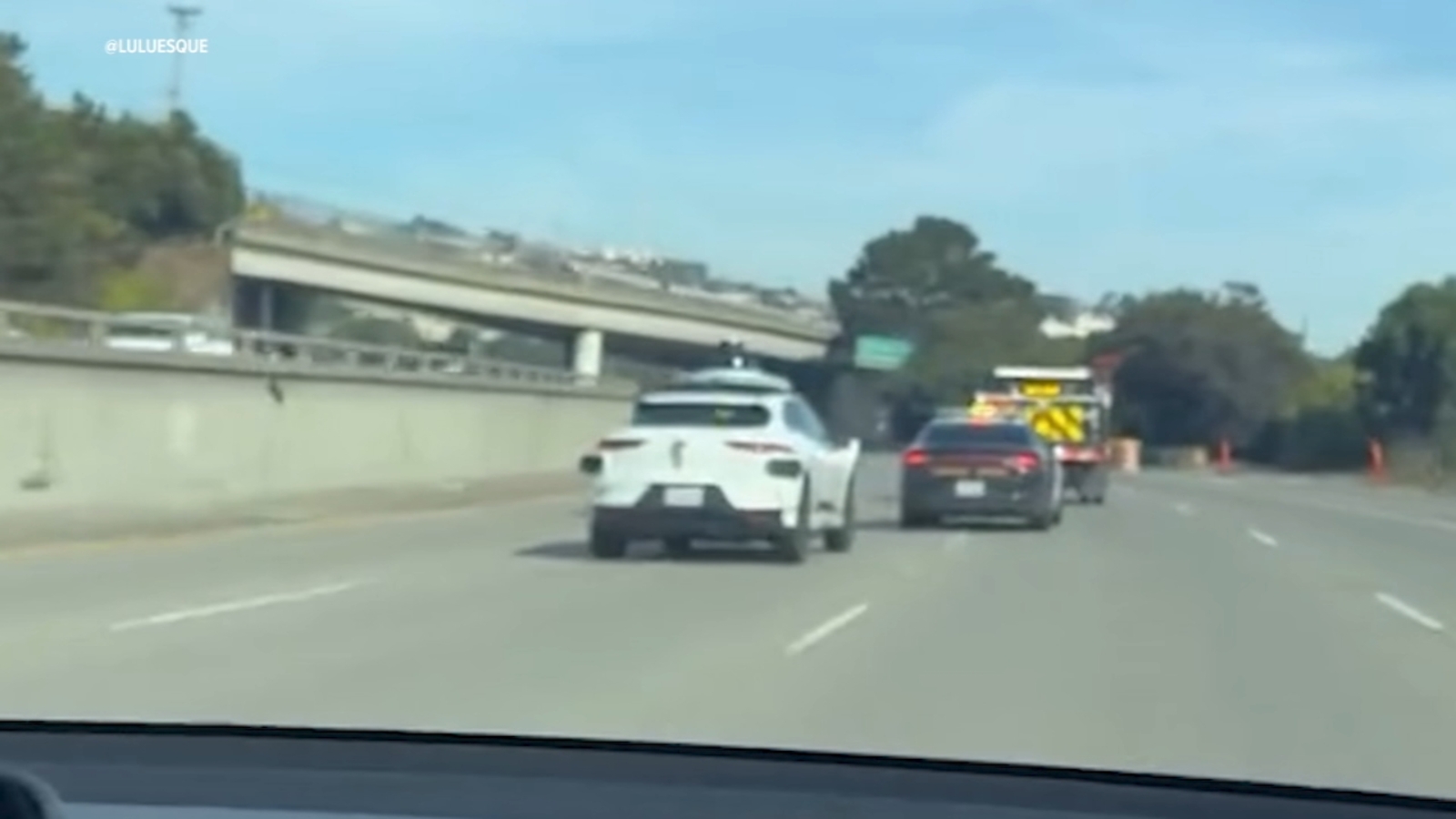
California’s Department of Motor Vehicles yanked Waymo’s freeway privileges on November 11, grounding the robotaxi fleet on every state highway after a cluster of construction-zone incursions and a televised near-miss with highway patrol officers.
The order, confirmed by DMV spokesperson Jonathan Groveman to the Associated Press, bars both testing and commercial driverless operations on freeways statewide.
It followed two episodes six days apart: three Waymo vehicles that drove into an active closure on U.S. 101 near Burlingame on November 5, and a single vehicle that tried to pass California Highway Patrol cruisers running a traffic break on Interstate 280 in San Francisco the next day. Video of the I-280 encounter spread widely on social media last week, ABC7 San Francisco reported.
“The Department determined that Waymo’s driverless freeway operations pose an imminent hazard to public safety due to recurring incursions by its vehicles into active construction zones where construction workers, vehicles and equipment are present.”
Groveman said in a statement to the AP. The restriction stays in force until Waymo “demonstrates to the Department that it has taken effective corrective actions to address the deficiencies that precipitated the restrictions.”
Waymo did not contest the facts. In a statement to ABC7 San Francisco, the Alphabet subsidiary said the November 5 construction-zone encounters “did not involve any injuries or collisions” and that it had “temporarily restricted freeway operations across our other operating markets to evaluate our performance.” Surface-street service continues, the company said, still logging “over half a million trips each week.”
Repeat offender
This is the second time in 2026 the DMV has clipped Waymo’s wings. In May the company voluntarily paused freeway runs in San Francisco, Los Angeles and Phoenix to rework how its stack handles construction zones, ABC7 San Francisco noted. The November order makes clear the May fixes fell short. Groveman told the AP that “similar incidents” had already occurred on May 18, two weeks before that first pause.
Elliot Slade, a San Francisco resident who was inside a Waymo that entered a construction zone earlier this year, told ABC7 San Francisco he has largely abandoned the service.
“I used to use it all the time and now it’s like ehh I’ll walk, or I’ll take the bus,” he said. “You had one chance to fix it if it went viral. And if they haven’t made sure it’s completely safe, then I’m disappointed. Super disappointed.”
The context gap
Billy Riggs, a professor at the University of San Francisco who studies autonomous mobility, framed the problem as one of perception versus understanding. “An automated vehicle can understand and identify all the aspects of the roadway and make really sophisticated judgments on them. But, many times, it can’t understand context,” he told ABC7 San Francisco.
Riggs added that aggregate data still shows autonomous vehicles crashing less often than human drivers, but said growing pains are inevitable as the technology scales.
The California DMV has ordered Waymo to stop operating its autonomous vehicles on state freeways, citing concerns that the vehicles pose an imminent public safety hazard. The DMV specifically cited two Bay Area incidents, one where a Waymo was seen attempting to pass a CHP patrol… pic.twitter.com/M3TKffa5WJ
The DMV’s language — “imminent hazard” — is regulatory nuclear grade. It shows that the agency believes the risk is active and specific, not theoretical. Waymo’s nationwide freeway pullback, announced the same day, suggests the company agrees the issue is systemic, not limited to California.
The ban takes effect immediately. Waymo’s path back to the freeway runs through a corrective-action plan the DMV has not yet defined publicly.
More on Waymo
The California DMV has ordered Waymo to stop operating its autonomous vehicles on California freeways, citing concerns that the vehicles pose an imminent public safety hazard. Waymo said: "We are working with the California DMV and other state officials diligently and…”
The California DMV has ordered Waymo to stop operating its autonomous vehicles on state freeways, citing concerns that the vehicles pose an imminent public safety hazard. Read more: https://t.co/6185UeTl5H pic.twitter.com/hXMJlli4SP
#Breaking: Waymo removed from California freeways. The state DMV ordered Waymo to stop operating its autonomous vehicles on state freeways, citing “an imminent hazard to public safety.” pic.twitter.com/mF3KWn2xGP
Related reading

Kaneohe Water Main Break Closes Paleka Road and Disrupts Service
A water main break on Tuesday afternoon in Kaneohe prompted road closures and left several residents without water...

Jacksonville Woodlands Offers 16 Miles of Trails and Views
Jacksonville Woodlands offers 16 miles of trails with several starting points. Sixteen miles of trail braid the hills...
Morehouse Student Arrested on Off-Campus Rape Allegation, President Says
Morehouse College police arrested a student Friday, Nov. 13, on an allegation of off-campus rape, President F. DuBois...

Delaware Reports 25 Measles Cases, Urges Vaccination Record Checks
Delaware shattered a decade of quiet on November 17 when health officials confirmed 25 measles cases — every...