Capital is flowing into the region’s earliest bets and its biggest factories at the same time, a split-screen moment that defines Greater Philadelphia’s life sciences economy right now.
Eli Lilly broke ground on a $3.5 billion injectable manufacturing campus in Fogelsville — the largest life sciences investment in Pennsylvania history — while Children’s Hospital of Philadelphia secured a $1 million grant to test an mRNA-based CAR T therapy for a deadly childhood brain tumor.
The Lilly Lehigh Valley site will eventually employ more than 850 people making next-generation obesity medicines, with operations expected by 2031. At CHOP, the three-year Accelerating Hope Award from Children’s Cancer Research Fund backs a first-in-human trial for diffuse midline glioma that uses messenger RNA to engineer CAR T cells inside the patient, a design meant to be faster, cheaper and safer than the current ex vivo manufacturing standard.
BioBuzz reported the grant and the construction start on the same day, showing how the region’s academic engines and industrial scale are advancing in lockstep.
Clinical momentum across the pipeline
Uniquity Bio posted statistically significant Phase 2 data for solrikitug in eosinophilic esophagitis, showing placebo-corrected histologic remission rates of 69 to 76 percent at week 24 and a reduction in dysphagia symptoms of 8 to 6 points across all doses tested. The anti-TSLP antibody is now moving to trials for a disease where durable, non-steroid options are scarce.
MAXONA Pharmaceuticals dosed the first patient in its MAX-001 trial for acute pain, testing a non-opioid candidate designed to sidestep the addiction risks that have reshaped prescribing guidelines. Aclaris Therapeutics launched a Phase 2b study of modzatinib (ATI-2138) in lichen planus, an inflammatory condition with no approved therapy; the molecule’s dual ITK/JAK3 inhibition aims to be a first-in-class oral option.
Verismo Therapeutics licensed Stanford Medicine’s in vivo CAR T engineering technology to extend its multi-chain KIR-CAR platform, a move that could eventually eliminate the need to ship patient cells to a factory.
A senior venture partner who tracks the corridor said the region is seeing the full continuum — from a $1 million academic grant testing a manufacturing paradigm shift, to a $5 billion factory that will supply the world’s hottest drug class — and that breadth is what makes this ecosystem resilient.
Medicus Pharma raises $4.25M equity and $10.5M debt swap
Medicus Pharma closed $4.25 million in equity financings, with $750,000 from the CEO, alongside a $10.5 million debt exchange — insider participation that signals confidence in the company’s CD228V precision oncology program.
On the academic side, Drexel University College of Medicine appointed Seena Ajit as interim chair of pharmacology and physiology effective November 16, while Olimpia Meucci stepped into a university-wide role as Senior Vice President for Research, Innovation, and Strategic Partnerships after quadrupling departmental research expenditures and securing $80 million in awards during her tenure as chair.
GSK won FDA approval for Nelkarmi (neladalkib) in previously treated ALK-positive non-small cell lung cancer, adding a commercial milestone to the region’s scorecard. Viatris completed its acquisition of Pacira BioSciences, reshaping a non-opioid pain portfolio that now sits inside a global generics and specialty giant. Integral Molecular marked 25 years as a Philadelphia biotech anchor, having provided antibody discovery and characterization services to partners worldwide since its 2001 founding.
Workforce pipes widen at the entry level
The Howard Hughes Medical Institute launched its Undergraduate Science Scholars Program to support life science students from Community College of Philadelphia and eight other community colleges, targeting expanded pathways into biomedical research for underrepresented backgrounds. The Monell Science Entrepreneurship Program for Healthy Aging opened its interest list for the 2027 cohort, an NIH-funded training track that blends sensory science, aging biology and commercialization.
Hiring boards stay active: Globus Medical lists 172 open roles across manufacturing, engineering and program management; GSK shows 129 openings in AI, clinical development and computational sciences; ICON plc posts 122 positions in clinical operations, project management and medical affairs. King of Prussia’s latest district report confirms the suburb’s lead in the region’s suburban life sciences market, citing company concentration, competitive real estate and continued advanced manufacturing investment.
Founded in 1876 by a Union army veteran and pharmaceutical chemist, Eli Lilly and Company was the first to mass-produce both insulin and the polio vaccine, and later the first to bring a GLP-1 receptor agonist to market with exenatide in 2005.
The calendar turns toward 2031, when Lilly’s first Fogelsville vials are expected to ship — a deadline that will test whether the region’s training programs, academic leadership and early-stage capital can keep pace with the factory floor.

Georgian Seminarian Translates Book of Common Prayer, Defines Episcopal Mission
Thoma Lipartiani, a senior Master of Divinity student at Virginia Theological Seminary, has completed a new translation of...

South Dakota Breaks Six School Records at Mid-Season Classic Opener
South Dakota opened the Coyote Mid-Season Classic at the USD Natatorium on Thursday. The Coyotes opened the Mid-Season...
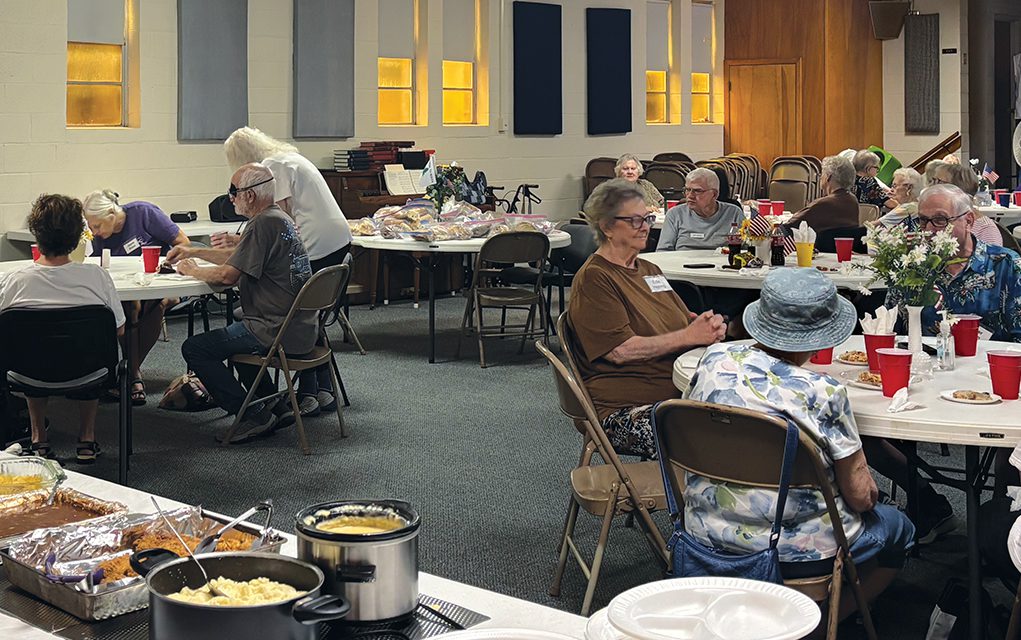
Topeka North Outreach Hosts Weekly Senior Luncheon for Five Years
For five years running, the Topeka Church of the Brethren has opened its doors every Wednesday for the...

NYC Bans Horse-Drawn Carriages, Ending 160-Year Central Park Tradition
New York City has officially outlawed its horse-drawn carriage industry, ending a 160-year tradition in Central Park when...