
If we are going to cure multiple myeloma, we need two things,
said C. Ola Landgren, M.D., Ph.D., senior author of the study. One, we need really effective medicines. Second, we need to be able to make sure there is no disease left behind after these treatments.
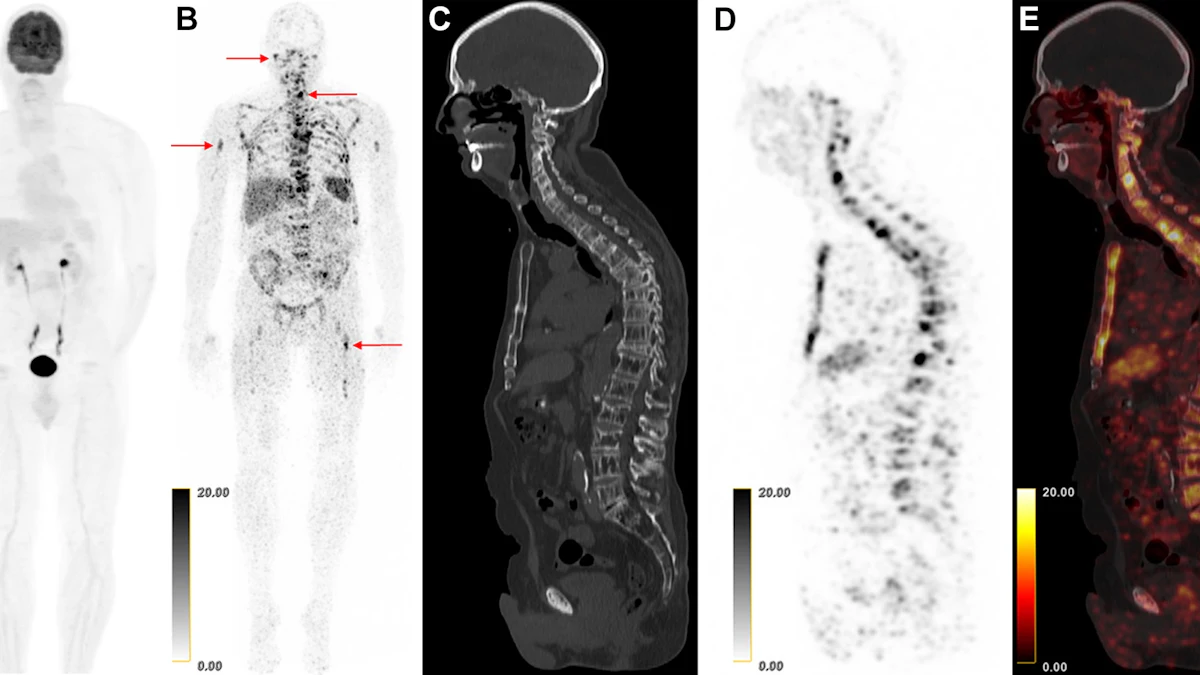
The second thing, Landgren’s team argues, is seeing the disease. A multicenter phase 2 trial published Nov. 3 in Radiology found that a CD38-targeted immunoPET scan detected active myeloma that standard glucose-based PET/CT missed in 17 of 60 patients — 28%.
Why glucose-based PET/CT misses myeloma
In up to 40% of cases, standard scans miss residual disease because myeloma cells show no abnormal glucose uptake, and one radiology trade outlet puts the gap at 30% to 50% of patients with biopsy-proven disease. Standard PET/CT assumes tumor cells guzzle more glucose than normal tissue. Myeloma cells don’t always cooperate. More than 36,000 Americans are diagnosed with multiple myeloma each year.
Myeloma cells frequently consume the same amount of glucose as the surrounding normal cells,
Landgren said. It’s very well known among radiologists and myeloma experts that some patients who have myeloma in their bones may not light up on PET scans. The methods are simply not designed to reliably capture multiple myeloma.

The Trial Caught 17 Missed Cases
Researchers at Sylvester Comprehensive Cancer Center and collaborators at Hoag Cancer Center enrolled 60 patients with multiple myeloma. Every participant underwent both a standard F-18 FDG PET/CT and an immunoPET scan using zirconium-89-labeled daratumumab, an antibody that binds the CD38 protein on myeloma cells, at the same time point with no intervening therapy.
ImmunoPET flagged disease the standard scan missed in 17 patients (28%), while FDG PET/CT caught disease immunoPET missed in 13 patients (22%); in the rest, both showed a similar extent of disease. Overall, the targeted tracer identified at least one lesion in 43% of participants (26 of 60), versus 47% (28 of 60) for FDG, a difference that was not statistically significant. Among the 60, immunoPET found cancer in 8 patients — 13% — whose FDG scans were negative, and biopsy confirmed active myeloma in all eight. Severe adverse events were not observed; nonsevere events occurred in 3 of 60 participants, or 5%.
We show that you can successfully find much more disease,
Landgren said. It’s a more sensitive and more precise technology, and we have very strong proof of principle that it works and that it’s meaningful.
The Patients Standard Tests Cleared
One patient had persistent back pain with normal blood markers and imaging; the immunoPET scan revealed myeloma lesions in the spine, and after the patient switched treatments, the pain resolved.
Another had negative scans and blood tests — then the targeted scan lit up widely.
Toward Same-Day Imaging
The antibody takes about a week to travel through the body and attach to cancer cells. Landgren and colleagues are already building next-generation versions with smaller antibody fragments that could reach tumors faster and enable a same-day test. Ongoing research is also probing whether the tracer can detect residual disease after treatment, predict response to CD38-targeted therapies, and guide CD38-targeted radioligand therapy linking daratumumab to isotopes such as lutetium-177 or actinium-225.
The study, published in Radiology under DOI 10.1148/radiol.260517, is proof of principle rather than a finished tool.
We are developing new and better technology designed to see where the disease is and make sure we are not missing it.
C. Ola Landgren, M.D., Ph.D., senior author of the study
Worth a look

Cornish Pirates Aim for Top Six After Crucial Away Win at Rotherham
The Cornish Pirates dismantled Rotherham Titans 40-21 at Clifton Lane on Sunday, running in six tries to claim...

British tennis player Jodie Burrage shares death threat message: ‘I hope you kill yourself
More than 12,000 abusive posts and messages were sent to female tennis players on social media last year,...

All Blacks security head Logan Cadwallader dies at Edinburgh hotel
Logan Cadwallader Dies at Edinburgh Hotel Prior to Scotland Test The All Blacks head into Saturday's Test match...

Raphinha to Sign Barcelona Contract Until 2030 on Thursday
Barcelona Sets Thursday Date to Formalize Raphinha Contract Extension Through 2030 Barcelona has finally locked down the calendar....