
Long before corporate chains engineered menus for tourists or the Michelin Guide arrived to survey the region, Central Florida was built by the calloused hands of ranchers and farmers who shaped its earliest economy.
As the Orlando Sentinel reported in its 150th anniversary retrospectives, the region’s food scene has deep roots in sunbaked fields, cattle ranches, and citrus groves that sustained pioneer households long before theme parks arrived.
While outsiders often express surprise that anything exists beyond the major attractions—prompting famous digital apologies from personalities like Andrew Zimmern and positive spotlights from Phil Rosenthal on Netflix—locals and their century-and-a-half-old newspaper have always known the reality. Food in Central Florida has remained fundamentally community-first, supported by multigenerational legacies and immigrant connections that set tables long before commercial tourism took hold.
From Hog and Hominy to Sweet Corn
Decades before dining became a regular fixture in the pages of the Sentinel, the publication clocked in with the region’s pioneer roots and church potluck dinners. Corn reigned as a principal crop across Central Florida during the 1800s, carried forward from indigenous residents to homesteaders.
By April 1918, the newspaper dedicated column inches to recipes like “Hominy Muffins Made With Corn Flour,” following up in April 1922 with notes declaring that “Hominy Grits should be better known.” This agricultural identity deepened further when Zellwood emerged as a commercial sweet corn capital in the 1940s, paving the way for its famous annual festival by the 1970s.
Meanwhile, Kissimmee’s cattle ranchers were free-ranging animals long before modern farm-to-table movements captured national attention. Heather McPherson, who spent 38 years at the Orlando Sentinel—including 28 years as its food editor—emphasized the importance of that foundation.
“You cannot discount its influence on our cuisine,” notes Heather McPherson, who spent 38 years with the Orlando Sentinel, 28 of them as its food editor. “Our weather, combined with what agriculture meant to the economy of the state, is vital. We gave birth to the nation’s beef industry. We had all of those elements right here.”
McPherson’s family relocated from Indiana to Seminole County in 1969, immediately seeking out self-sustaining local connections like beef from ranchers and fresh sweet corn.
Citrus Booms and Hard Lessons
The region’s identity was tied inexorably to citrus, a crop celebrated since the inception of the Sentinel’s progenitor, the Orange County Reporter. That agricultural boom faced catastrophic interruptions when a terrific rainstorm blew in just after Christmas in 1894, plunging temperatures in Orlando to 18 degrees.
A subsequent freeze on Feb. 7, 1895, proved even more severe, leaving 21,727 barren acres where fruit and trees alike succumbed to the cold, according to historical accounts from the Orange County Regional History Center.
Yet resilience defined the local food community long before modern economic shifts. As agricultural production modernized, the Sentinel’s coverage evolved.
In November 1949, Grace Warlow Barr cemented her place in the midcentury community through her column “What’s Cooking?” An Orlando native whose career spanned 27 years as Women’s and Food Editor, Barr connected local ingredients directly to home kitchens. Her philosophy—famously summarized by colleagues as “Start with a stick of butter”—bridged the gap between the hardscrabble survival cooking of earlier generations and a modernizing Orlando.
Multigenerational Legacies
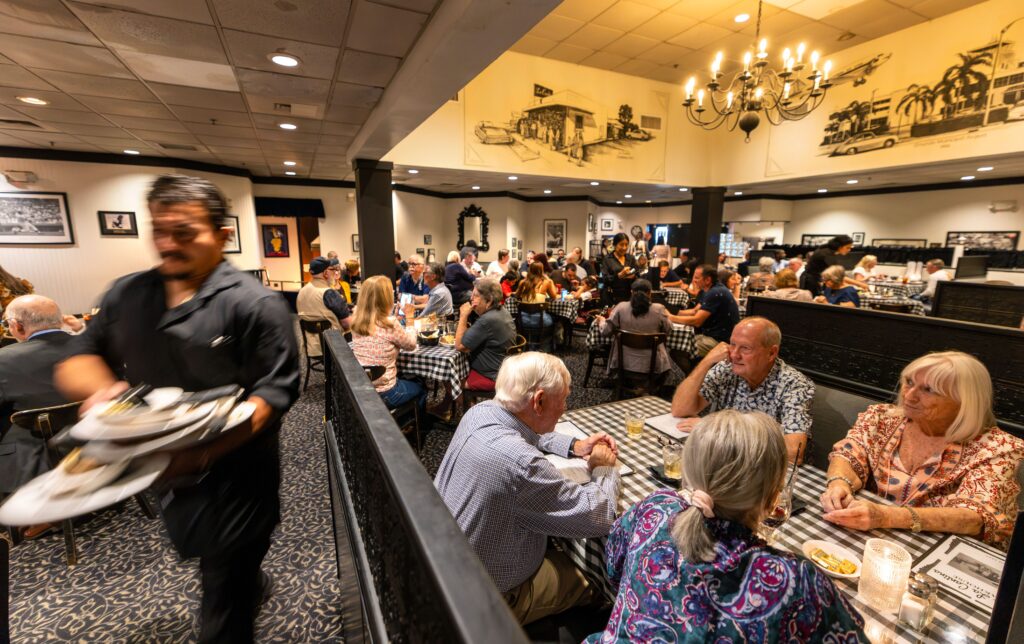
That spirit lives on in institutions like La Cantina, established in 1947 by Edie and Rudy. Karen Hart, a third-generation owner, reflects on carrying forward the family business.
“To be able to carry [something like] that on is probably the best gift that I didn’t know I received for the longest time,” says Karen Hart, third-generation owner of La Cantina. “We are all there to help each other, always, whenever anything happens.”
Other neighborhood landmarks tell a similar story of endurance. Shannon Smith Woodrow grew up around Beefy King, an iconic steam-prepared roast beef shop founded in 1968 that celebrated 55 years in business in 2023. Former Sentinel food critic Scott Joseph, who covered the dining scene for 20 years, watched these neighborhood favorites operate alongside high-end establishments like Arthur’s 27 and La Coquina.
When Joseph reviewed the newly opened Ravenous Pig near the end of his tenure in 2008, he signaled that the region’s culinary future was secure. Decades after the first rows of corn were planted and the earliest citrus blossoms scented the air, Central Florida’s table remains anchored by the people who grew it.
Worth a look

Local Sports Recap: Cross Country Success and Football Playoff Results
Southern Illinois high school football playoffs progressed this weekend and cross country stars reached the state level. According...

FPHL Weekend Recap: Hat Tricks, Record-Breaking Milestones, and River Dragons Victory
The Federal Prospects Hockey League saw a weekend defined by dramatic shifts in momentum, from Danbury’s long-awaited breakthrough...

Analysts Debate Replacing Daniel Jones With Anthony Richardson
The Indianapolis Colts are staring down a familiar, uncomfortable reality. Following a 27-23 loss to the Dallas Cowboys...

Clever Basketball Looks to Grow With Veteran Roster and Six Seniors
Clever Blue Jays Eye Growth After 22-Win Season Three years ago, the Clever basketball program faced a difficult...