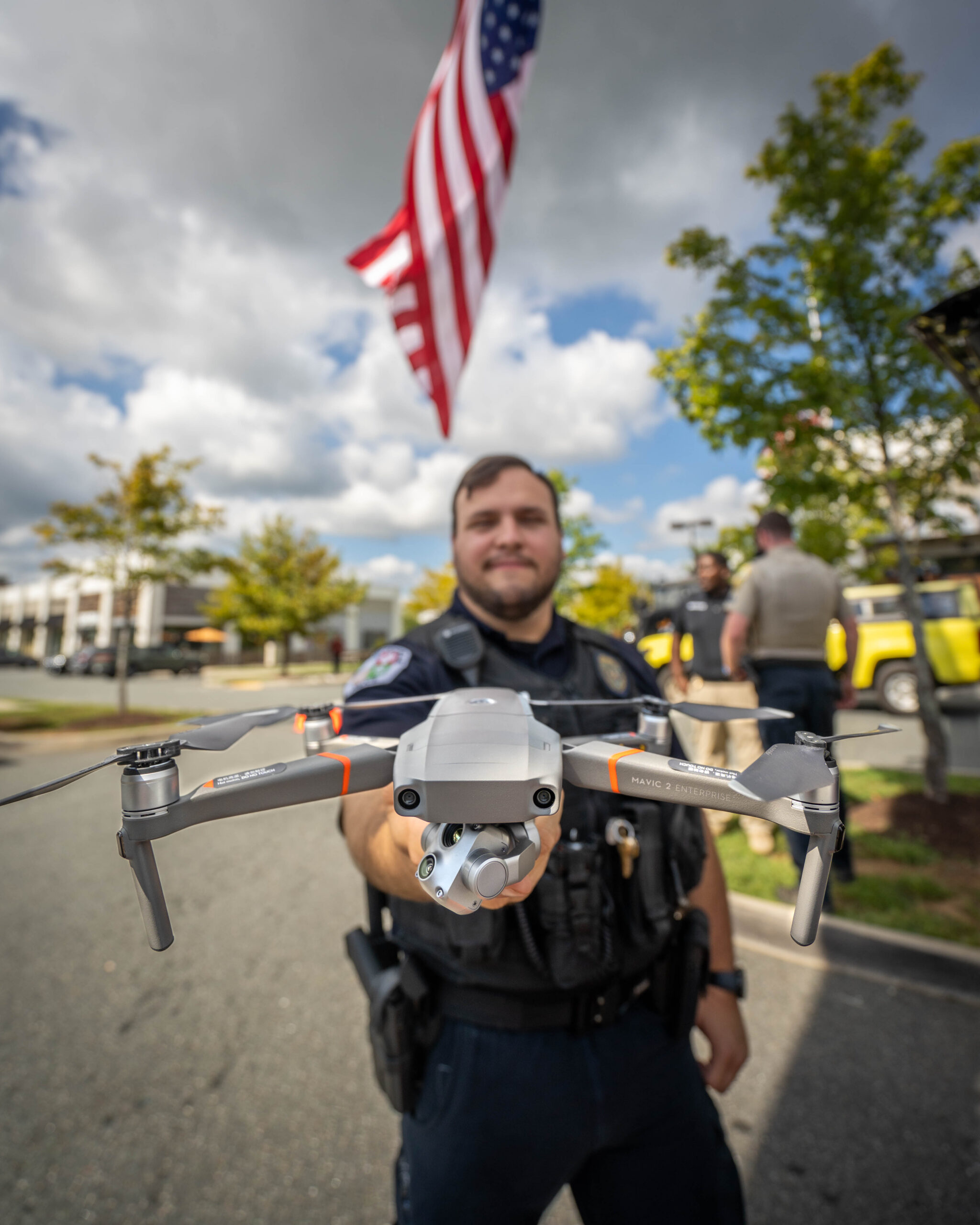
Charlottesville Police Push to Expand Drone Response
“What we’re essentially looking to do is supplement police response and in some cases replace it altogether with a drone,” says Sgt. Brian Curry of the Charlottesville Police Department.
The Charlottesville Police Department wants to scale up its aerial footprint by integrating a drone first-responder program designed to observe and report on a broader array of public safety incidents. Sgt. Curry has been assigned to lead this proposed addition within the department’s Emergency Services Unit. While CPD officers currently deploy unmanned aircraft for crowd management at large gatherings like the Tom Tom Festival, search and rescue operations, and dangerous person response work, the new drone first-responder framework aims to handle routine calls.
The department’s current drone program was formalized in 2023 under the direction of Sgt. Collin Bise, who will continue managing existing operations. Under the proposed expansion, however, aircraft would handle everyday calls from the sky. During a September 29 community police academy meeting, officers highlighted that drones could serve as initial responders for reports of a disabled vehicle, allowing department staff to verify whether a scene involves a simple stalled car or an escalating hazard before a patrol car arrives.
Beyond efficiency, the department points to officer safety as a primary driver. Sgt. Eric Thomas, CPD’s community involvement coordinator, notes that utilizing an aerial feed helps evaluate the volatility of an unfolding situation. “Do we need more units or less?” Thomas asks.
Charlottesville Proposes First Regional Drone Responder Program
Charlottesville’s proposed setup would establish the first drone first-responder program in the region. Comparable initiatives already operate elsewhere in the Commonwealth, including within the Virginia Beach Police Department and various agencies across Northern Virginia. In Fairfax County, police report that their drones launch in under two minutes and arrive ahead of ground units in roughly 70 percent of cases.
Yet expanding surveillance tech comes amid heightened local sensitivity regarding privacy. In December 2025, Charlottesville discontinued its use of automated license plate reader cameras from Flock following sustained public pushback. While the city’s existing drone operations have largely avoided that level of organized opposition, James Walker, director of the Police Civilian Oversight Board, notes that his tenure has seen no major public complaints or formal misconduct findings targeting the program. Even so, adding more eyes to the sky could alter that dynamic.
To address potential anxiety, officials are promising visibility. “We’re all about transparency, so we’re going to be building a transparency website,” Curry said at the September 29 meeting. “And you can log on and see … the flight path we flew and what type of call we were flying to. So there’s no guesswork as to why the police are flying a drone.”
Curry points out that drones and their remote operators lack the legal powers held by an officer on the ground, and flights remain bound by strict Federal Aviation Administration regulations. The department recently deployed a drone to provide overwatch during the September 12 arrest of an individual linked to a shooting on the Downtown Mall.
Cross-Training with the Fire Department
Because the expansion will demand significantly more flight hours while police drone pilot numbers remain limited, CPD is looking to pool local resources. The department plans to partner with the Charlottesville Fire Department, which has maintained its own drone program since 2021.
CPD currently operates three Skydio X10 aircraft designated for first-responder use, stationed out of the Ridge Street fire station drone hive, according to Thomas. To meet the anticipated jump in 911 deployments, officials intend to cross-train fire personnel.
“They have 15 pilots,” Curry says. “We don’t have that many yet. … So if I can’t spare an officer to fly a drone, I will call the fire department and say, ‘Hey, I need a drone up.’”
To mitigate logistical and safety hazards, the department intends to purchase a multidirectional antenna designed to help aircraft avoid conflicts with other regional traffic, such as the University of Virginia’s Pegasus medevac helicopter. The new units are also equipped with onboard parachutes.
Police Schedule Public Safety Technology Forum for November
City leadership emphasizes that community dialogue must precede wide deployment. During an August 17 City Council technology briefing, Police Chief Michael Kochis stressed the need for caution. “We as a police department have to be very careful when it comes to technology, that we are not moving faster with this stuff than our communities actually understand it,” Kochis said.
To facilitate that discussion, CPD has scheduled its initial “Let’s Talk” public safety technology forum for 6:00 p.m. on November 9 at the Velocity Urgent Care Community Room, located at 920 E. High St. Residents unable to attend in person can access a livestream through the Albemarle-Charlottesville NAACP website. Additional neighborhood sessions are planned throughout November and January.
Related reading

State Military Reservation Undergoes Major Infrastructure Upgrades
Barracks gutted and roads repaved in Virginia Beach Buildings 231, 232, 342, and 343 are stripped down to...

Author says Seattle fashion restores Mexican identity
Reclaiming Identity Through Washington High Fashion In a personal essay, an immigrant writer explores cultural heritage, geographic displacement,...

No. 3 Clear Creek Amana Sweeps Burlington to Advance to State Volleyball Tournament
Delivering a masterclass in postseason volleyball, Clear Creek Amana swept Burlington 25-13, 25-10, 25-12 on Tuesday night at...

Utahns want lake protections, GSL Collaborative survey shows
Utahns want lasting protections and immediate water inflows for the shrinking Great Salt Lake, according to a 509-person...