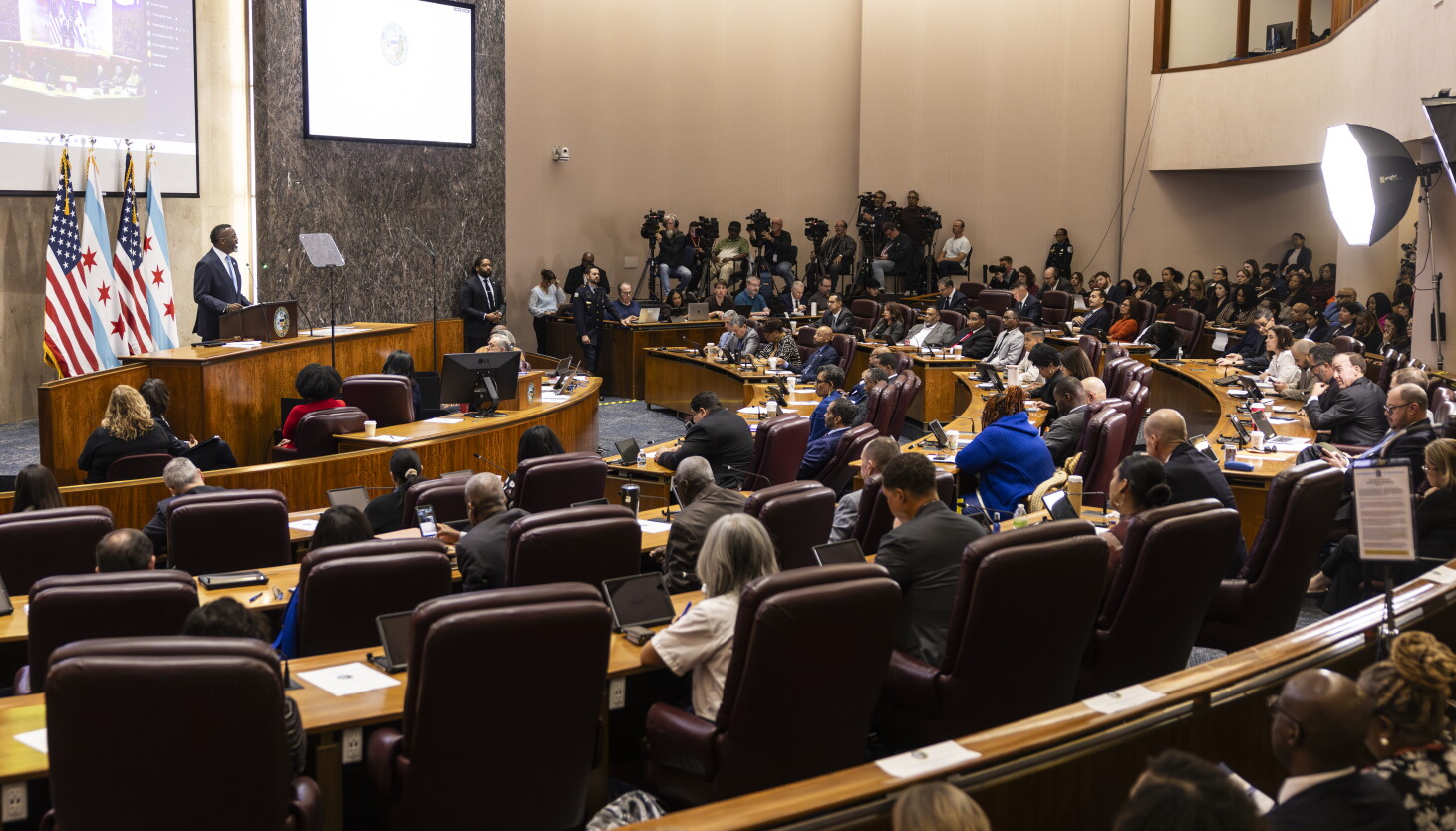
Facing claims of political double standards, the Chicago City Council passed a resolution unanimously on Wednesday that calls on the Illinois General Assembly to put a binding constitutional amendment on the ballot to tax individual earnings exceeding $1 million, according to the Chicago Sun-Times.
The non-binding measure reflects the reality that the city cannot levy such a tax itself. Because state law governs income taxation, local leaders depend entirely on Springfield to act.
This push for state-level action highlights a deep split on the Council over Mayor Brandon Johnson’s revenue proposals as the city faces mounting budget pressure. Twenty-eight alderpersons have declared their opposition to more than $400 million of the mayor’s tax-the-rich proposals, creating a tense political standoff.
The measure came from the same group of lawmakers who defeated Johnson’s corporate head tax last year and have promised to block it again this year. That revived head tax would charge businesses with more than 125 employees twenty-five dollars per employee monthly.
Johnson’s Council supporters backed the resolution while simultaneously accusing its sponsors of passing the dirty work of taxing the rich to Springfield while blocking similar efforts at home.
“I am at a loss right now trying to wrap my head around the hypocrisy of this introduction from people who have been completely opposed to taxing the rich and are passing the buck to the state,” said Ald. Rosanna Rodriguez-Sanchez (33rd), telling the Chicago Sun-Times that the move is an opportunistic attempt to brand opponents as progressive without requiring actual work.
Clashing Over Local Job Taxes
Ald. Byron Sigcho-Lopez (25th) echoed those sentiments, telling colleagues that the political posturing is laughable and urging them to leave the theatrics out of the budget process.
On the other side of the aisle, critics of the mayor’s local agenda defended the distinction between a statewide millionaire tax and a local employment levy. Ald. Michelle Harris (8th) countered that the two policies carry entirely different economic consequences for the city.
“Taxes on jobs is a killer. It will kill our economy. It will kill our city. And it’s the fastest way to get big businesses to leave our city, take their jobs, run away and take them to communities all outside the city,” Harris told the Chicago Sun-Times.
Zoning Committee Chair Gilbert Villegas (36th) argued that the Council’s hands are tied and that Springfield must step in to help close the fiscal gap. Villegas said the resolution outlines concrete action items to get wealthy earners to pay their fair share.
Upcoming Budget Woes
As the debate intensifies, some lawmakers are urging their peers to temper the political attacks to keep the broader budget process moving forward.
“This is an easy vote. … But, I want to caution us throwing daggers at each other at this moment,” said Ald. Jesse Fuentes (26th), telling the Chicago Sun-Times that the city needs cooperation to pass a balanced spending plan.
Before taking office as the 57th mayor of Chicago following the 2023 election, Brandon Johnson worked as a social studies teacher in the Chicago Public Schools system and served on the Cook County Board of Commissioners from 2018 to 2023, representing the 1st district after defeating an incumbent in his first race for public office.
Raised in Elgin, Illinois, Johnson later became an organizer with the Chicago Teachers Union and helped organize the 2012 strike.
Fuentes pointed out that the city faces severe financial hurdles that will only worsen next year. Whether the Illinois General Assembly will take up the proposed constitutional amendment remains undetermined.
Related reading
- Former Indiana Cross-Country Coach Charged With Misdemeanor Battery After Allegedly Slapping Student’s Thigh
- SIUE 66ERS Host North Park to Open Three-Game Home Stand
- Elon Musk Claims He Is Not MAGA After Regret Over Midterm Spending (newsarchyuk.com)
- Cameron Bancroft Claims Entire Australian Team Knew of 2018 Sandpaper Plot and Slams Pat Cummins (world-today-news.com)

Former Indiana Cross-Country Coach Charged With Misdemeanor Battery After Allegedly Slapping Student’s Thigh
A former southern Indiana high school cross-country coach faces a misdemeanor battery charge following an incident with a...

SIUE 66ERS Host North Park to Open Three-Game Home Stand
SIUE men's basketball opens a three-game home stand against Division III North Park on Thursday at First Community...
Indiana Coach Charged With Battery After Allegedly Slapping Student’s Thigh
Coach Nicholas Ellis faces a misdemeanor battery charge after a student said he slapped her leg on October...

Leandro P. Rizzuto Scholarship Offers Up to $55,000 for Italian American Students in Italy
Students pursuing Italian American heritage studies can apply for up to $55,000 in funding through the Leandro P....