
Chicago finally has a place to go — and it cleans itself.
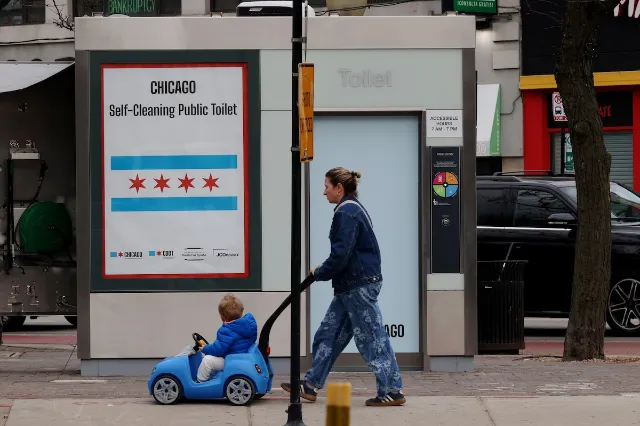
The city’s first automated public toilet opened Wednesday at the Polish Triangle in West Town, ending a long stretch where the nation’s third-largest city offered almost no standalone restrooms for people moving through its neighborhoods.
Ald. Daniel La Spata, 1st Ward, cut the ribbon on the stainless-steel unit after a five-year push that began with a 2021 City Council call for more facilities. The Washington Post reported the station unlocks for 15-minute sessions between 7 a.m. and 7 p.m., then runs a two-minute wash cycle that scrubs the seat, floor and walls before the next person enters.
JCDecaux, the French street-furniture giant that already operates 400 similar toilets in Paris and dozens in San Francisco, New York and Berlin, donated the hardware. Installation still cost the ward more than $400,000, La Spata said, though WTTW News put the figure closer to $500,000 after complicated utility work behind the Chopin Theatre and under Division Street. The Chicago Tribune noted La Spata originally earmarked about $315,000 in 2024 before the final bill climbed.
“Having a safe, clean, accessible place to use the toilet is a human right. You shouldn’t have to go and buy a $5 cup of coffee to use the restroom.”
said Christian Malatesta, the Wicker Park resident who emailed La Spata’s office for the honor of being the first user. He emerged giving two thumbs up and calling the craftsmanship “great.”
The infrastructure gap
American cities trail global peers on public sanitation, a deficit the Global Public Toilet Index has documented for years. Chicago’s own 2021 Tribune investigation found vast swaths of the city with few or no publicly operated bathrooms, leaving tourists, transit riders, delivery workers, parents with small children and unhoused residents to rely on private businesses or go without.
La Spata argued the new unit fills a dignity gap. “It has been baffling me when people overstate the notion that you can walk into any business or restaurant and use their bathroom at any time. That’s just not reality,” he told the Tribune.
How the machine works
Once the door closes, a countdown clock starts. As the 15-minute limit approaches, a voice warns the occupant. When time expires, the doors open and stay open — motion sensors prevent them from closing until the person leaves.
Then the cycle begins: the toilet seat retracts, soapy water douses it, a jet blasts the metal floor left to right, and heated air dries the surfaces. Alan Sullivan, co-CEO of JCDecaux North America, told the Tribune the company runs more than 2,500 such units worldwide. “What they offer is dignity,” he said. “You don’t have to be self-conscious about using these.”
Staff will check the station four times a day, Sullivan told WTTW News. An emergency call button, grab bars, non-slip flooring and a hands-free exterior water fountain round out the features.
Chicago’s first self-cleaning toilet opens today at the Polish Triangle. The free facility will be open 7-7 daily. The toilet bowl and floors are cleaned automatically after each use, and each visit is limited to 15 minutes, two technicians here told me. @BlockClubCHI pic.twitter.com/OpfieYUnuG
City and JCDecaux to track usage and plan expansion
The city and JCDecaux will track daily and hourly usage, maintenance frequency, operating costs, sanitation complaints and feedback from nearby businesses and residents. Stewart, a JCDecaux spokesperson, told WTTW News that four or five additional toilets could arrive over the next two to three years, pending city authorization. La Spata said early reviews have been encouraging despite some neighborhood opposition, and he will push for more units across the wards.
Sean Wiedel, deputy commissioner for citywide services at the Chicago Department of Transportation, called the Polish Triangle “frankly, a more difficult location” because of the utility constraints. “It took a little bit longer but we’re here today to open it for the first time,” he said at the ceremony.
A model tested elsewhere
Paris has 400 of the JCDecaux units. San Francisco and New York operate their own fleets, and New York is adding 40 more soon, Sullivan said. Berlin uses them as well. Chicago’s pilot joins that cohort, testing whether a self-cleaning, time-limited, advertising-supported model can survive the city’s winters and usage patterns without becoming a maintenance burden or a safety concern.
The next City Council budget cycle will reveal whether the ward funds — or citywide capital dollars — follow the pilot’s data.
Related reading
Fears Jr. Among Five Oscar Robertson Weekly Honorees
Michigan State guard Jeremy Fears Jr. earned a share of the season’s first Oscar Robertson National Player of...

Williston Fifth Grader Oli Agoos Elected Vermont’s Kid Governor on Climate Platform
Williston Central School fifth grader Oli Agoos won Vermont's second Kid Governor election Tuesday, earning a one-year term...
High Pointe Offers Golf Assessment, Highlights Pediatric OT Tips
Clarksville golfers staring at cooler temperatures and dwindling daylight have a narrow window to address the back pain...

Norway Beat Denmark 3-2 to Top Nations League Group, Denmark Face Relegation Playoff
Norway completed a Nations League double over Denmark with a 3-2 win in Copenhagen on Tuesday, a result...