
China’s export machine hit a record $1 trillion trade surplus by October — the fastest ever — while retail sales at home crawled to 0.4%, the National Bureau of Statistics reported on Monday.
-
The Bottom Line:
- Exports surged 35.2% in October on AI-driven demand, pushing the trade surplus past $1 trillion two months earlier than last year’s record pace.
- Retail sales missed forecasts by half, rising just 0.4% year-on-year versus an expected 0.8%, as the property downturn enters a fifth year.
- Fixed-asset investment collapsed 16.9% in October alone — the sharpest monthly drop on record — with real estate investment plunging 33.3%.
The Alpha Metric: A 16.9% Investment Free-Fall
The single number that rewrites the growth narrative is not the export boom. It is the 16.9% year-on-year collapse in fixed-asset investment (FAI) for October alone, calculated by Trivium China from NBS cumulative data.
That monthly print widens the January–October decline to 8.1%, Caixin Global reported, missing the 6.9% consensus forecast by a full percentage point. Infrastructure spending — usually Beijing’s reliable lever — dropped 12.2% in the month. Manufacturing FAI fell 9.2%. Only one sub-sector posted growth: computers, AI, and electronic equipment.
This investment vacuum matters because it confirms the economy’s new structural dependency. With property development investment down 21.6% for the year and private investment retreating 11.4%, the capital formation engine has seized. Goldman Sachs now sees 2026 GDP at 4.6%, slowing to 4.5% in 2027. The stimulus measures rolled out since August have yet to arrest the slide.
🇨🇳 #China’s The Economy Falters With Surprise Across-the-Board Slowdown – Bloomberghttps://t.co/NVYuszwjlZ pic.twitter.com/YrZpf1EHw1
Export Strength Masks a Narrowing Base
October’s 35.2% export surge was powered by the global AI infrastructure buildout. Output of computers, AI, and other electronic equipment jumped 19.4% — the strongest print since 2012. High-end and intelligent manufacturing contributed more than half of industrial output growth in the first ten months, NBS spokesperson Fu Linghui told a press briefing.
But the auto sector — last year’s export star — stalled. Auto output grew just 0.9%, the weakest since 2022, as record domestic sales declines forced production cuts. Mobile phone sales grew 6.5%, down sharply from double-digit rates months earlier. The surplus hit $1 trillion by October, yet the composition is brittle: a single sub-sector carrying the weight of the world’s second-largest economy.
#China split between a struggling consumer & real estate economy & a booming export sector in October: ✅Industrial production +4.8% y/y (⚠️cooling) ✅Exports +35% y/y 🔶Retail +0.4% y/y (⚠️cooling) 🔻Property investment -22% y/y YTDhttps://t.co/QUGlmYx9Dz
“The market was already worried about a slowdown in the AI capital-spending cycle even before the Nvidia scandal that put flows of restricted chips to China under renewed scrutiny,” said Zhiwei Zhang, president and chief economist at Pinpoint Asset Management. “Now the risk has become even more serious.”
Consumption Stays Frozen Despite Holiday Boost
Retail sales rose 0.4% in October after a 1.1% gain in September, missing the 0.8% consensus. The miss is striking because the month contained the week-long National Day holiday and the start of the Singles Day shopping festival. Services retail sales grew 4.0% for January–October, narrowing from 5.8% in the first three quarters.
Consumer inflation ticked down to 0.7% in October, its first deceleration after two straight months of increases. New home prices in 70 major cities fell 2.4% year-on-year — the 40th consecutive monthly decline. Property sales dropped 14.1% for the year. The World Bank estimates real home prices have fallen roughly 23% from their 2021 peak, with sales volume at roughly 40% of peak levels.
“The persistently soft consumer confidence remains the main issue preventing a consumption recovery, and a more effective policy push must address this,” ING’s Song said.
Youth Jobless Rate Near Record 18%
The jobless rate for 16-to-24-year-olds excluding students stood at 18% in September, near the highest level since the statistical revision in 2023. Caixin Global cited an August reading of 18.9%. Urban unemployment overall inched down to 5.1% in October, but the youth figure shows a structural mismatch: advanced manufacturing invests heavily in automation, limiting job creation even as output rises.
IMF projections show China’s working-age population (20–60) shrinking by 226 million through 2050, pushing pension spending from 5.4% to 11.9% of GDP. That demographic drain compounds the consumption drag: households repairing balance sheets after property losses face rising elder-care costs and vanishing wage growth.

Chinese Deflation Exports Hit US Consumers
The lopsided Chinese recovery changes the price of goods on U.S. shelves. Cheap EVs, solar panels, and AI servers flood global markets — Chinese automakers earn CNY 20,000 net profit per vehicle overseas versus CNY 5,000 at home, JPMorgan estimates — depressing margins for Western competitors.
But a Chinese consumer who isn’t buying means less demand for U.S. semiconductors, agricultural exports, and luxury goods. The $1 trillion surplus is, in part, a transfer of deflationary pressure.
Treasury yields and the dollar have priced in a slower global growth impulse. If the AI capex cycle turns — Nvidia’s China restrictions are a live catalyst — the export pillar cracks. Beijing’s policy room narrows: monetary easing has stabilized short-term funding, but fiscal stimulus targeting household consumption remains absent. ANZ’s Zhaopeng Xing told Reuters that no new stimulus measures are expected for the rest of the year.
The Open Question
Whether the August stimulus package finally transmits into January–February investment data — or whether the 16.9% October plunge marks a new floor.
Disclaimer: The information provided in this article is for educational and market analysis purposes only and does not constitute financial, investment, or legal advice. Always consult with a certified financial professional before making investment decisions.
Keep reading

Judge Refuses to Pause Ruling That Essayli Serves Unlawfully as Interim US Attorney
Federal judges in Los Angeles recused themselves en masse, forcing a Hawaii-based senior jurist to decide whether the...

Allegiant and Sun Country Add 16 Nonstop Routes for Summer 2027, Including MSP Return
Allegiant Travel Company announced 16 new nonstop routes across Allegiant Air and Sun Country Airlines on Monday, extending...

Joaquin Phoenix Stars in Jonathan Glazer-Directed AI Eyewear Campaign for Gentle Monster
Joaquin Phoenix returns to the uncanny valley of artificial intelligence, this time wearing the product instead of falling...
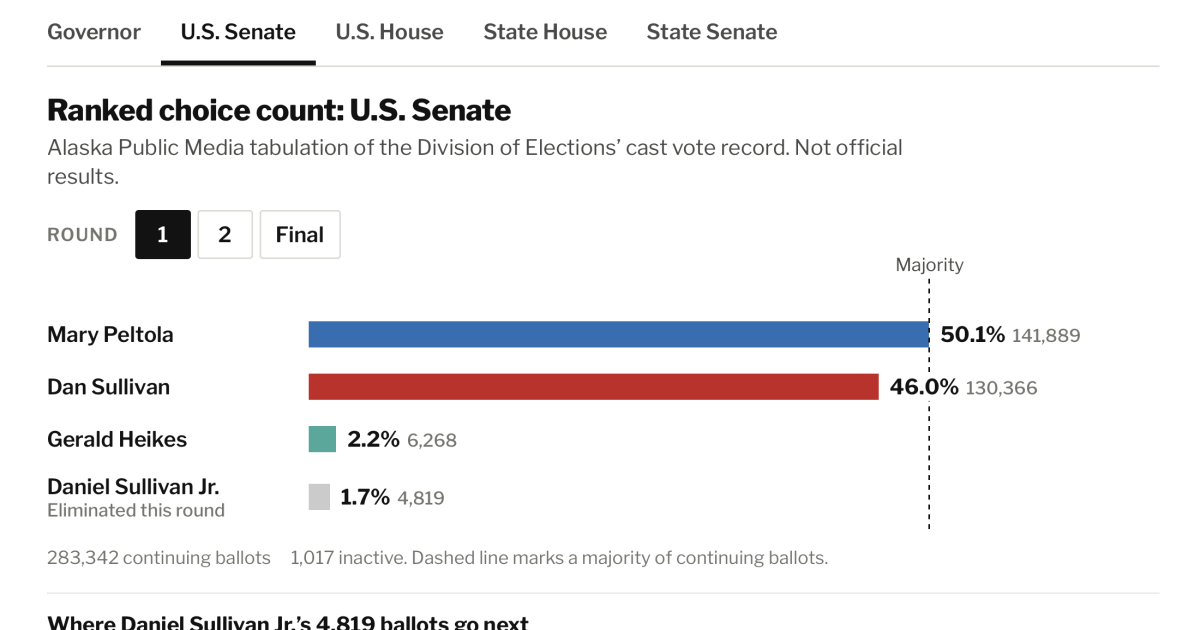
Peltola at Roughly 50% in Alaska Senate Race; Ranked-Choice Tabulation Wednesday
Democrat Mary Peltola sits roughly 50 percent of first-choice votes in Alaska's U.S. Senate race as of Monday,...