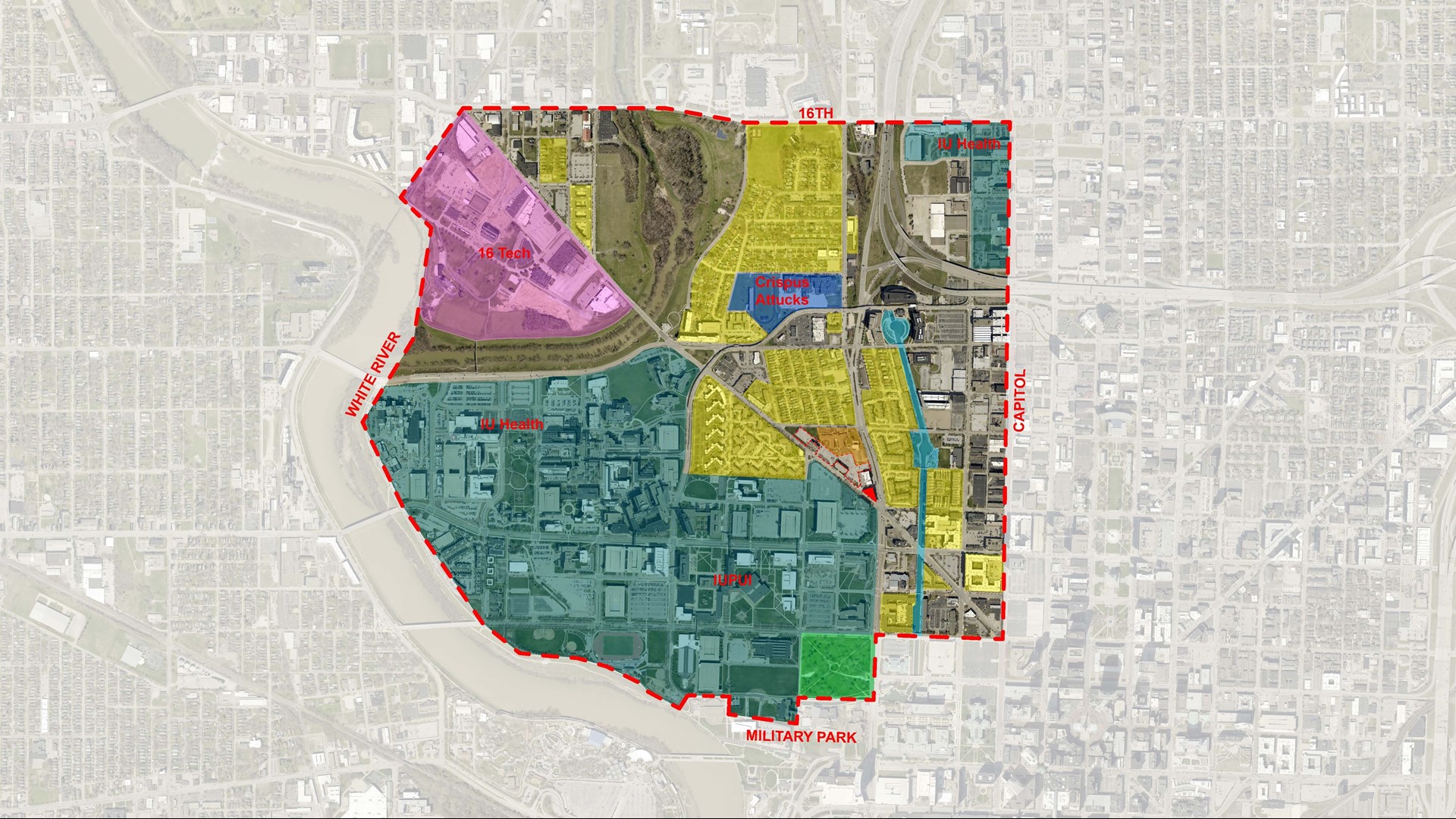
Indiana Avenue’s ghosts got a hearing on Monday, when the city finally showed up with a 139-page strategic plan to stitch the corridor back together.
The Department of Metropolitan Development unveiled the draft at a Nov. 17 open house, nearly four years after the effort was first announced in February 2023.
For residents like Steve Nelson, who lives in Ransom Place, the document represents a shot at economic reinvestment in a neighborhood that has waited decades. “I think it’d be very helpful to bring another positive light onto this part of the city,” Nelson, 50, told Mirror Indy.
The plan tries to answer a wound inflicted in the 1960s and 1970s, when construction of I-65 and I-70 and the expansion of the IUPUI campus — now IU Indianapolis and Purdue in Indianapolis — razed homes and Black-owned businesses. Before the bulldozers, the Avenue was a cultural artery where Duke Ellington, Ella Fitzgerald, and Wes Montgomery played clubs that no longer exist.
A plan built on listening, then delayed by turnover
Carmen Lethig, the department’s deputy director, said staff turnover stalled the timeline after a public kickoff in April 2024. The city also swapped architecture firms midstream, moving from New York-based Elizabeth Kennedy Landscape Architect to Ohio-based MKSK, which has an Indianapolis office. “We evaluated where the plan needed to go, and in order for it to be actionable, it had to have some more local perspective,” Lethig said.

Elizabeth Kennedy led the initial listening sessions; MKSK folded that feedback into the draft now circulating. A work circle of neighbors, historians, planners, and representatives from community organizations — including both university campuses — shaped the recommendations.
Preservation, pedestrian links, and a Castle Hall lifeline
The document proposes extending the Cultural Trail southeast along Capitol Avenue and Washington Street, with public art and storytelling partnerships along the route. It also targets the city-owned former Cancer Survivors Park at 10th Street and Indiana Avenue as a site to honor the corridor’s legacy.
Perhaps the most tangible preservation win: a push to redevelop the former Colored Knights of Pythias building at 711 N. Senate Ave. Known as Castle Hall, the structure landed on Indiana Landmarks’ 10 Most Endangered list this year. Saving it would anchor a physical history that interstate construction nearly erased.
“It just was a general sentiment that we heard throughout the planning process, that as part of whatever redevelopment happens along the Avenue, there should be a benefit for the Black community.”
Carmen Lethig, Deputy Director, Department of Metropolitan Development
The plan also calls for creating opportunities for Black-owned businesses and establishing scholarships and workforce development for residents of surrounding neighborhoods.
Music, memory, and the next deadline
For Paul Slaughter, who grew up on the Avenue in the 1950s and 60s and attended Crispus Attucks, the renderings matter less than the sound. He co-hosted Echoes of Indiana Avenue on WFYI, and his group Words of Wisdom plays on the Cultural Trail’s Indiana Avenue Sound Experience.
“You got a building here. If this space is not available, make one available,” Slaughter said. “It’s that important.” He wants a music academy or a club that honors the jazz lineage.
The city recommends hiring a full-time staffer to oversee implementation — likely not a city employee, Lethig said, so partners are still figuring out where that role sits. DMD aims to certify the plan early next year and launch a public-facing dashboard by March 2027 so residents can track progress.
Comments are open on Konveio until Dec. 18. The draft plan is split into two parts on the city’s site, accessible via a bar at the bottom of the page.
Keep reading

Voyager 1 Reaches One Light-Day Milestone, Inspires Nebraska Classrooms
Voyager 1 crossed one light-day from Earth at 5:16 a.m. Eastern on Wednesday, becoming the first human-made object...
UMKC PMP Exam Prep Course: 35 Contact Hours, PMBOK 8th Edition Aligned, Evening Schedule
The University of Missouri–Kansas City’s Innovation Studio is opening a Project Management Professional prep course that runs Monday...

Marshall and Genie Loeb Donate $1 Million to UMMC Cancer Center Campaign
Marshall Loeb and his wife Genie committed $1 million to the University of Mississippi Medical Center’s cancer campaign...

St. Paul City Council Confirms 26-Year Veteran Jeramiah Melquist as Fire Chief
The St. Paul City Council voted unanimously Wednesday to confirm Jeramiah Melquist as the city's next fire chief,...