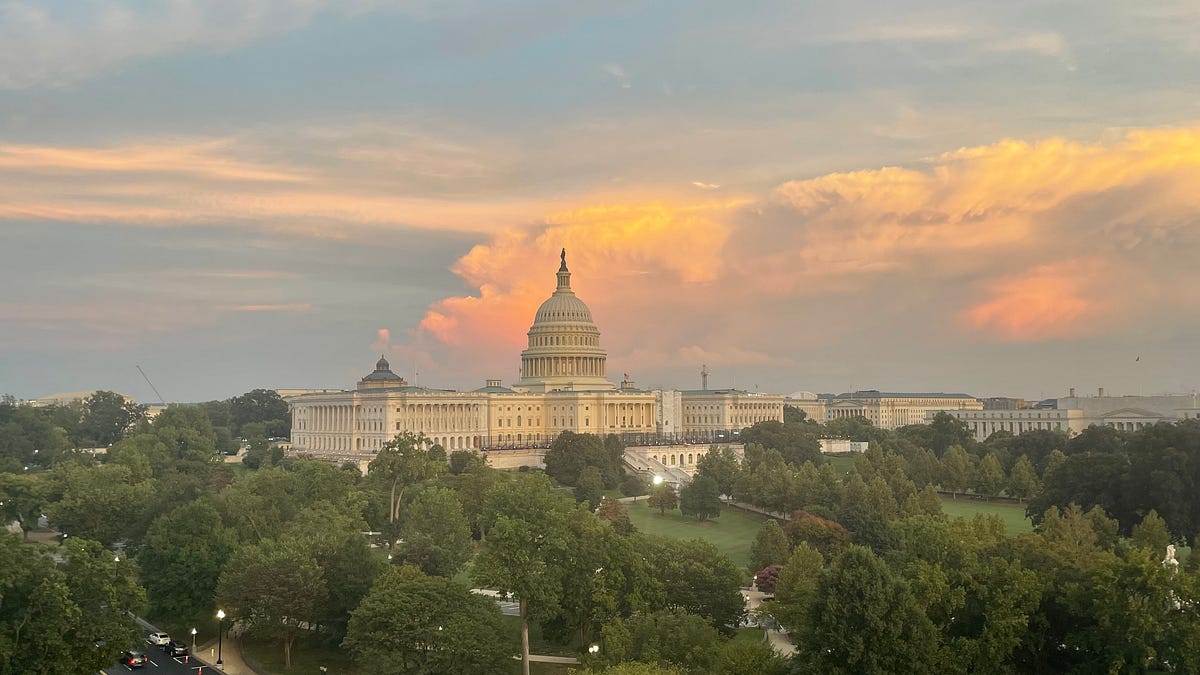
Clarence Edwards writes on Distant Early Warning that Gordon “Jack” Dover died in September.
Edwards joined the firm, a forerunner of today’s Tiber Creek Group, in the early 1990s. On his first day, Dover handed him the Intermodal Surface Transportation Efficiency Act — “smaller than a textbook, thicker than a Manhattan telephone directory” — and told him to locate a soft earmark for a client.
“We have an earmark in there for a client. It’s a soft earmark — see if you can find it,” Dover said, according to Edwards.

As Dover’s legislative research assistant, Edwards covered hearings and markups of the House Energy and Commerce Committee under Chairman John Dingell. He writes that the committee was considered the epicenter of power in the House and that Dingell kept a photo of Earth from space outside the hearing room, pointing to it and saying, “That is our committee’s jurisdiction.”
Edwards researched nuclear waste cleanup and Yucca Mountain, telecommunications reform, and Hillary Clinton’s health care proposal, drafting memos for Dover’s review before they went to clients.
He and Dover sat in Dover’s office the day after the 1994 midterms, processing the fact that Democrats lost the House to Newt Gingrich and his Contract with America, calling clients to reassure them they could still be effective lobbyists in the new Washington.
Edwards describes that era as “a city and country on the verge of political disruption, the telecommunications revolution, and a wave of globalization: the start of the era we’re currently experiencing.”
He calls the firm his “Hogwarts,” a four-year apprenticeship in lobbying, politics, and the nature of power, adding, “Washington hasn’t changed that much, and theres’ not a day goes by that I don’t use something they taught me.”
Related reading
Washington Huskies Defeat Oregon Ducks 33-27 in Double Overtime
The Washington Huskies defeated the Oregon Ducks 33-27 on Saturday, Nov. 28, in a double-overtime game at Autzen...
Maurice Washington Urges Charleston School Board Unity After Dunmeyer-Roberson Election
Former Charleston City Council member Maurice Washington argues in a column for the Post and Courier that the...

A “Super El Niño” is steering the odds toward a warmer, wetter winter for New Jersey
A "Super El Niño" is steering the odds toward a warmer, wetter winter for New Jersey, with NOAA...

Marine Scores TD as Idaho State Falls in FCS Playoff
Lewis took a direct snap from shotgun formation and powered through multiple defenders for a second-quarter touchdown. Idaho...