Colin Woodard Maps the Fault Lines of the American Experiment
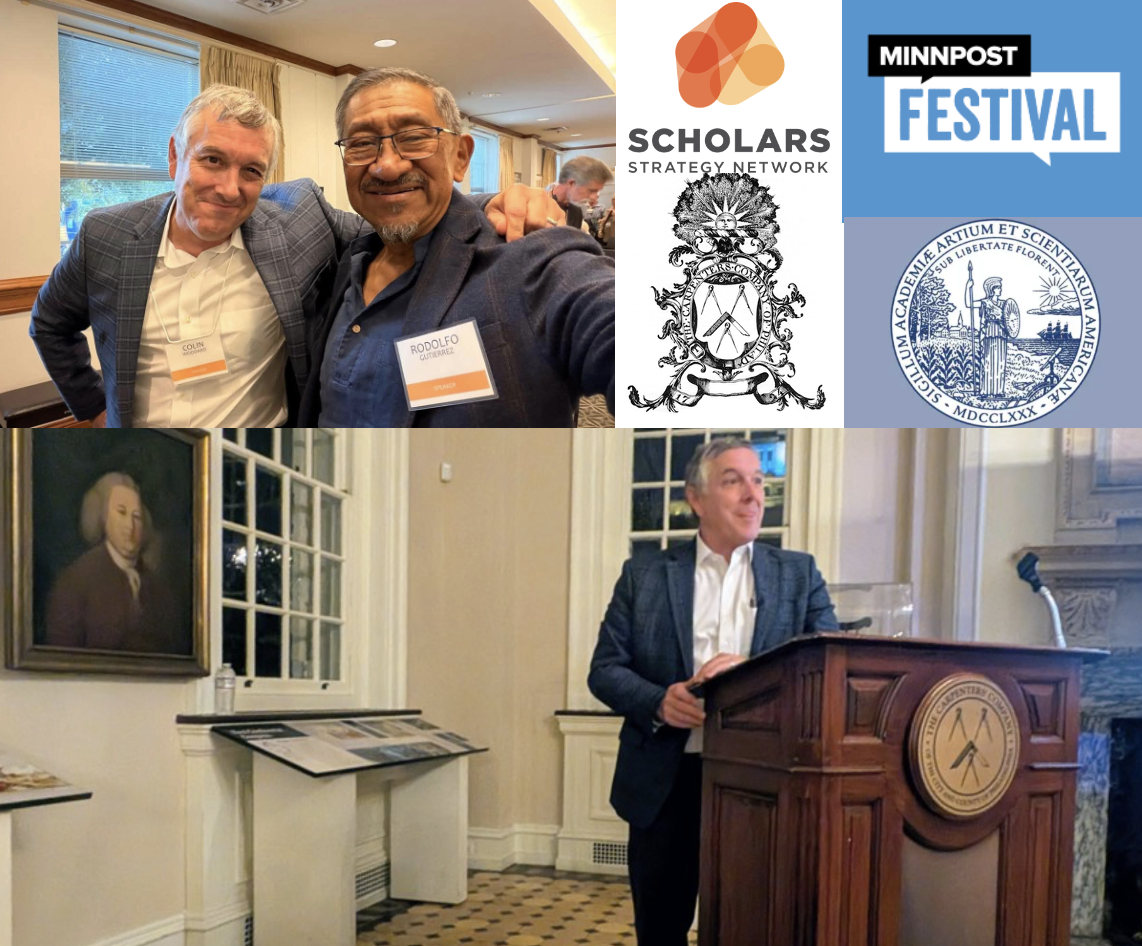
Over the past two months, historian and Nationhood Lab director Colin Woodard has taken a rigorous, cross-country tour to address an uncomfortable reality: the American democratic tradition is currently facing a sustained, multi-front challenge. From Minneapolis to Philadelphia, Woodard has been presenting research that frames the nation’s current political polarization not as a recent phenomenon, but as a deep-seated struggle over the very “soul” of the country. This effort to define and defend the American liberal democratic tradition comes as the nation prepares to commemorate its 250th anniversary.
The urgency of this project stems from what Woodard identifies as an intensifying authoritarian threat. As the director of the Nationhood Lab, which is based at the Pell Center for International Relations and Public Policy at Salve Regina University, Woodard argues that the centrifugal forces currently pulling at the federation’s stability require more than just political commentary; they require a deeper understanding of the regional cultures that have shaped the United States since its inception.
Historical Context at the MinnPost Festival
In early October, Woodard brought this analysis to the 2026 MinnPost Festival in Minneapolis. Sitting down with Rodolfo Gutierrez, the executive director of Hacer, he traced the historical roots of the country’s divisions. The conversation focused on why certain regions of the country remain at odds and specifically highlighted the role Minnesotans have played in resisting authoritarian trends. By grounding the discussion in regional history, the presentation aimed to move beyond the surface-level partisan bickering that often dominates cable news and social media discourse.

This academic approach was echoed in late September at the American Academy of Arts and Sciences in Cambridge, Massachusetts. During a convening focused on the upcoming 250th anniversary of the United States, Harvard’s Danielle Allen opened a series of discussions that included public intellectuals and civic leaders. Woodard used the platform to emphasize that the survival of the American Experiment is far from guaranteed, a point he later reiterated during an October 6 webinar hosted by the Scholars Strategy Network alongside Georgia State University’s Jennifer McCoy.
The Keystone Role of Pennsylvania
To close out this recent series of talks, Woodard traveled to Carpenter’s Hall in Philadelphia—a site with profound symbolic weight as the home of the First Continental Congress in 1774. It was here that he focused on the role of Pennsylvania, a state that has long served as a bellwether for national trends. Woodard explained that the state’s political volatility is a direct result of it being the intersection of two distinct regional cultures.
“In tight elections, it’s always on the edge…and then it’s almost unanimous in these big omnibus elections, switching over from one party to the other, along with the rest of the country,” Woodard said, describing the Midlands, a cultural region defined by the Quakerism-informed roots of William Penn. “And in many ways, Pennsylvania has also been the keystone that can hold our nation together.”
This analysis of Pennsylvania’s “keystone” status offers a lens through which to view modern swing-state politics. Rather than viewing electoral shifts as mere statistical anomalies, Woodard suggests they are the manifestation of deep cultural undercurrents that have existed for centuries. The talk, which was covered by City & State Pennsylvania, underscored the reality that the state’s internal cultural tension is a microcosm of the national struggle to maintain a coherent, functioning federation.
The Nationhood Lab’s work—which includes additional presentations in Austin, Richmond, and Charlestown—is designed to provide better tools for citizens and policymakers to understand these forces. As the country moves toward its 250th-anniversary commemorations, the core question remains whether the American public can reconcile these competing cultural identities before the structural integrity of the liberal democratic order is further compromised. The research suggests that the path forward requires acknowledging these regional realities rather than attempting to smooth them over with broad, nationalistic platitudes.
Keep reading

OUAZ Women’s Basketball Beats Saint Mary 96-54 to Move to 3-0
The OUAZ women’s basketball team pushed their record to a perfect 3-0 on Saturday, dismantling the College of...

Cattle Club opens in Billings after nearly $1 million liquor license cost
A Million-Dollar Hurdle for a Neighborhood Bar For the first time on a Saturday, the Cattle Club opened...

27 Arrested in Major Georgia Dogfighting Operation; 29 Dogs Seized
A Multi-State Investigation into Organized Dogfighting The investigation into a sophisticated, multi-state dogfighting operation in northeast Georgia has...

Boston Modernizes Article 80 to Streamline Large-Scale Development Review
Boston Raises Review Thresholds to Accelerate Development Boston is recalibrating its development review process to address a nearly...