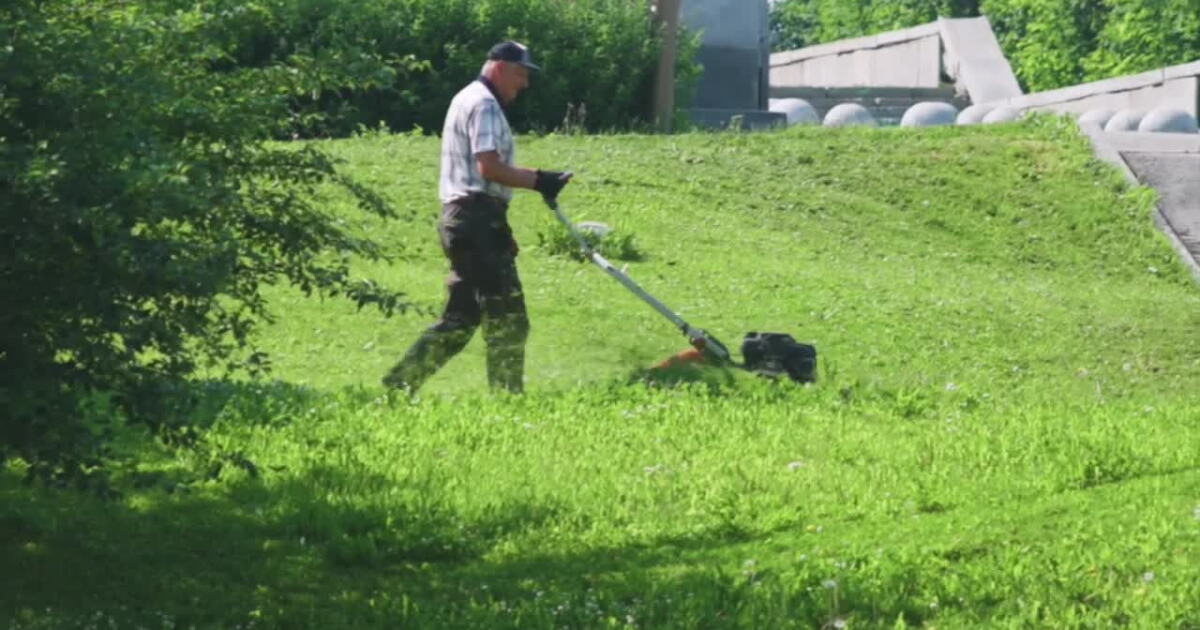
Colorado’s Air Quality Control Commission approved a rule Friday that will phase out most commercial gas-powered lawn equipment during summer months on the northern Front Range, starting June 1, 2027, to address ozone pollution that violated federal standards on 66 days this past summer.
The unanimous vote expands a 2025 requirement that applied only to government agencies, now covering private landscaping companies in nine counties including Denver, Adams, Arapahoe, Boulder, Broomfield, Douglas, Jefferson, Larimer and Weld, the Colorado Sun reported. The restriction runs each year from June 1 through Aug. 31, the high-ozone season.
How the phaseout works
Commercial operators must cut the share of gas-powered equipment in their fleets to 25% by 2030 and 10% by 2032, according to CPR News. The rule targets six common tools: push and walk-behind mowers, string trimmers, hedge trimmers, leaf blowers, edgers and pole saws. Companies will file an annual inventory of equipment they use.
“It’s a first of its kind regulation,” said Michael Silverstein, executive director of the Regional Air Quality Council, which leads air-quality planning for the Front Range. “We have significant problems attaining federal standards for the pollutant ozone in our summer months. And these are just really important emissions that need to be controlled,” he told CPR News.
Why ozone drove the decision
Ground-level ozone forms when nitrogen oxides and volatile organic compounds from fossil-fuel combustion react in sunlight. The Front Range has failed to meet the EPA’s 70-parts-per-billion standard for 14 years. This summer, monitors recorded violations on 66 days, just shy of the 67-day record, the Colorado Sun reported.
Gas-powered lawn and garden equipment accounts for roughly 13% of the region’s ozone-forming pollution, according to the Regional Air Quality Council.
One hour of running a commercial leaf blower emits smog-forming pollution comparable to driving a new car from Denver to Los Angeles, the California Air Resources Board estimates, cited by CPR News. The state health department projects the rule will also cut greenhouse gases by 166,000 tons annually — equivalent to removing 39,000 gasoline cars.
Industry warns of service gaps and cost
Landscapers say the timeline forces them to scrap usable equipment before electric replacements exist for every task. David Ward, owner of Ward’s Lawn Service, told Denver7 that about 45% of his fleet is already electric, but the mandate accelerates replacement of the rest.
“We’re having to take a whole pile of equipment and basically throw it out the window, and have to buy a whole bunch of batteries, a whole bunch of electric equipment that was not in the plan that we had previously with the state.”
Ward said. He also warned that midsummer aeration services may disappear because no electric aerators are on the market yet. “We’ll have to drop midsummer aerations because there’s not even tools out there to do the job, so there’ll be no midsummer aerations because that lies between June 1 and August 31, so that’s revenue’s gone,” he told Denver 7 Colorado News (KMGH).
John McMahon, head of the Associated Landscape Contractors of Colorado, said the industry had negotiated in good faith since July but felt its concerns were not adequately considered.
“CDPH had the information; they had the letter. We have been working with them since July. We have been working with them since July. "We had, in good faith, as a landscape industry," McMahon told Denver 7 Colorado News (KMGH). The association plans to challenge the commission’s decision, questioning the process and how industry data was weighed.”
State says transition is feasible; incentives exist
Michael Ogletree, senior director of the state’s air quality programs, said in a press release that “air pollution from gas-powered lawn and garden equipment has historically been left unchecked. It adds up and exacerbates Colorado’s ozone pollution challenges. We must continue to address this issue to protect people’s health, and these new requirements are a step in the right direction.” The state pledged to work with operators during implementation.
The Colorado Department of Public Health and Environment found electric equipment costs are similar to gas models, though batteries, chargers and possible electrical-panel upgrades add $275 to several thousand dollars per business, CPR News reported. Amanda Perkins, climate policy specialist for Adams County, told the commission that local governments adapted quickly under the 2025 rule and that cost was not a significant deterrent, according to CPR News.
Colorado offers a 30% point-of-sale discount on qualifying electric lawn equipment through 2030, and the Regional Air Quality Council provides grants for commercial operators. Silverstein said more incentives will be needed to smooth the transition, CPR News reported.
What remains unresolved
The Associated Landscape Contractors of Colorado has not yet filed its legal challenge, and the commission has not responded to the industry’s process complaints. The first compliance deadline arrives June 1, 2027.
USDA Designates Three North Dakota Counties as Natural Disaster Areas Due to Drought
The U.S. Department of Agriculture has designated three North Dakota counties as natural disaster areas due to severe...

CF Industries Acquires Faustina Ammonia Plant for $360 Million
Deal structure and production targets ItemFigureSource Cash at closing$360 milliongasworld, Reuters, VCPost Offtake agreement value$240 milliongasworld, Reuters, VCPost...

Concord Medical Gets NYSE Notice Over Delayed 20-F Filings
Concord Medical received a NYSE non-compliance notice on November 23, 2026, for delayed 20-F filings and has six...

Maersk Ship Loses Steering Near Chesapeake Bay Bridge, Anchors Safely
"The ship did not make contact with the bridge or impact bridge operations," the Maryland Transportation Authority said...