
Spain votes November 29 as polls show a right-wing majority likely, with far-right Vox holding the power to end a Socialist era.
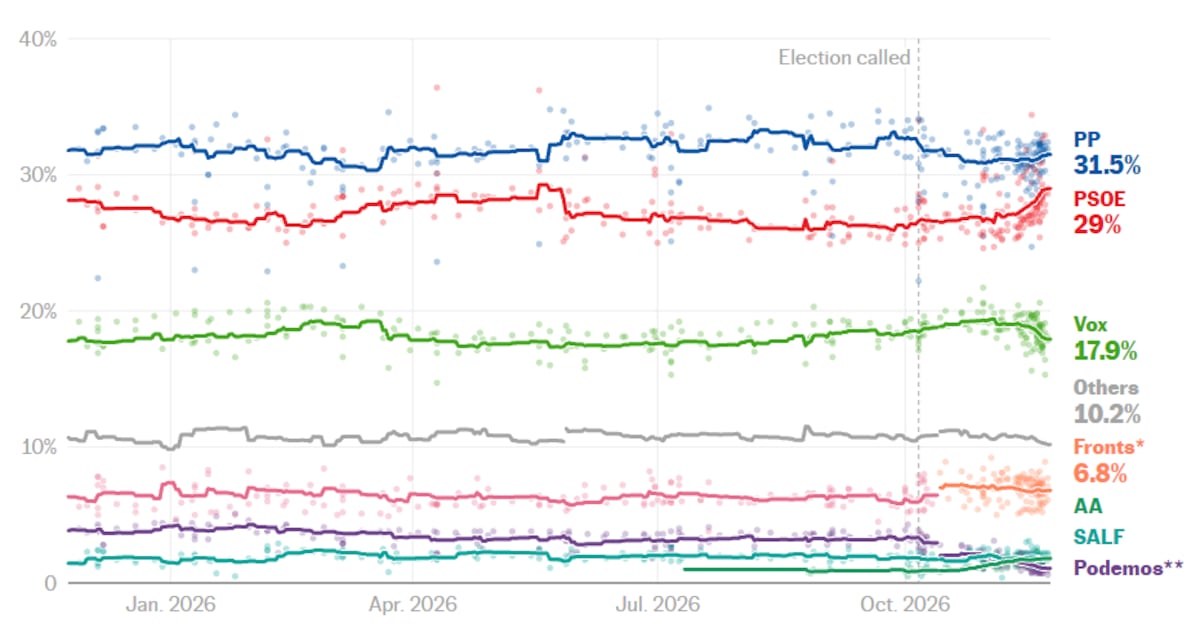
The conservative People’s Party (PP) leads at 30.3%, followed by Prime Minister Pedro Sánchez’s Spanish Socialist Workers’ Party (PSOE) at 29.8%, and Vox at about 15.6%, according to a polling average by EL PAÍS. Together, the PP and Vox command a projected combined vote share of 51.2%, comfortably ahead of the left’s 38.7%. This gives them a clear path to a parliamentary majority in the 350-seat Congress of Deputies.
Should the right win, Vox’s influence could reshape Spain’s direction. The party’s leader, Santiago Abascal, vows to reverse Sánchez’s progressive policies on immigration, gender, and international alignment. Martinez-Canto, speaking to Anadolu, noted that under Sánchez, Spain carved out a distinctive foreign policy voice—recognizing Palestinian statehood and clashing with Washington over Gaza and defense spending.
- Right-wing bloc (PP, Vox, SALF) leads with 51.2% of vote share.
- PSOE trails at 29.8%, with left-wing allies at 38.7% combined.
- Vox, polling at ~15.6%, could be kingmaker in new government.
Vox’s Surge: Immigration and Anti-Establishment Anger
Vox’s rise hinges on stoking fears over immigration and capitalizing on disillusionment with Sánchez’s government. Al Jazeera reports that since 2021, a “huge influx of migrants” has fueled backlash. Vox accuses Sánchez of enabling a “migrant invasion” and legalizing undocumented workers, framing it as a threat to Spanish identity.
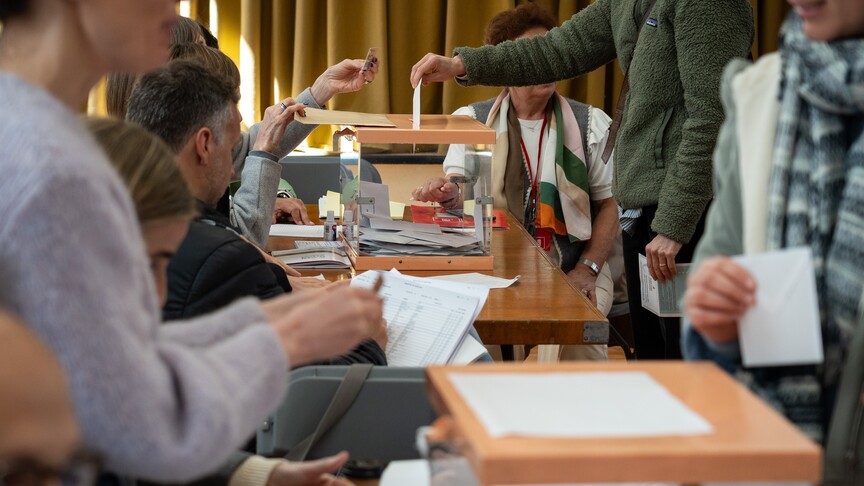
The party’s pivot from Catalan separatism to immigration reflects a strategic shift. Founded in 2013 by PP dissidents, Vox struggled initially but entered Andalusia’s parliament in 2018. As Catalan tensions faded, Vox zeroed in on migration, hardening its discourse to stop voters from fleeing to the right, per Al Jazeera. Polling by Ipsos suggests up to 20% of PP voters could defect to Vox, drawn by its tough stance.
Javier Martinez-Canto said he thinks corruption has played a major role in the Socialists’ struggles, explaining that scandals eroded centrist support.
Margarita Peces and I have been researching the foreign policies of Spain's radical-right Vox party, which both sees international matters as integral to its domestic project and is well-networked (arguably more than the PP) in Europe, the US and LatAm.https://t.co/LOCgqyfR4J
Sánchez’s Record: Gains and Grievances
Sánchez, prime minister since 2018, points to tangible achievements: nine minimum wage hikes, from €858 to €1,500 monthly, and a labor reform cutting temporary employment from 25% to 15% of workers. His government also funneled €1 billion into fighting gender-based violence and equalized parental leave at 16 weeks. The Nation notes that under Sánchez, wind and solar now generate over half of Spain’s electricity.
Yet these wins are overshadowed by crises. Rents have surged 43%, with housing costs eating up 100% of income in large cities. Corruption probes targeting Sánchez’s family and the collapse of his housing relief package have fractured trust. The Irish Times reports that Sánchez’s open-door immigration policy—legalizing undocumented migrants—backfired, becoming the right’s rallying cry.
Vox’s sense of a last-ditch mission to “save Spain” is also part of a wider, civilisational sense of a West in peril and of the common front of nationalists needed to defend it. @ECFRPower https://t.co/l7SypGVMVx
The prime minister has framed the election as a battle for Spain’s soul, warning that Vox would roll back women’s rights and target migrants. “It can’t get worse than this,” Carla Gallegos Arévalo, 18, told The Christian Science Monitor, explaining why she supports Vox amid Spain’s housing crunch.
Abascal Warns of Last Free Elections
Vox leader Santiago Abascal has warned that if Prime Minister Pedro Sánchez were to win, these could be “the last elections in which we freely decide our future”. The Irish Times reports this remark, which highlights the high stakes of the election and frames it as a turning point for Spain’s democratic future.

With politicians in the People’s Party (PP) and Vox suggesting that the government could manipulate Sunday’s election result, Sánchez has hit back, accusing both parties of “practising preventive Trumpism”. The Irish Times reports that such accusations have heightened tensions in the final stretch of the campaign.
Right’s Lead Grows Amid Scandals
Since the 2023 general election, when the parties were nearly tied with the right securing 45.6% of the vote and the left 44%, the right’s advantage has expanded considerably. By 2024 and the summer of 2025, the right’s vote share had climbed from 48% to 52%, according to El País.
I talked to the BBC about what I think will happen if Vox enters into a coalition (of any sort) with PP after Sunday’s election. https://t.co/YvenPR7Atm
Martinez-Canto, a political scientist at the Institute of Public Goods and Policies in Madrid, said that under a right-wing government, Madrid could take a less prominent international role, adopt a more accommodating stance toward the US, and return to the broader European consensus on the Middle East. Anadolu reports that this potential shift in foreign policy is a key concern for observers.
Europe Watching: A Shift in Alliances
A PP-Vox government would mark a seismic shift for Spain’s role in Europe. The European Council on Foreign Relations warns that Vox seeks to restore powers to national governments and roll back the EU Green Deal. The party, which joined the far-right Patriots for Europe group, opposes the EU-Mercosur trade deal, complicating potential coalitions.
Spain’s stance on NATO could also change. Sánchez rejected Trump’s demand for 5% of GDP on defense, yet military spending grew 50% in 2025, exceeding 2% of GDP. Asociación Almendrón notes that Vox’s foreign-policy instincts—aligning with the Atlantic right—could isolate Spain from mainstream European positions.
“For the first time, the PP opened the door to the far-right to be able to govern – that created a precedent for everything that happens today nationwide,” said Bosco Govantes.
Bosco Govantes, political science associate professor at Sevilla’s University, via Al Jazeera
With the election days away, the question is not just who wins, but how Spain’s political landscape will fracture—or realign. EL PAÍS reports that Spanish law bans polls in the final five days, leaving voters and observers in the dark as the campaign closes. The outcome could redefine Spain’s democracy—and its place in Europe—for years to come.
Ninety years after the start of the Spanish Civil War, its ghosts are wandering into the campaign for the Nov. 29 election, underscoring the deep divisions that persist in a country still grappling with the legacy of the bloody conflict and its aftermath.https://t.co/tjdKmGBZD8
Keep reading

International Campaign to Ban Landmines: Myanmar Records Highest Casualties
Global landmine casualties reached a five-year high in 2025 as at least 6,929 people were killed or wounded...

Italian Couple Faces Eviction From Pasolini Home Under Medieval Law
An Italian couple who bought a house built by filmmaker Pier Paolo Pasolini now faces eviction after a...
Delhi Nighttime Cooling Capacity Drops, Researchers Say
Delhi's summer nights have lost their ability to cool down, trapping millions in homes that radiate heat long...

Pilot Projects Find Cool Roofs Cut Indoor Heat by 4-5 Degrees
Pilot projects in two coastal towns near Chennai are testing whether cool roof tiles and reflective paint can...