
“We’re definitely seeing people, both buyers and sellers, leave the market due to the challenges,” said Denver real estate agent Cooper Thayer.
A nearly 19% drop in home sales was recorded statewide in October when compared to the same month the prior year, the Colorado Association of Realtors reported.
The slump began when interest rates started to go up in 2022, but it got deeper this year, Thayer told CPR News. There was hope at the start of the year that rates would stabilize or go down, he said. “However, interest rates did not do that.”
Thayer pointed to unforeseen factors like the war in Iran and renewed inflation for driving mortgage rates higher. “I think a lot of buyers and sellers have seen the headlines and 7% is a scary number. It’s something that we’re not used to,” he said. “I can tell you anecdotally, we’ve got a lot of people sitting on the sidelines kind of waiting.”
Buyers now have more negotiating power than they’ve had in a long time. Price cuts were included in half of all sales transactions in Denver’s metro area during October, a recent report from the Colorado real estate association indicated.
“[Buyers have] been allowed a lot more time in their decision-making process and a lot more options than they’re used to,” Thayer said.
According to Thayer, home prices have largely avoided significant declines because many homeowners choose not to sell unless they can secure their desired price. “We have definitely worked hard to temper expectations,” he said.
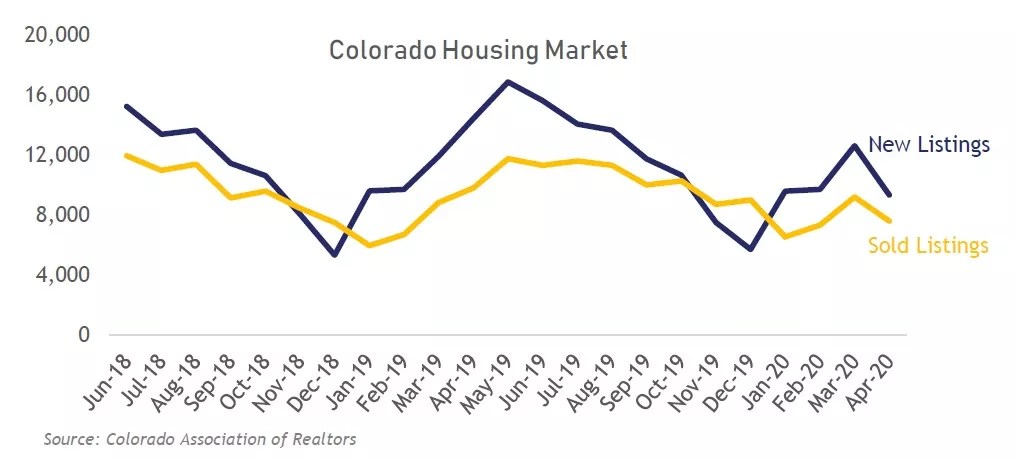
But cracks are starting to show. Colorado Springs real estate agent Patrick Muldoon reported that the state is among the top five in the nation for both price reductions and sellers who end up losing money on their homes.
The association report suggests that October’s steep sales drop signifies mounting pressure on Colorado’s housing market. “Colorado is really setting the pace for a housing correction that needs to happen,” Muldoon said in the report. “Sellers are on borrowed time … Prices are set by the consumer, and in this case, that is a buyer that would rather rent than buy because Front Range real estate is too expensive.”
The Colorado Association of Realtors (CAR) provides authoritative housing data through its monthly Market Trends Housing Report, which analyzes statewide and regional statistics, such as October 2026’s 19% sales drop and a 98.1% average sale-to-list-price ratio.
As the primary data source for the industry, CAR’s report tracks market shifts by unit, noting that homes with price reductions spent a median of 66 days on the market in October, compared to nine days for those that did not, illustrating how pricing expectations impact trends. The association’s role extends to identifying affordability challenges, with statewide affordability falling 8.4% year over year in 2026, helping stakeholders gauge the market’s trajectory.
As for the year ahead, Thayer doesn’t see the market getting any easier anytime soon. “If you are in a place in your life where you don’t need to move or it doesn’t make sense to move and you can hold on for a few more years, for a lot of sellers, it makes sense to do that,” he said.
Leopold Aschenbrenner’s Hedge Fund Plunges 65% in Q3 After Citadel Rescue, Predicts AI Will Upend Gold, Real Estate, Nvidia
Leopold Aschenbrenner’s Situational Awareness hedge fund lost 65% in the third quarter after a July meltdown forced a...

Lil Baby Atlanta Birthday Concert Moved to Dec. 6 for Hawks NBA Cup Game
All previously purchased tickets and parking passes remain valid for the rescheduled date, State Farm Arena Communications confirmed....

Des Moines Teen Found Safe in Minnesota After Roblox Contact; Police Used License Plate Readers, Cellular Data
A Des Moines teenager was found safe outside Duluth, Minnesota, on Friday night after police used license-plate readers...
Richmond Defeats VMI 89-87 on Johnson’s Late Surge
Richmond defeated VMI 89–87 on Saturday in a non-conference men's college basketball game at the Robins Center, according...