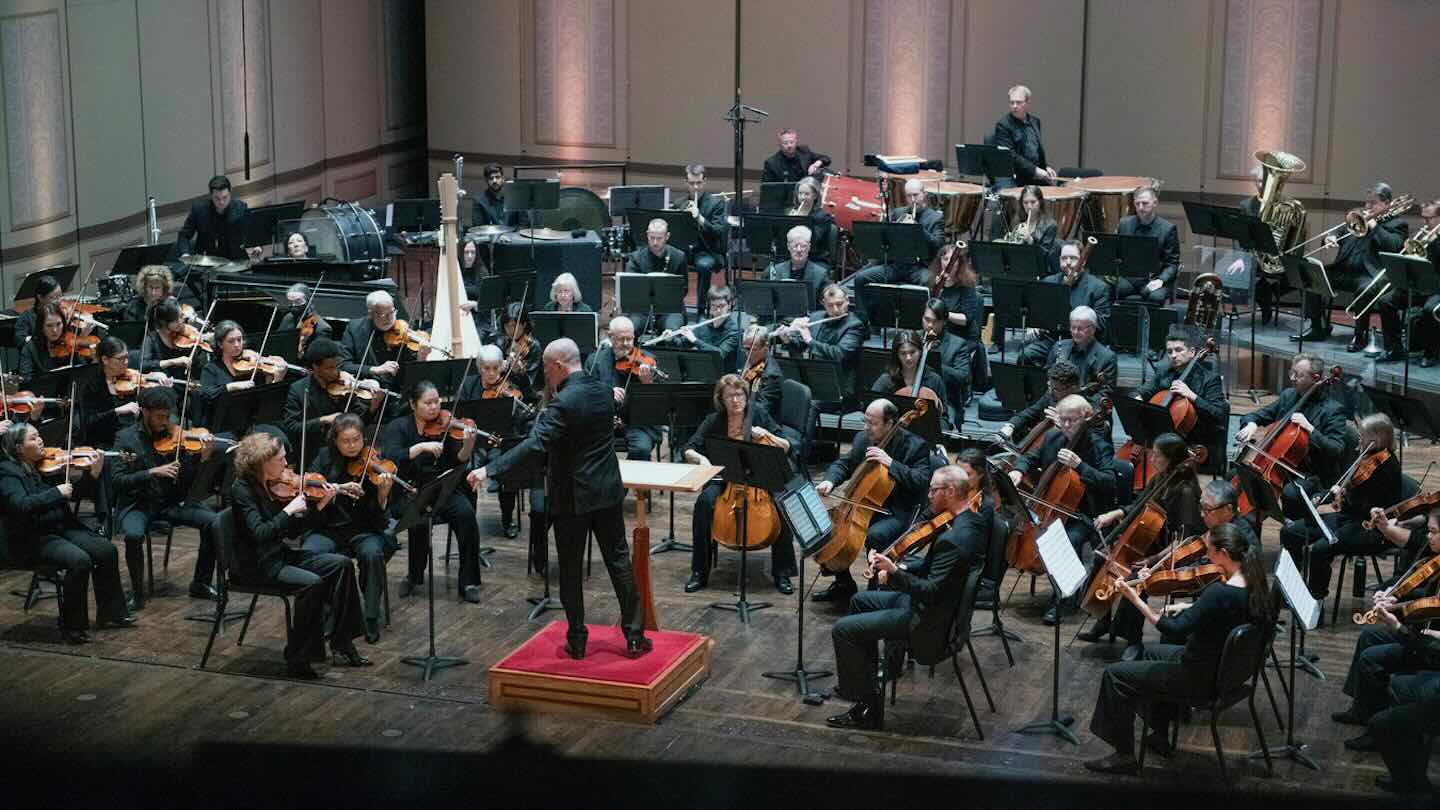
The Ohio Theatre Setting and the Columbus Symphony Orchestra’s Bold Programming
The ornate Spanish-Baroque architecture of the Ohio Theatre can easily swallow one’s attention. The vibrancy of the room is a feast for the eyes, while the amber glow of limited lighting adds an air of foreboding. It proved a striking backdrop for the Columbus Symphony Orchestra’s Oct. 24 program titled “Mysteries, Anthems, and Victories,” which served up a masterclass in energetic communication.
Music Director Rossen Milanov led the orchestra through a demanding night of contemporary compositions and canonical repertoire. These performances at the Ohio Theatre previewed a historic 75th-anniversary season and laid the groundwork for a subsequent performance at Carnegie Hall on Oct. 28. Featuring works by Gregory Spears and bass-baritone Davóne Tines, the evening tested the boundaries of how orchestras engage with modern sociopolitical themes alongside nineteenth-century staples.
Inside Gregory Spears’ The Mysteries
Gregory Spears’ The Mysteries, which received its official world premiere the previous night, approaches orchestral writing by leaning into instruments’ inherent strengths rather than pushing them to artificial limits. The three-movement structure demonstrates a tight narrative cohesion, relying on repetition and fragmentation as modes of transformation.
The episodic first movement, “♩= 62,” features short motivic passages set in consonant harmony and lush timbres. A particularly dynamic moment arrives when three percussionists position themselves in a crescent from left to right behind the orchestra, their woodblock call-and-response syncopation bouncing across the stage. By contrast, the second movement, “Solemn,” relies on fragments of a minimalist yet Romantic main melody moving fluidly through the sections. In the final movement, “Grazioso,” that same theme undergoes an exposition of false starts. When the gorgeous melody finally sounds in full, Spears immediately sours it with a dissonant pitch from the piccolo and thick, slow glissandi in the lower strings, causing the orchestra to slowly phase apart.

Confronting American History in Tines’ Concerto No. 2: ANTHEM
Following Spears’ work, the orchestra tackled Davóne Tines’ collaboratively-composed Concerto No. 2: ANTHEM, originally performed by Tines with the Los Angeles Philharmonic in August 2022. The piece brings core songs of American patriotism and African American history into direct conversation with original music and arrangements by Michael Schachter, Caroline Shaw, Tyshawn Sorey, and Tines, threaded together by an original poem by Mahogany L. Browne.
In the first movement, “CODE: The Star-Spangled Banner,” Schachter pairs the U.S. National Anthem with lesser-known stanzas from Francis Scott Key’s original poem. While the movement begins with triumphant bombast, the shift into dissonant settings of the less celebratory verses feels stark. Later, in “CODE SWITCH: Americana?,” Shaw’s whiplash musical setting jumps between Irving Berlin’s “God Bless America,” “Simple Gifts,” “Dixie,” and other minstrel tunes. Hearing Tines sing the word “pickaninny” directly into a concert hall forces an uncomfortable confrontation with the ugly historical connotations embedded in American musical history.
The emotional core sharpens further in Tyshawn Sorey’s setting for “after ‘Oh, Freedom,’” which leans into despair with a distant trumpet, trombones, drum roll, and atonal harmony. This gives way to “NEW CODE: ‘Lift Ev’ry Voice and Sing,’” an arrangement of the Black National Anthem. As Tines sang the words “our native land,” the performance resonated deeply within the hall, visibly moving members of the audience.
The Canonical Counterweight: Tchaikovsky’s Fifth
Orchestras everywhere currently face a distinct tension: perform challenging new works that push the art form forward, or bring back canonical chestnuts that guarantee ticket sales. At the intermission, one audience member remarked, Now we can enjoy the Tchaikovsky.
That sentiment captures the exact divide modern cultural institutions must manage.
Tchaikovsky’s Symphony No. 5 in E minor filled the familiar role, yet it paired naturally with the preceding contemporary works. Milanov made expert use of rubato and acceleration, oscillating gracefully between guiding the ensemble and stepping out of their way. The Columbus Symphony Orchestra maintained its expressive dedication from the first note of the night to the last.
Whether audiences will eventually embrace works by Spears and Tines with the relaxed familiarity they currently afford Tchaikovsky remains an open question. For now, the orchestra proved that contemporary programming can command a room.

Arkansas vs. Missouri: Why the Razorbacks Must Stop Losing the Battle Line Rivalry
Arkansas has lost 10 of its last 12 annual SEC matchups against Missouri, a stretch of dominance that...

Arizona Auto Theft Trends: The Rise of High-Value Vehicle Fraud
Arizona is seeing a paradoxical shift in auto theft: while official reports show the lowest number of stolen...

Why Alaska Is a Cheap Bargain for National Political Power
A U.S. Senate seat in Alaska carries the exact same weight as one from California or Texas when...

UAH Basketball Earns No. 25 Spot in NABC Preseason Poll
The University of Alabama in Huntsville (UAH) men's basketball program has entered the 2026-27 season with national momentum,...