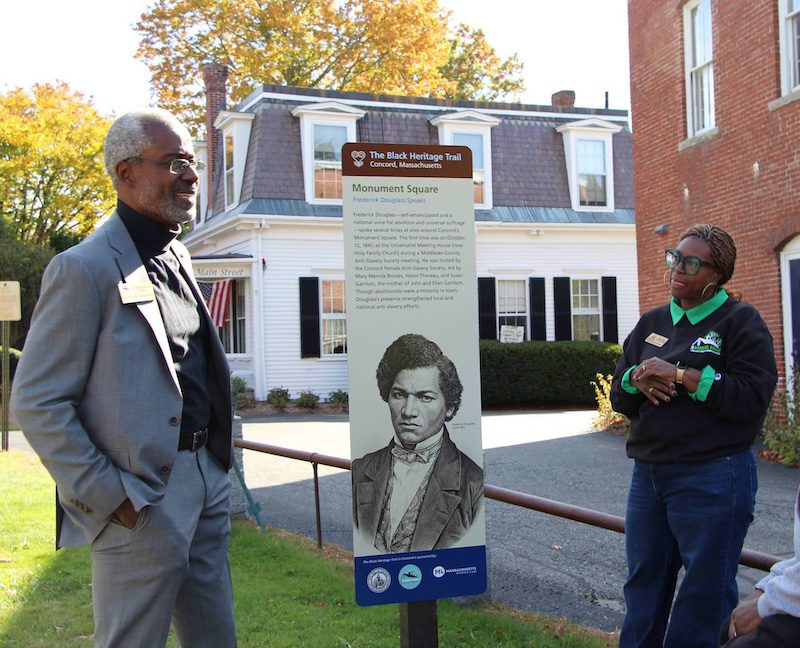
Concord’s Black Heritage Trail is now complete, with ten interpretive markers installed at key sites around town.
The markers, which are educational tools rather than monuments, form a connected walking route designed to highlight the presence and contributions of Black individuals and families, both past and present, directly in public spaces.
The initiative received financial backing from a Massachusetts Office of Travel and Tourism Destination Capital grant, supplemented by Town of Concord ARPA funds, and adhered to the town’s established procedures for public art and right-of-way approvals. The project had a budget of $28,000.
The trail originated from a collaborative effort involving the Robbins House, Concord’s Diversity, Equity and Inclusion Committee, the Concord Visitor Center, and the town’s Economic Vitality Division. Its objectives are to enhance public awareness of narratives not completely represented in current historical materials, motivate individuals to discover the area on foot, and aid the community’s objective of fostering a more inclusive Concord.
“Black history is Concord history,” said Mark Johnson, President of Concord-Carlisle High School’s Black Student Union, at the trail’s unveiling on Thursday, Oct. 22. Johnson, a Boston resident attending school in Concord through the METCO program, added, “It’s in the streets we walk, the buildings we pass, and the ground we stand on.”
A Shift in the Town’s Look and Identity
The markers aim to make visible what has been largely absent from the physical landscape. “Much of the history of Black Concordians exists in archives, scholarship, and town records,” the town of Concord explained in its official overview. “What has been largely absent is its presence in the landscape people move through every day.”
According to a regional cultural tourism study by the Metropolitan Area Planning Council, tourism is central to Concord’s economy, supporting 4,040 jobs and accounting for 53% of total annual commodity sales. Yet, Black Americans represent a $145 billion travel market, making 184 million leisure trips annually, while Black Massachusetts residents make up 10% of the state’s population but account for less than 4% of Concord’s visitors.
“The Black Heritage Trail Markers Project is a direct investment in closing that gap,” the town’s official page states, “giving a growing visitor segment a reason to see themselves in Concord’s story.”
The project was guided by an advisory team of 18 community members and involved working through the complexities of placing signs on public and private property, including in different historic districts.
“We had some of these public meetings, like the Historic District Commission, usually a pretty chill kind of meeting,” said Joe Palumbo, a Diversity, Equity, and Inclusion Commission member and Robbins House co-chair. “We had like 50, 60 people showing up online for these things in the dead of summer, because people wanted good things to happen.”
Students and Officials Reflect on the Trail’s Impact
The unveiling ceremony featured speeches from Concord-Carlisle High School students who emphasized the trail’s importance in making history tangible. “They remind my generation that the fight for human dignity wasn’t just happening somewhere stuffed between the pages in our textbooks,” said Kyle Amouzgar, a BSU student ambassador. “It was happening right on these streets with people in Concord.”
The sites selected for the markers were chosen for their historical significance, documentation, and accessibility. The markers identify the house where Harriet Tubman stayed during her 1859 visit and recount Frederick Douglass’ 1841 speech at the Universalist Meeting House. They also highlight enclaves where Black families built communities and explore their experiences with education, property ownership, and the pursuit of equal rights.
“We wanted to center those stories and put them into the landscape,” said Mimi Graney, Concord’s Economic Vitality Manager. “People who are visiting Concord might look around and think there’s not a lot of people that look like me.”
While the signs are designed to be educational and relatively inexpensive, their installation and the public engagement surrounding the project were seen as successes in themselves. “Even if the signs had not been approved, the town would have accomplished its goal of increasing awareness just through the well-attended meetings,” Graney said.
Visitors and residents can learn more about the Black Heritage Trail and pick up tour information at the Concord Visitor Center. Each marker serves as a starting point for discovery, allowing people to see Concord’s story as a fuller one, with room for everyone who helped build the community. What remains to be seen is how the trail will reshape Concord’s identity as a destination in the years to come.

UVM Leahy Institute Awards $4.2M for Rural Healthcare, Housing, Climate Projects
The Leahy Institute for Rural Partnerships at the University of Vermont is distributing $4.2 million through its latest...

Stolen Street Sweeper Clocked at 90+ Mph Thanksgiving; Mt. Juliet Officer Declines Chase, Suspect Caught
A stolen street sweeper hit more than 90 mph in a 40 mph zone on Thanksgiving morning, and...

Tulane Defeats Maine 70-62 in Daytona Beach Classic as Gray Scores 23
Tulane used a 10-2 run to open the third quarter and defeated Maine 70-62 on Saturday in the...

Lincoln Memorial Leads Lenoir-Rhyne 44-30 in First Half
Lincoln Memorial led Lenoir-Rhyne 44-30 in the first half at Lenoir-Rhyne. During the first half, Lenoir-Rhyne player Jones...