GLP-1 medications, often viewed as quick weight-loss aids, could prevent millions of deaths and free up vast farmland by 2050, according to a new study.
The research, published in Nature Communications on November 19, projects a dramatic ripple effect from the use of these drugs beyond individual health outcomes.
- Up to 7.7 million deaths could be avoided globally by 2050 with widespread GLP-1 use and healthier diets.
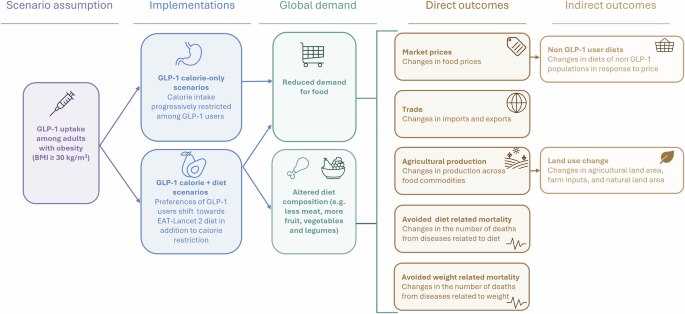
- The study used the LandSyMM global food system model to simulate the effects of reduced calorie intake from 2025 to 2040, evaluating outcomes in 2050. The model assumes that adults with obesity gradually reduce their daily food supply to 1,850 kilocalories per person, accounting for an estimated 19% consumer-level food waste. This reduction is based on a conservative estimated intake of 1,500 kilocalories for those using the medication.
The primary scenario focused on calorie reduction alone, which the study projects could prevent up to 6.6 million deaths globally by 2050 and free up 32 million hectares of natural land.
A second, more ambitious scenario combined GLP-1 use with a shift towards the EAT-Lancet diet, a “planetary health” diet rich in plant-based foods. This combination increased the lifesaving estimate to 7.7 million deaths avoided and freed up 46 million hectares of natural land, an area slightly larger than Italy.
The model also revealed complex economic shifts. Lower food demand in countries adopting GLP-1 treatments would reduce global food prices, making food more affordable elsewhere. However, this price drop could lead to increased consumption of unhealthy foods among people not receiving the medication, partially offsetting the health gains.
The study estimated this effect would result in about 10 additional deaths per million adults in the calorie-reduction-only scenario and six additional deaths in the combined scenario. “As a result, lower-income regions experience small increases in consumption despite no prescribed change in dietary preferences in these regions,” say the authors.
The impact varied significantly by country. For example, Russia and the United Kingdom had similar projected obesity rates for 2050, but Russia saw nearly double the mortality reduction when combined with dietary changes, attributed to its initially meat-heavy diet. “The model further indicates that these demand-side changes lead to lower global food prices, improving food affordability, while simultaneously reducing pressure on agricultural production systems,” the researchers explained.
Study Warns Against Blaming Individuals for Environmental Impact
The study’s lead author, Dr. Roslyn Henry from the University of Aberdeen, emphasized that the findings should not place environmental responsibility on individuals with obesity. “Our findings suggest that these changes in food consumption could have consequences that extend beyond the individuals receiving treatment, including potentially reducing pressure on natural land in other parts of the world,” she told Audacy. “However, it’s important that these findings aren’t interpreted as placing environmental responsibility on people living with obesity, or suggesting that medication is an environmental solution.”
The researchers used obesity prevalence projections from the Global Burden of Disease Study to estimate the potential impact of GLP-1 uptake. They said that while obesity rates have tripled globally since 1975, current access to these medications remains limited, concentrated in wealthier nations. As of late 2025, approximately 2.9% of adults in the UK and a minority of eligible adults in the US were using such medications, constrained by cost and insurance coverage.
“Given that approximately 42% and 26% of the US and UK adult populations, respectively, experience obesity, this implies that current uptake represents a minority of those potentially eligible for treatment, although not all users necessarily have obesity and access is shaped by cost, insurance coverage, and clinical eligibility criteria,” the study authors added.
The study also acknowledged limitations. It did not account for treatment discontinuation, potential weight regain, or the environmental impact of drug production itself. The authors described the scenarios as exploratory, stating their conclusions depend on sustained treatment and assumed dietary changes.
“The authors cautioned that the projections did not explicitly account for treatment discontinuation or weight regain,” News-Medical reported. “The study also did not quantify greenhouse gas emissions or the environmental effects of medication production,” authors said.
Nature Communications, published by Nature Portfolio since 2010, is a multidisciplinary journal with an impact factor of 18.1 as of 2025, covering physics, chemistry, earth sciences, medicine, and biology.
Its peer-review process for interdisciplinary papers like the GLP-1 study involves specialized editors; for health and clinical sciences, this includes Nathalie Le Bot as of 2022, ensuring rigorous evaluation across fields. The journal adopted open access in January 2016, making all content freely available, and authors can submit preprints “under consideration” since 2017 to facilitate early sharing.
While the potential benefits are substantial, the researchers urged a broader perspective. “GLP-1 medicines can play an important role in tackling obesity, but they shouldn’t become a technological fix that allows the wider food system to escape scrutiny,” The Conversation quoted the authors. “They can help people eat less in an unhealthy food environment, but the long-term goal should be to make it easier and more affordable to have a healthier, more sustainable diet.”

Indonesia Targets OECD Membership by 2028 Depending on Reforms
“There is no fixed timetable set,” said Mathias Cormann, Secretary-General of the Organisation for Economic Co-operation and Development,...

Jensen Huang’s Senate Hearing and Nvidia GTC to Drive Seoul Stocks
Jensen Huang week. That label, used by market participants, captures the dense calendar of catalysts confronting South Korean...

US Stroke Cases to Nearly Double by 2050, Costs to Top $423 Billion
Nearly 20 million U.S. adults could be living with stroke by 2050, almost double the current count, according...

Sandiganbayan Drops Romualdez Co-Accused as State Witness for Plunder Bail Hearing
The Sandiganbayan Third Division has allowed the prosecution to drop Samchan Foreign Exchange Corp. president Felicito Cristobal Guevarra...