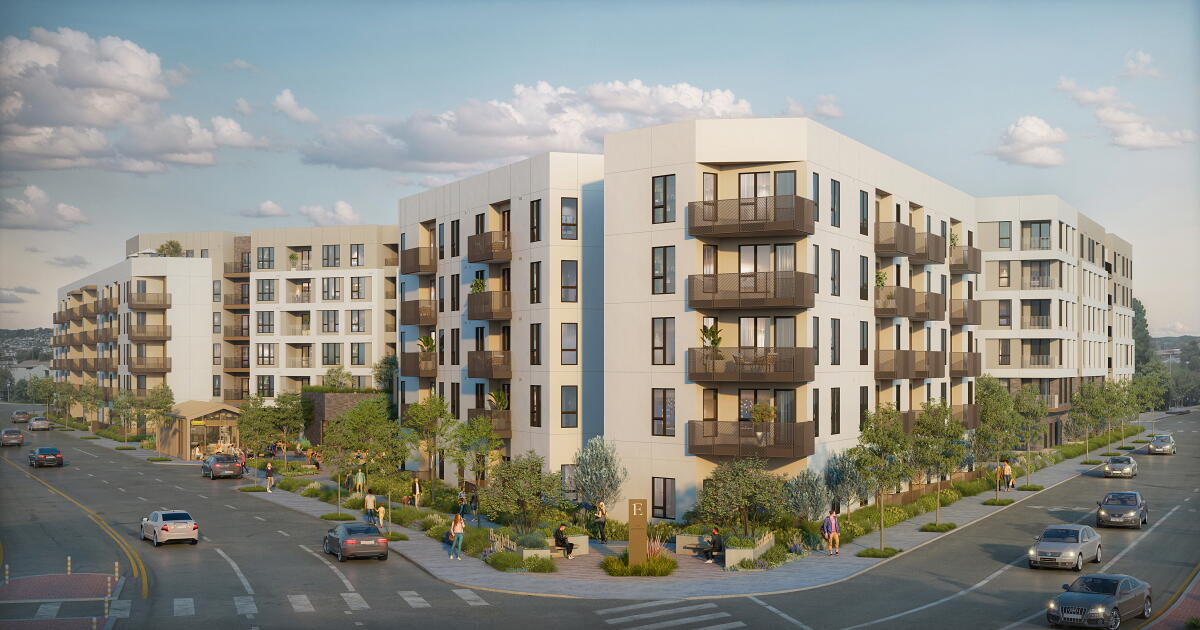
Grading Begins at Culver City’s Jefferson and Sepulveda Intersection for a New 344-Unit Complex
Earth is being moved at the busy intersection of Jefferson and Sepulveda boulevards in Culver City, where construction has officially begun on a $200-million apartment complex called ElevenOneEleven. This project is breaking ground at a time when housing development in much of Los Angeles County has slowed significantly, despite persistent demand for new homes, the Los Angeles Times reported.
The development, a joint effort between Dallas-based Lincoln Property Co. and New York-based McCourt Partners, will feature 344 apartments situated above street-level retail businesses. The project will add two public parks, providing more public space in the fast-changing city. The construction site, a 3.5-acre plot located at 11111 Jefferson Blvd., was formerly home to a U.S. Post Office, a Coco’s restaurant, and a Valvoline auto repair shop, a familiar intersection undergoing a dramatic transformation.
A City in Transition: From Studios to Tech and Entertainment Hubs
Culver City, a city of 40,000 people, has a rich history deeply intertwined with American cinema. It was once the home of major movie studios, including MGM (now Sony Pictures Studios), Culver Studios, and Hal Roach Studios, where classic comedies featuring Stan Laurel and Oliver Hardy and the “Our Gang” series were produced. But the city has undergone a profound shift in recent decades, emerging as a premier destination for creative and technology businesses, with HBO, Amazon, and Apple all establishing a significant presence there.
“The city has undergone a significant transformation from its historical roots in entertainment into what it is now,” said Jordan Lang, president of McCourt Partners. “It’s a cool place people want to be, and we see a market with a lot of room for growth.” This transformation is central to understanding why a project of this scale is not only possible but actively pursued in Culver City, even as similar projects elsewhere in the region face steep headwinds.
Addressing the Housing Crisis with a Mix of Market and Affordable Units
Culver City is facing a familiar challenge for successful, job-rich areas in Southern California: a severe housing shortage. The city boasts one of the strongest employment bases in the region, yet it is widely considered “severely under-housed,” a paradox that makes projects like ElevenOneEleven both critically necessary and financially viable. Public officials are acutely aware of this issue, with Mayor Freddy Puza stating that the city is endeavoring to meet the Southern California Assn. of Governments’ (SCAG) target of adding 3,341 housing units by 2029.
The ElevenOneEleven development is designed to directly contribute to this goal. When completed in late 2028, the complex is expected to house as many as 500 residents. It will include 52 units with subsidized affordable rents, making part of the new housing available to lower and middle-income residents. Developers anticipate that many residents will be drawn from the city’s thriving technology and entertainment industries, which are major drivers of the local economy.
Lang said institutional capital likes Culver City. The developers' recent success in securing nearly $133 million in construction financing from an Arkansas bank showed their confidence. This financial backing is a significant achievement, especially when compared to the broader investment climate in Los Angeles, which has grown increasingly inhospitable for large-scale housing projects.
The Headwinds of Development in Los Angeles
The contrast between Culver City’s thriving development scene and the broader Los Angeles County housing slowdown is stark. According to the Los Angeles Times, observers note that the years since the COVID-19 pandemic emergency have revealed how tangled and unpredictable regulations can be in L.A., causing institutional investors like pension funds and insurance companies to pull their money out of the city and deploy it elsewhere.
Other significant challenges plague housing developers across the region. Rising construction costs and a shortage of skilled labor have created what developers call 'intense headwinds.' Complex and changing local rules make it hard to predict long-term profits, which discourages the big investment needed for large projects.
“There are some pretty intense headwinds in our world,” Lang said, putting a human face on the systemic challenges. “Everyone says we need housing, but then it’s really hard to actually provide housing.” This sentiment captures the central tension in California’s housing policy: the broad political consensus on the need for more homes often clashes with the practical and economic realities of building them.
Lincoln Property Co. has a history of successful large-scale development in the area, having been one of the major forces behind the nearby Playa Vista community, which was built on the site of the former Hughes Aircraft Co. headquarters.
It reflects the forces shaping California’s urban landscape: the tension between a need for housing and the difficulty of supplying it, the contrast between cities that can attract capital and those that cannot, and the transformation of communities like Culver City as they evolve from historical roots into new economic engines.
As the grading continues at Jefferson and Sepulveda, the project stands as a tangible piece of progress for Culver City. Yet, it also serves as a pointed question for the rest of Los Angeles: if a city with Culver City’s advantages and a developer with Lincoln’s pedigree can barely break through, what does it take to build more homes in a region that desperately needs them?
Related reading

Wisconsin Policy Forum highlights Madison’s 2027 budget pressures
Ahead of Vote, Madison's 2027 Budget Balances Services and Pressures As the Common Council prepares for next week's...
Governor Morrisey Announces Reopening of Greenbrier Labor and Delivery Services
For the families of Greenbrier Valley, the sound of a newborn’s cry will soon echo in a familiar...

SeaPort Airlines Launches Direct Spokane-Olympia Flights for 2027 Legislative Session
SeaPort Unveils Direct Spokane-Olympia Flips for 2027 Session OLYMPIA, Wash.—The grueling five-hour drive across the Cascades is about...

Ashlynn Kulha, Ellie Goodrich earn Player of the Year awards
Ashlynn Kulha and Ellie Goodrich Dominate as Seven Monarchs Land All-Sun Belt Honors NEW ORLEANS – In a...