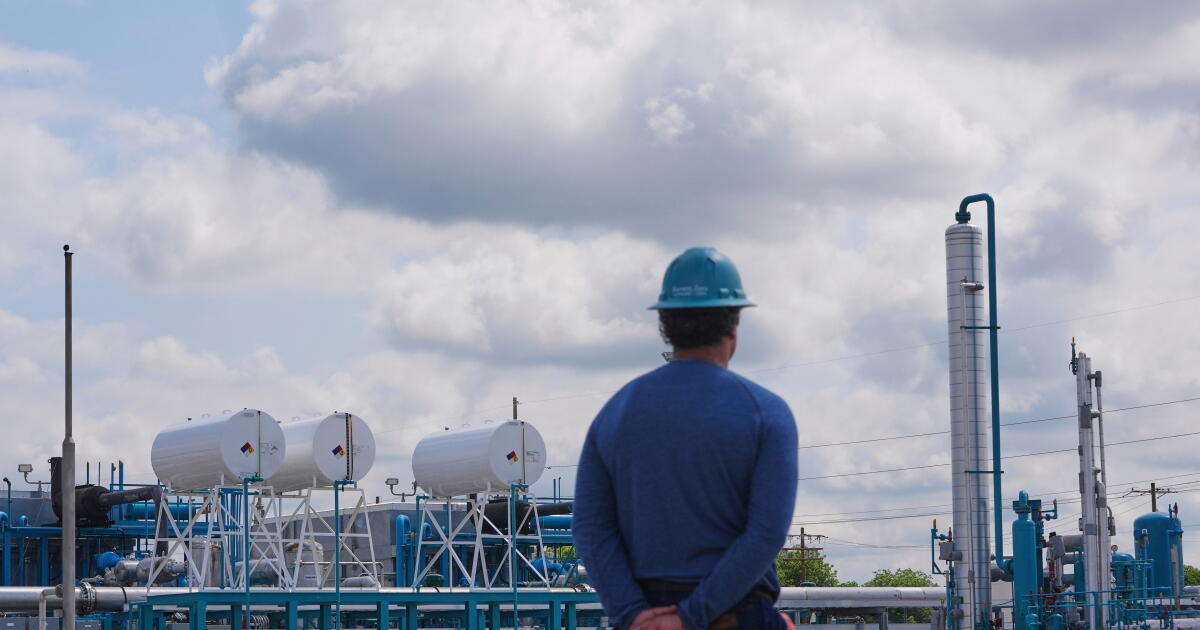
United Nations climate talks in Turkey are poised to declare for the first time that the world must suck carbon dioxide from the air because it has failed to stop warming at 1.5 degrees Celsius.
The acknowledgment, embedded in early drafts of the COP31 communique set to close Friday, marks a historic pivot: nations are preparing to accept a decades-long overshoot of the Paris Agreement’s flagship target and a reliance on unproven, trillion-dollar removal technologies to bend the temperature curve back down.
“Carbon removal is the magic eraser we’re left with when we’ve busted the world’s carbon budget, such as the 1.5C target,” Stanford University climate scientist and emissions tracker Rob Jackson said in an email. “Is carbon dioxide removal feasible technically? Yes. Is it likely to happen at the billion-ton scale needed to make a difference? No.”
The math is brutal. The world needs to remove 320 billion metric tons of carbon dioxide this century — eight years’ worth of current global emissions — to return to 1.5°C, United Nations Environment Programme Director Inger Andersen told the conference.
Berkeley Earth climate scientist Zeke Hausfather calculated the price tag at roughly $22 trillion for every tenth of a degree of cooling. Even under the most optimistic overshoot scenario, peaking just two- or three-tenths of a degree above the threshold, the bill runs $44 trillion to $66 trillion by 2100.
“We need deep emission reductions. That is, and will always remain, the most important tool at our disposal,” said Denmark’s environment minister, Samira Nawa.
Denmark is targeting a 110% emissions cut — going beyond net zero to net negative — and has formed the Group of Negative Emitters (GONE) with Ethiopia, which chairs next year’s COP32, to push the agenda. But the technology barely exists.
Current direct air capture plants remove in a year what fossil-fuel plants emit in half an hour, said Johan Rockström, director of the Potsdam Institute for Climate Impact Research. The hope is to scale to 5 billion tons annually by 2050; nature-based solutions like reforestation have managed at most 2 billion tons over the past decade.
The overshoot math
October’s global average temperature hit 1.8°C above pre-industrial levels — the highest monthly anomaly on record — and Berkeley Earth scientists predict 2026 will surpass 2024 as the hottest year ever measured. The 1.5°C limit is measured over decades, but the short-term signals are flashing red.
Climate Analytics Chief Executive Bill Hare warned that without sharper policy shifts, the world is on track for at least 2.7°C by 2100 — a level no amount of carbon removal could offset.
That reality frames the COP31 draft language: deep cuts first, removal second. “There’s not much point of thinking about that until we have deep emission reductions,” Hare said at the conference. The communique drafts acknowledge the world will enter a dangerous temperature zone for decades before attempting a return.
Two different technologies, one confused debate
The talks also risk conflating carbon dioxide removal — pulling CO2 already in the atmosphere — with carbon capture and storage, which traps emissions at the source. The distinction matters: the former is a planetary cleanup tool; the latter lets polluters keep polluting. Draft texts encourage both, but analysts worry the political convenience of capture will distract from the removal scale required.
Rockström, while stressing the daunting physics, insisted the target cannot move. “We must keep this as our safe landing temperature, now that we fully understand how dangerous it is to exceed 1.5°C,” he said. World Resources Institute global climate and economics director Melanie Robinson put the stakes plainly: “If you’re a champion of 1.5 degrees C, then you’re also a champion of reaching net-negative emissions.”
The Potsdam Institute for Climate Impact Research, founded in 1992 by Hans Joachim Schellnhuber, is a German government-funded institute and member of the Leibniz Association. Ranked among the top environmental think tanks worldwide, it employs about 400 people on Potsdam’s historic Telegrafenberg.
Researchers from the natural and social sciences analyze the Earth system, assess climate risks and develop policies and solution pathways towards a manageable climate future. The institute is currently led by three directors, including Johan Rockström, who succeeded Schellnhuber as co-director in 2018.
COP31 negotiations in Turkey are scheduled to end Friday, though they rarely finish on time.
Worth a look

JPMorgan Chase, Visa, Mastercard Confirm Third-Party Vendor Cyberattack Exposing Customer Data
JPMorgan Chase, Visa and Mastercard confirmed Thursday that a cyberattack on shared third-party vendors may have exposed customer...

Aeneas Sweeps DSBF Final in Career-Best 1:54 at Bally’s Dover
Aeneas turned a $110,000 Delaware Standardbred Breeders' Fund final into a clinic on pocket patience Thursday night, stalking...

Dr. Seuss’s How the Grinch Stole Christmas! Musical Opens Dec. 11 in Helena; Resale Tickets Start at $1,679
Dr. Seuss's How the Grinch Stole Christmas! The Musical opens a six-performance run at the Helena Civic Center...

Las Vegas Police Swarm GTA Mansion After Swatting Call
Las Vegas police swarmed a Grand Theft Auto-themed mansion Wednesday night after a swatting call interrupted a live...