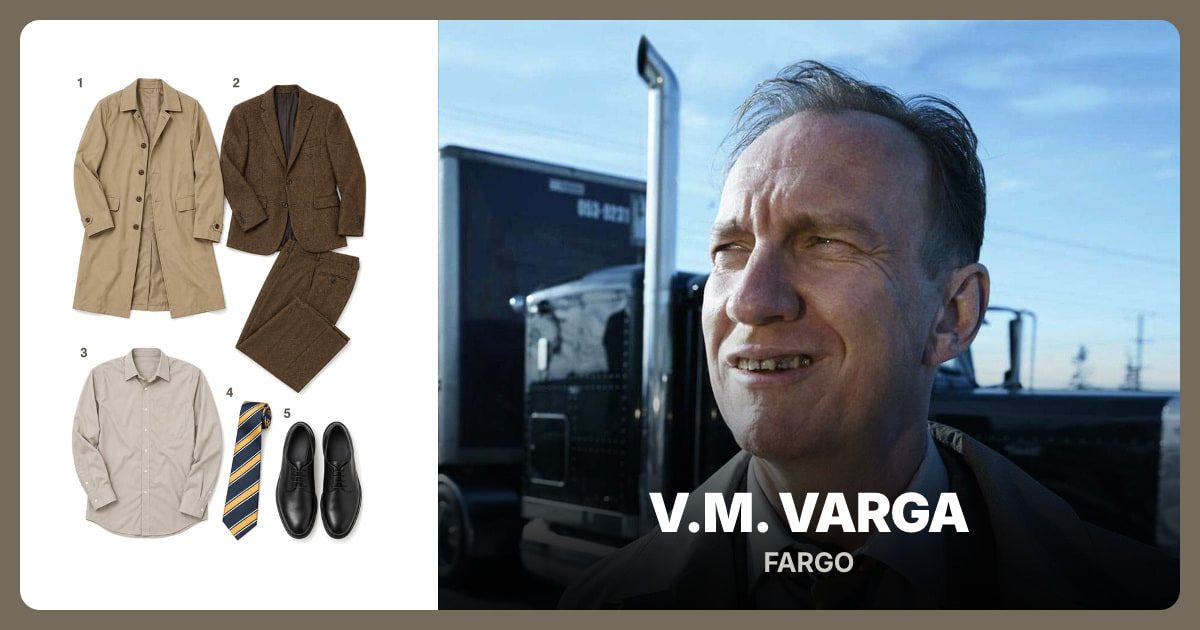
A new costume guide from Costumewall breaks down the exact wardrobe pieces needed to replicate the look of V.M. Varga, the antagonist played by David Thewlis in the third season of the FX series Fargo.
The guide identifies the character’s signature ensemble as a textured brown suit, pale stone-colored shirt, navy-and-gold striped tie, khaki trench coat and black Derby shoes, emphasizing that the outfit’s power lies in its mundane, slightly rumpled presentation rather than any flashy tailoring.
According to the guide, the costume relies on a specific layering order: the stone dress shirt is tucked into matching brown suit trousers, the suit jacket is added, and the khaki coat is worn open over the top. The tie should be knotted loosely near an open collar, with a muted diagonal stripe pattern.
The source notes that the screen-used suit reads as a gray-brown with herringbone texture, while commercially available alternatives tend to be browner, advising cosplayers to “keep the rest of the outfit quiet and let the layers do the work.” A vest is explicitly excluded. Short brown hair brushed loosely across the top with a side part completes the look, with no wig, hat or elaborate makeup required.
“Varga’s unsettling presence is the final accessory, and thankfully it costs nothing,” the guide says. The character is described as a “mysterious outsider and antagonist” who arrives amid the Stussy family business troubles and becomes involved in a money-laundering financial scam, destabilizing the community around him. The guide also notes the coat and suit can serve double duty for a detective costume. The full breakdown is available at Costumewall.
Before his Emmy-nominated turn as V.M. Varga in Fargo (2017), David Thewlis established a pattern of disquieting ordinariness in Mike Leigh’s Naked (1993), where his Johnny is a homeless, highly intelligent street philosopher whose rambling intellect masks a menacing volatility. That same year, he played James Jackson, a sexual predator in Prime Suspect 3, presenting a superficially unremarkable figure whose threat emerges through psychological manipulation rather than theatrical villainy.
Later roles deepened this register: in Gangster No. 1 (2000), his unnamed gangster radiates cold, calculated menace beneath a polished surface, while The Boy in the Striped Pyjamas (2008) casts him as a concentration-camp commandant whose bureaucratic domesticity makes his complicity more disturbing.
Worth a look

Missouri Prepares for Possible Fallout From Iowa Army Lead Azide Detonation Amid Court Rulings
Missouri officials are preparing for possible fallout from a U.S. Army plan to detonate 9,773.5 pounds of lead...

Caitlin Clark Eyes Augusta Debut as Offseason Golf Goal
"I want to play Augusta for the first time," Caitlin Clark said on the "New Heights" podcast with...

FHLBank Indianapolis Awards Over $33.7M in 2026 Housing Grants, $13.9M for Indiana
The Federal Home Loan Bank of Indianapolis announced Monday it will award more than $33.7 million through its...

Albuquerque Man Sentenced to Five Years for Using AI to Create Child Sexual Abuse Images
Albuquerque resident Richard Gallagher, 69, was sentenced to five years in a New Mexico prison after pleading guilty...