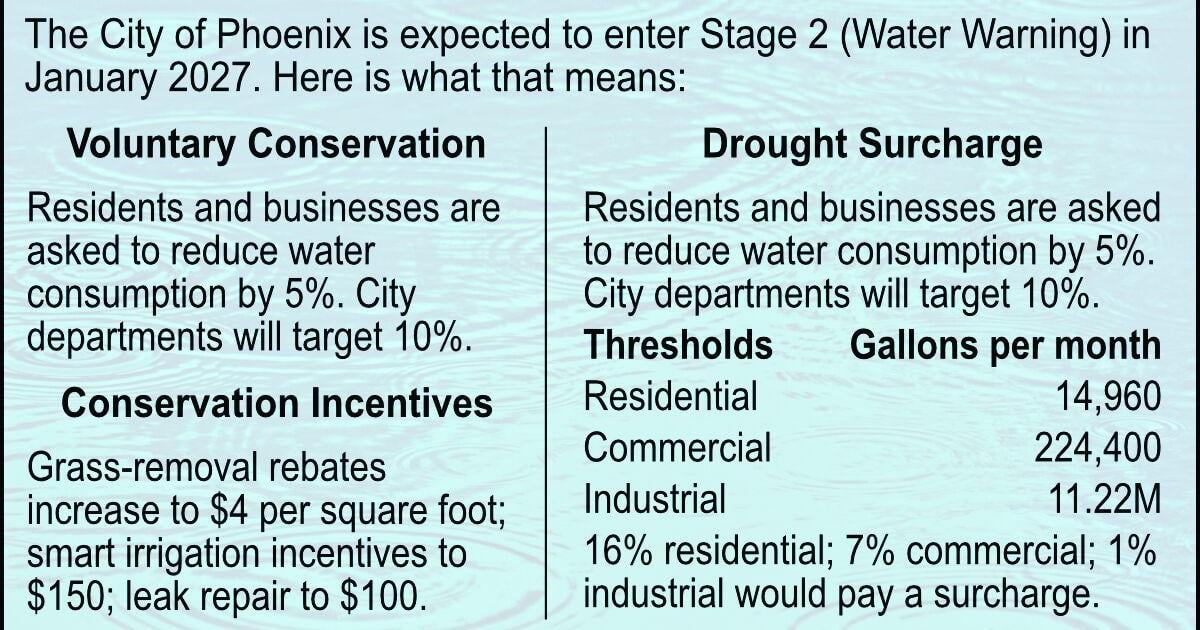
Phoenix City Council members warned last week that a proposed drought surcharge could penalize condominium owners, apartment residents and homeowners associations whose water is billed through a single commercial account.
The concerns surfaced during a Nov. 10 policy session as water officials outlined preparations for major reductions in Colorado River deliveries beginning in January.
“We’re going to punish residential users who live in an apartment or own a condo,” Councilwoman Ann O’Brien said during the meeting. She highlighted a structural inequity: individual residential customers would pay a surcharge only after using more than 20 units of water monthly — about 14,960 gallons — while commercial accounts, including those serving HOAs and multifamily properties, would face the surcharge after 300 units, or 224,400 gallons.
O’Brien offered the example of a 120-unit condominium complex. If the residential threshold were applied to each unit separately, the combined allowance would be 2,400 units. Under the proposed commercial classification, the surcharge would begin after 300 units. “Why should residents be treated differently simply because their water bills are handled collectively?” she asked.
City Manager Ed Zuercher acknowledged the problem.
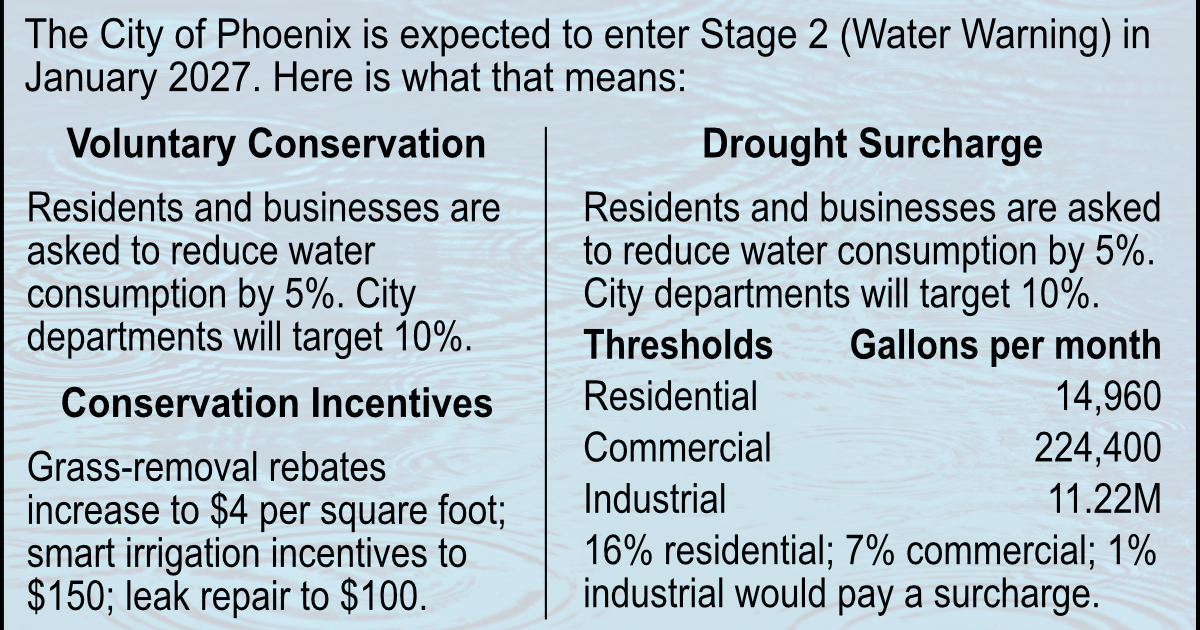
The surcharge would be $2.10 for each unit — 748 gallons — consumed above the applicable threshold. City modeling indicates the charge would affect approximately 16% of residential monthly bills, 7% of commercial bills and 1% of industrial bills, and could generate roughly $40 million to support conservation efforts and development of additional supplies. A homeowner using 25 units in a month would pay an additional $10.50, representing five units above the threshold.
The issue carries particular weight in Ahwatukee, where homeowners associations maintain extensive common areas, landscaped neighborhood entrances, parks and street medians. Zuercher said that HOAs rank third in water consumption among the city’s categories of commercial customers.
A resident who identified himself as a volunteer with his neighborhood’s HOA and water conservation committee told the council the proposal would cost his community more than $30,000 annually. He said the association had already eliminated winter overseeding, reduced summer irrigation and taken other conservation steps. He argued that additional water charges would ultimately be passed along to homeowners despite those investments.
Councilwoman Debra Stark raised a second barrier: the cost of complying with city requirements when an HOA wants to replace grass with desert landscaping. She said some associations must hire landscape architects and prepare detailed plans before making improvements, expenses that can diminish the financial benefits of city incentives.
Councilwoman Laura Pastor echoed the sentiment. “We have to remove the barriers,” she said.
Water officials outlined expanded programs intended to encourage reduced consumption as Phoenix prepares to rely more heavily on stored water and other backup supplies. Free water-efficiency consultations for residential customers, businesses and HOAs would also be expanded.
The debate comes as Phoenix faces a significant reduction in one of its major water sources. Phoenix officials anticipate the city’s Colorado River deliveries could decline by approximately 30%.
Phoenix has remained in Stage 1, designated a Water Alert, since June 2022. The designation would not mean residents are in danger of losing water service. The first advanced purification facility is expected to begin delivering water in 2029. Until those projects become operational, Phoenix expects to depend more heavily on existing supplies and conservation.
Worth a look

Maryland Medicaid Recipients Keep Coverage Through June With Work Requirement Delay
Maryland Medicaid recipients keep coverage through June 2027. The state health department announced Friday that Maryland Medicaid recipients...

Malory Shaw Argues Latino Teacher Shortage Undermines Nevada’s Student Population
In a column for The Fulcrum, University of Nevada, Reno student Malory Shaw argues that Nevada’s severe shortage...
Chilly Cheyenne Weekend Before Midweek Thanksgiving Warmup
Chilly Cheyenne weekend awaits before a midweek Thanksgiving warmup arrives. The National Weather Service in Cheyenne reported a...

OHSAA Football Playoff Scores for Ohio Regional Finals on Nov 20, 2026
Danville secured a 58-20 victory over Willow Wood Symmes Valley in Ohio Division VII Region 27. Ohio high...