
North Dakota recorded its first confirmed cases of pine wilt disease in August 2026, while emerald ash borer was detected in three new locations across the state, according to the annual “Dakota Gardener” column by North Dakota State University Extension forester Joe Zeleznik.
The column, published Nov. 27 by the Farm Forum, details a mix of botanical discoveries and pest advances documented during the 2026 field season. Pine wilt, a disease complex involving a nematode, a sawyer beetle and a fungus, has moved northward through the Great Plains for decades and was finally confirmed in North Dakota this year.
It threatens Scotch pine, Austrian pine and possibly mugo pine, though native ponderosa pine “very rarely suffers from pine wilt,” Zeleznik wrote. Drought conditions over the past several years helped the disease spread.
Emerald ash borer was found in three new locations in 2026, including Bismarck and Prosper in rural Cass County. The insect was also confirmed in Fargo, though Zeleznik called that detection “a bit anticlimactic” because the borer had already been found in neighboring Moorhead, Minnesota, in 2023.
On the discovery side, round-leaved dogwood (Cornus rugosa) was documented in North Dakota for the first time. Nathan Rokke of the Grand Forks County Soil Conservation District and Tyler Janke of the Minnesota Department of Natural Resources found the species on several north-facing slopes in the Pembina Gorge, where shrubs formed thickets “hard to walk through,” Zeleznik wrote.
Additional finds in 2026 included new limber pine (Pinus flexilis) stands in a remote area near Marmarth, discovered by USDA Forest Service colleagues in Dickinson. A single stand had been known in the Badlands since the late 1940s.
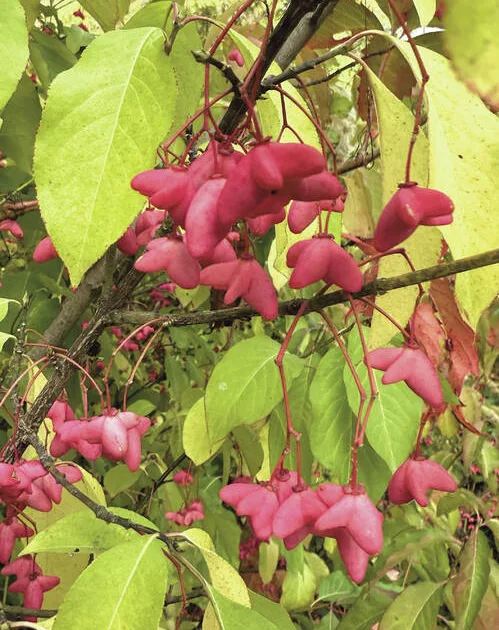
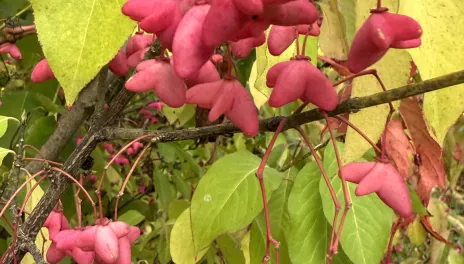
Zeleznik also recorded his first in-person sightings of eastern wahoo (Euonymus atropurpureus) — a shrub native to the eastern U.S. but found in North Dakota only along a 20-mile stretch of the Sheyenne River southwest of Kindred — and creeping Oregon grape (Mahonia repens), confirmed in just two locations in Bowman and Slope counties.
Elm zigzag sawfly, first detected in North America in Quebec in 2020, has spread through the eastern and midwestern U.S. but has not yet been found in North Dakota. Zeleznik observed the pest this year in Perham, Minnesota, about an hour’s drive from Fargo. He said that females sometimes lay eggs in vehicle wheel wells, “which then help spread the insect incredibly long distances.”
Squirrel caches mushrooms in Scotch pine
Zeleznik’s wife spotted a red squirrel carrying a large disk up a Scotch pine outside her sewing room and repeated the behavior several times. A quick internet search revealed that red squirrels sometimes cache mushrooms in conifer trees, providing nutritious food over the lean winter months.
Zeleznik said that squirrels bury acorns in flowerpots every year, leading to oak seedlings among the zinnias and cosmos each spring. He said the mushroom discovery was a surprise: “Who knew?!”
Red squirrel behavior observed at home
Zeleznik wrote that he saw a red squirrel run along his deck and bury an acorn in a flowerpot, a routine that produces oak seedlings among the zinnias and cosmos each spring. Days later, his wife saw a squirrel running up a Scotch pine outside her sewing room carrying a large disk in its mouth.
The pair watched the squirrel continue its labors several times before an internet search explained the behavior. Zeleznik said the mushrooms provide nutritious food over the lean months of winter.
The column is republished from NDSU Extension under a Creative Commons license.

LeBron James Scores as 76ers Rout Pacers to Reach NBA Cup Quarterfinals
LeBron James scored 21 points and the Philadelphia 76ers routed the Indiana Pacers 111-87 on Friday night to...

Community Remembers Lauren Becker at Omaha Vigil
Family and friends of Lauren Becker gathered in a candlelight vigil at the Kids Can parking lot in...

Pistons Win Over Milwaukee Likely Secures East Group a for Detroit
East Group A standings show the Orlando Magic leading at 3-1 with a minus-1 point differential, followed by...

Armed Robbery Suspect Terrence Jones Chased Across Indianapolis Motor Speedway Track, Faces Felony Charges
Terrence Jones, identified by police, allegedly stole six cartons of Newport cigarettes worth $864 from a Speedway gas...