Deep Fission has converted a preliminary letter of intent into a definitive contract with the Great Plains Industrial Park in Parsons, Kansas, committing the company to build a commercial nuclear project and supply power to the region. The agreement comes as the company fights a collapse in its share price and allegations of financial instability following a short-seller report.
By shifting from a non-binding collaboration to a binding contract, Deep Fission is attempting to signal operational stability to a market that has seen its stock plummet almost 84 percent from its initial public offering price. For Kansas, the stakes are measured in megawatts; the partners are targeting an initial 150 MW by 2028, with a long-term vision to scale the site to 2,000 MW as demand grows.
A borehole reactor in the Kansas plains
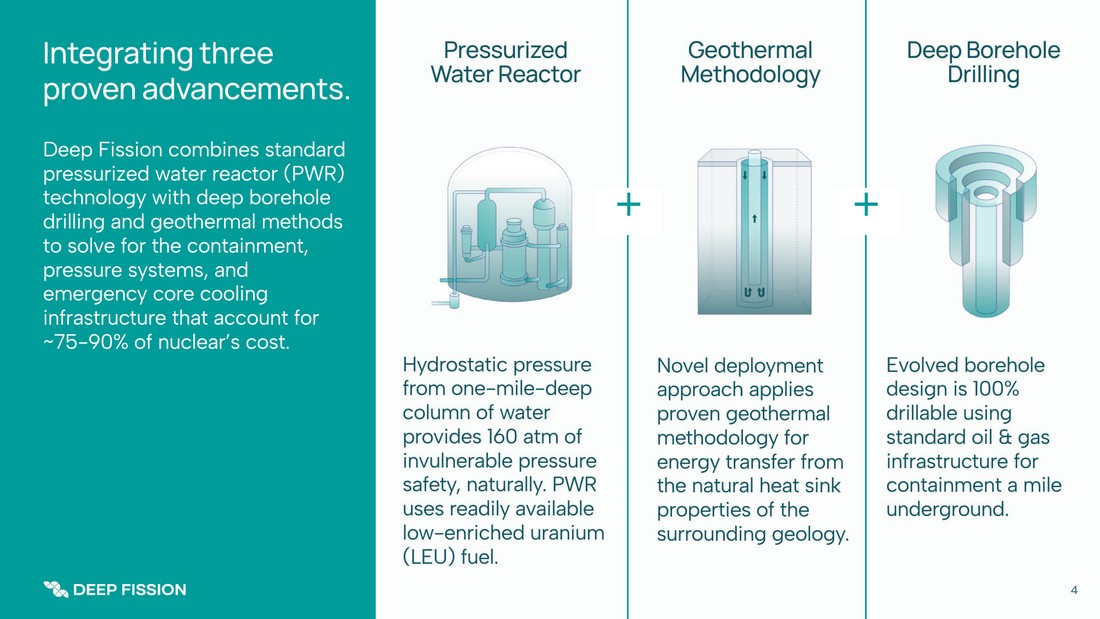
The technology driving this project is a departure from traditional nuclear architecture. Deep Fission is developing a small pressurized water reactor (PWR) designed to be placed in a borehole approximately one mile underground. The theory is simple: by burying the reactor, the company can slash deployment costs, accelerate construction, and inherently improve safety and security by using the earth itself as a shield.
Great Plains Development Authority (GPDA), has made a 25-year power purchase agreement with Deep Fission to power its industrial park in Parsons, Kansas. Article link in reply.The agreement is for 150 MW, starting in 2028, and for 2 GW in 2031. I'm assuming that the purchase… pic.twitter.com/7MZfhNCpu9
However, the road to the borehole has been inconsistent. Over the last three years, the company has frequently shifted its design specifics. While the long-term goal is massive scale, the first reactor is currently targeted at an output of approximately 8 MWe, with follow-on deployments aiming for 15 MWe.
Deep Fission is pursuing a unique regulatory path through the U.S. Department of Energy (DOE) Reactor Pilot Program. While other participants like Antares, Aalo Atomics, and Oklo used their pilot reactors as stepping stones to gather data for entirely separate commercial units, Deep Fission intends for its pilot reactor to eventually transition into a fully NRC-licensed, commercially operating unit.
The “Money Pit” allegations
The new power agreement arrives amidst a firestorm of financial scrutiny. In a report titled Deep Fission ($FISN): a Money Pit, Iceberg Research—a firm that openly shorts the companies it targets—accused the company of lacking transparency and operating with dwindling capital. Iceberg claims that Deep Fission’s timelines are unrealistic and that its progress through the DOE’s authorization process has been sluggish.
The market reaction was swift and brutal. In the week following the report, the stock dropped 35 percent, falling from $8.12 to $5.25. It has since cratered to $2.59 per share. The financial bleeding has attracted legal predators; four separate law firms have launched investigations into the company, using the Iceberg report to seek damages for shareholders.
Deep Fission has pushed back hard, calling the Iceberg report “highly misleading” and claiming it is riddled with “distortions, inaccuracies, and mischaracterizations.” The company has stated it is currently evaluating potential legal remedies.
Regulatory milestones and the race to 2028
Despite the boardroom chaos, the physical project in Parsons continues to move through a streamlined DOE authorization pathway, which is significantly faster than the traditional Nuclear Regulatory Commission (NRC) licensing process. The company broke ground in December 2025 and has already cleared two major hurdles.
| Milestone | Status | Date Completed |
|---|---|---|
| Other Transactional Agreement | Completed | December 2025 |
| Nuclear Safety Design Agreement | Completed | August 2026 |
| Preliminary Design Safety Agreement | Pending | TBD |
| Design Safety Agreement | Pending | TBD |
| Final Readiness Review | Pending | TBD |
The company is now racing toward a July 2026 criticality target for its test reactors.
The economic friction of “Fast-Track” nuclear
There is a fundamental tension here between the speed of the DOE’s pilot program and the rigor of the NRC’s commercial licensing.

The real impact of this project falls on the local economy of Labette County. The Great Plains Industrial Park is designed to attract R&D and data centers, both of which are power-hungry. If Deep Fission delivers, Parsons could become a site for energy projects.
With three regulatory milestones remaining and a stock price in freefall, the definitive contract signed with the GPDA isn’t just a business deal—it’s a lifeline.
Keep reading

Top Halloween and Weekend Events: O’ahu Guide
Honolulu is leaning into a high-contrast blend of cultural celebration and psychological horror for the upcoming Halloween weekend...

Hall Booth Smith Welcomes Jim Standard Back as Of Counsel
Hall Booth Smith, P.C. (HBS) has brought James “Jim” Standard back to its Atlanta office to serve as...

Denver Broncos Release Unofficial Depth Chart Ahead of Chiefs Game
The Denver Broncos have released their unofficial depth chart for Sunday's Week 8 matchup against the Kansas City...

PPIC poll shows support for California billionaire tax has slipped
Support for California's proposed billionaire tax has slipped in the final stretch before Election Day, shifting from a...