
International marine geologists have uncovered evidence of the deepest-known explosive volcanic eruption on Earth, at depths reaching 4 miles beneath the surface of the western Pacific Ocean.
Pyroclastic Rocks Discovered at Challenger Deep
The team utilized a remotely operated vehicle, Jason/Medea, to explore the Mariana Trench’s Challenger Deep, the planet’s deepest known seafloor point. The ROV observed and collected pyroclastic rocks, definitive proof of an explosive eruption composed of ejected rock fragments and volcanic glass.
“The key findings are the discovery of recent igneous activity near the trench,” said geologist Robert Stern, a professor emeritus at the University of Texas at Dallas and a visiting researcher at UCLA who is the lead author of a study describing the findings in the journal Frontiers in Earth Science.
“Pyroclastic rocks are well known from volcanic eruptions on land and even in the shallow ocean, but they aren’t known from as deep as we discovered them,” Stern said.
Explosive Eruption in an Unlikely Location
The Mariana Trench is a subduction zone where one tectonic plate dives beneath another. Typically, large volcanoes form about 125 to 185 miles from the trench. The pyroclastic rocks, however, were found within the trench itself.
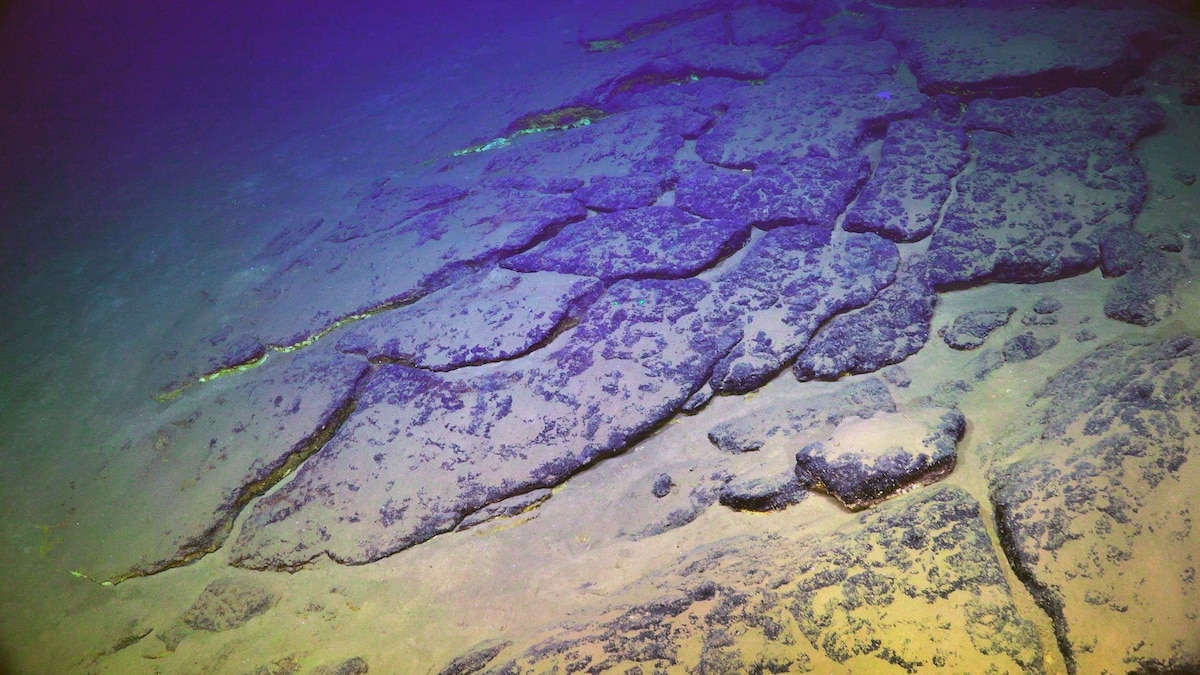
The ROV made the startling discovery at 20,170 feet deep, identifying thin, flat layers of rock. The minerals and textures of these rocks confirmed their origin as a pyroclastic flow—a superheated avalanche of rock, ash, and gas. The entire team was nervous during the dive, as Jason/Medea cannot dive below 21,300 feet without risking implosion.
Extensive Seafloor Exploration
The researchers conducted 10 dives with the ROV, exploring 340 miles of a geological structure called a forearc. “The ROV was our principal research tool used for looking at and collecting samples from the seafloor down to 6,500 meters (4 miles),” Stern said, according to Reuters. Seven of the dives were in the forearc around the Challenger Deep, with the other three in shallower waters near Guam due to weather conditions.
The collected rocks contained broken pieces and volcanic glass cemented in a finer-grained matrix. “This is unmistakably the product of a volcanic eruption. We did not see any eruption, and we have not yet found the vents from which the pyroclastic rocks erupted,” Stern said.
Team Faces Peril During Deep Dive
The remotely operated vehicle Jason/Medea can only dive to a maximum depth of 21,300 feet without risking implosion. This forced the team to explore the deep geologic wall near the Challenger Deep, approaching the robot’s operational limit.
As Jason/Medea descended to 20,170 feet, the researchers encountered pyroclastic rocks. The entire team was a little nervous during the perilous dive, knowing any deeper could have caused the vessel to implode.
Researchers Study Forearc Structure
The ROV served as the principal research tool, allowing scientists to observe and collect samples from the seafloor down to 6,500 meters. These samples confirmed the discovery of the deepest-known explosive volcanic eruption.
A Geological Puzzle Remains
While the precise age of the rocks is not yet known, Stern said they appear to be recent in geological terms. The team is now focused on understanding how explosive eruptions could possibly occur at such depths, given the immense water pressure.
“The intense pressures at the depths that these submarine volcanoes erupted makes the eruption style different than it would be on land or in shallow water, where the pressures are much lower,” Stern said.
Robert Stern, a professor emeritus at UT Dallas, has a long history with deep-sea geology dating back to 1976 when he began studying the volcanic rocks of the Mariana island arc.
His research on the Izu-Bonin-Mariana arc system spans over 40 years, including numerous marine expeditions exploring submarine volcanoes and deeper regions by dredging and ROV studies. In 2015, he was inducted into the Oroville, California Union High School Hall of Fame for his contributions to geoscience.
How such explosive eruptions are possible at these depths remains an open question.

USC Annenberg Media: Lincoln Riley Deserves Another Year
USC football head coach Lincoln Riley deserves another year, USC Annenberg Media reported. “Fire Riley” chants echoed throughout...

7 Wilmington-Shot TV Christmas Episodes to Stream: ‘One Tree Hill,’ ‘Summer I Turned Pretty,’ ‘George & Tammy’ and More
Wilmington-shot series deliver seven holiday episodes spanning three decades of television history, the Rock Hill Herald reported Saturday....

Luka Dončić Says He Asked Lakers Front Office to Acquire Walker Kessler
Luka Dončić says he asked Lakers front office to acquire Walker Kessler. Walker Kessler is averaging 10.8 rebounds,...

Jordan Scott Praised by Jordan Smith Jr. After Arkansas Game
Former five-star recruit and No. 2 prospect in the country, Jordan Smith Jr., has praised Jordan Scott as...