
“I felt like I didn’t miss a shot for three years straight,” Aaron Gordon said, reflecting on a rare moment of offensive efficiency during Denver’s recent victory over Toronto. The 32-year-old Nuggets forward is currently navigating a period of significant adjustment, attempting to rediscover the rhythm that has defined his 13-year NBA career amid shifting roles and a slow start for the Denver roster.
The struggle has been visible in the box scores. Before Wednesday’s win, Gordon endured one of the most difficult five-game stretches of his tenure in Denver, averaging just 9.8 points while shooting 31.8% from two-point range and 27.3% from beyond the arc. This slump coincides with a broader team struggle; Nuggets head coach David Adelman noted that, with the exception of Jamal Murray, the entire squad is still searching for consistent offensive flow.
According to a report from The Denver Post, the tension in Gordon’s game isn’t just about shooting percentages, but about the physical and tactical demands placed upon him. Adelman has tasked Gordon with increased responsibilities, including occasionally bringing the ball up the court to alleviate pressure, a role that may be contributing to his lack of traditional offensive rhythm.
The rotation puzzle in Mexico City
As the Nuggets prepare for a four-game road trip beginning Saturday against the Indiana Pacers in Mexico, the coaching staff is actively experimenting with how to integrate Gordon into the lineup. The primary challenge lies in the “stagger”—the specific way players are rotated to ensure the team doesn’t lose momentum when starters head to the bench.
Earlier this season, Adelman attempted a rotation that utilized Trevon Brazile as the primary substitute, pulling Gordon early in the first quarter to bring him back for the start of the second. This was intended to keep Gordon fresh, but it created a disconnect in the team’s chemistry. When Gordon played as the lone starter alongside the second unit—specifically alongside power forward Marvin Bagley III—the results were statistically poor. The duo posted a minus-6.8 net rating in their first 55 minutes together, a figure that dipped to a minus-10.1 during stretches where Brazile was not on the floor.
To address this, Adelman has begun reverting to a two-stint substitution pattern for Gordon, allowing players like Cam Johnson to stagger with the bench unit instead. The goal is to find five players who “flow well together,” a process Adelman admits is still in flux.
Finding rhythm through the free throw line
The coaching staff’s strategy for Gordon’s return to form is rooted in a specific statistical observation: his success is tied to his ability to get to the charity stripe. Adelman believes that once Gordon finds success at the free throw line, the rest of his game—specifically his perimeter shooting—tends to follow.
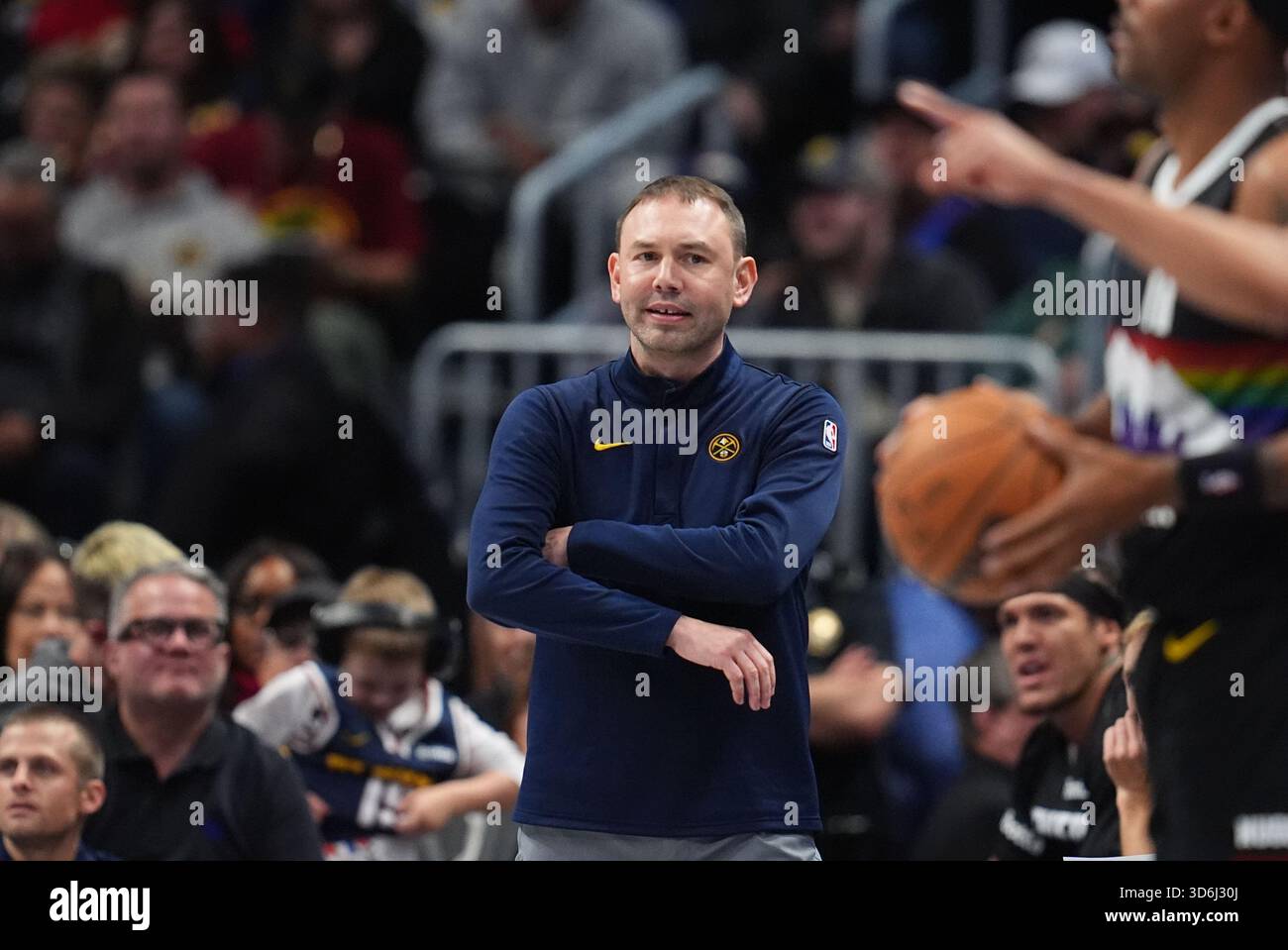
“I find when Aaron’s game really takes off is when he finds the free throw line. He sees the ball go in. It usually leads to more fluidity from three,” Adelman said.
On Wednesday, Gordon showed glimpses of this resurgence. He finished with 17 points on an efficient 7-for-9 shooting performance. Beyond the scoring, his defensive presence provided a much-needed spark, highlighted by a crucial late-first-half block on a Collin Murray-Boyles dunk attempt that ignited a Denver fast break.
However, the “riddle” of Gordon’s season remains partially unsolved. While his offensive numbers spiked on Wednesday, his defensive impact has not yet returned to its usual elite levels. The mismatch between his offensive outbursts and his defensive consistency suggests that his physical rhythm is still being recalibrated.
Longevity versus immediate impact
The debate within the Nuggets’ camp involves a delicate balance between winning games now and protecting Gordon’s long-term health. The “in and out” approach—using shorter stints on the floor and more time on the bench—is a move designed to prevent injury and keep him warm, but it has arguably made the team’s rotation more clunky and difficult to manage.
Gordon, who has a long-standing relationship with Adelman dating back to their time together in Orlando, seems to trust the process. He noted that the current experimentation is a necessary part of finding the best configuration for the team’s success and his own career longevity. As the team moves into the Mexico City leg of their schedule, the focus remains on whether these tactical shifts can stabilize a roster that is still finding its footing in the early stages of the season.
The Nuggets’ ability to find a consistent identity may depend on whether Gordon can transition from a player struggling with a changing role back into the reliable, high-impact force that has anchored Denver’s interior for years.

9th Annual Heart of Albany Festival Brings Artists and Creativity to Tift Park
Tift Park hosts 9th annual Heart of Albany Festival Artists and community members gathered at Tift Park in...

Dartmouth vs. Harvard Men’s Soccer Box Score: 3-3 Draw Results
Dartmouth and Harvard Split Points in 3-3 Draw in Boston A high-scoring stalemate in Boston saw Dartmouth College...

Grappone Mazda Test Drives Raise Funds for Concord High Music
Concord High School students aim for $10,000 through Mazda test drive fundraiser A single test drive could contribute...

North Lincoln Breaks State Record with 7th Straight XC Title
North Lincoln sets all-time state record with seventh straight cross country title The North Lincoln girls cross country...