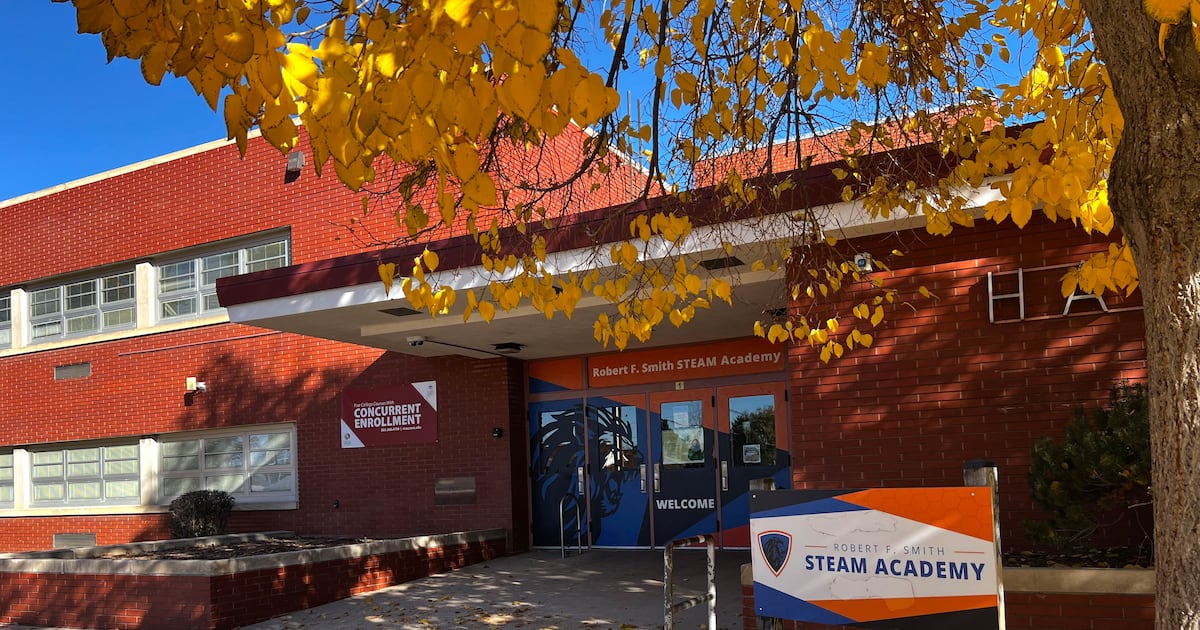
The Denver school board voted 4-2 on Thursday to shutter Robert F. Smith STEAM Academy at the end of this school year.
The decision leaves just 24 students enrolled at the high school this year, Chalkbeat reported. The facility, which was designed to model the environment of historically Black colleges and universities, now faces permanent closure following a split vote by district officials.
Board Vice President Monica Hunter and member John Youngquist were the two dissenting voices on the board. Hunter, a former Denver teacher who works for the statewide teachers union, had requested a pause in the vote to allow for a final agreement regarding teacher concessions.
“The rationale is this is precedent setting,” said Superintendent Alex Marrero, noting that the district may face further consolidations in the future. “And potentially we have some more (school) consolidations coming, and it would not behoehve us to honor those indefinitely.”
Denver Public Schools funds its campuses on a per-student basis, a model that makes low-enrollment schools difficult to maintain. District officials said that Robert F. Smith had become financially unsustainable for the district.
Superintendent Marrero indicated that the district had reached its limit regarding negotiations with staff. While the district and teachers had verbally agreed on a $1,000 payment to teachers and certain protections for international teachers on work visas, other requests were denied.
Hunter said that the rejected requests included providing non-tenured teachers with two paid days off to interview for other positions. As enrollment in Denver Public Schools continues to decline, Marrero intends to recommend additional school closures across the district.
The school’s decline was not an overnight occurrence but rather a series of logistical and administrative hurdles. Robert F. Smith was the brainchild of a group of Black parents and sports coaches in northeast Denver, opening in 2021 without a boundary, which required students to actively choose the school.
The school’s early years were marked by several setbacks:
- In its first year, the district incorrectly listed the school’s address, which founders claimed put the academy at a disadvantage.
- While enrollment grew in 2022, it dropped in 2023 after the school was relocated.
- The move took the school away from the far northeast part of the city where it had its strongest community support.
Internal turmoil also contributed to the instability. The founding principal departed the school, and a parent involved in the school’s inception, Brandon Pryor, successfully sued the district after being banned from school grounds.
The closure highlights a growing tension between district leadership and those who believe the administration should act before a school reaches a point of no return. Board member John Youngquist expressed frustration with the timing of the decision.
“What happened at Robert F. Smith was heartbreaking and the district should intervene earlier when schools are struggling ‘instead of what feels sometimes like allowing something to happen until there’s no other decision,’” Youngquist said.
This perspective suggests that the district’s current approach focuses on reacting to insolvency rather than proactively stabilizing struggling campuses. For the small cohort of students remaining, the decision means a sudden shift in their educational environment and community ties.
The decision comes as Denver Public Schools continues to grapple with shifting demographics and the economic realities of per-pupil funding models.
Keep reading

Iowa Hawkeyes Need 10-2 Finish and Upsets to Reach Playoff
Iowa Hawkeyes fans are eyeing a 10-2 finish to secure a spot in the College Football Playoff. The...

Indiana Beats Tennessee Tech 90-66 as Samet Yigitoglu Anchors Frontcourt
Indiana defeated Tennessee Tech 90-66 at Simon Skjodt Assembly Hall on Thursday evening. The Hoosiers moved to a...

Research Suggests Individual Actions Can Help Restore Boise Foothills
“People care about the foothills,” Ryan Peck said, noting that they care about the trail systems they utilize...

NDSU Fans Travel to Hawaii for Game Against University of Hawaii
North Dakota State football fans are traversing thousands of miles to reach Honolulu for a Saturday game against...