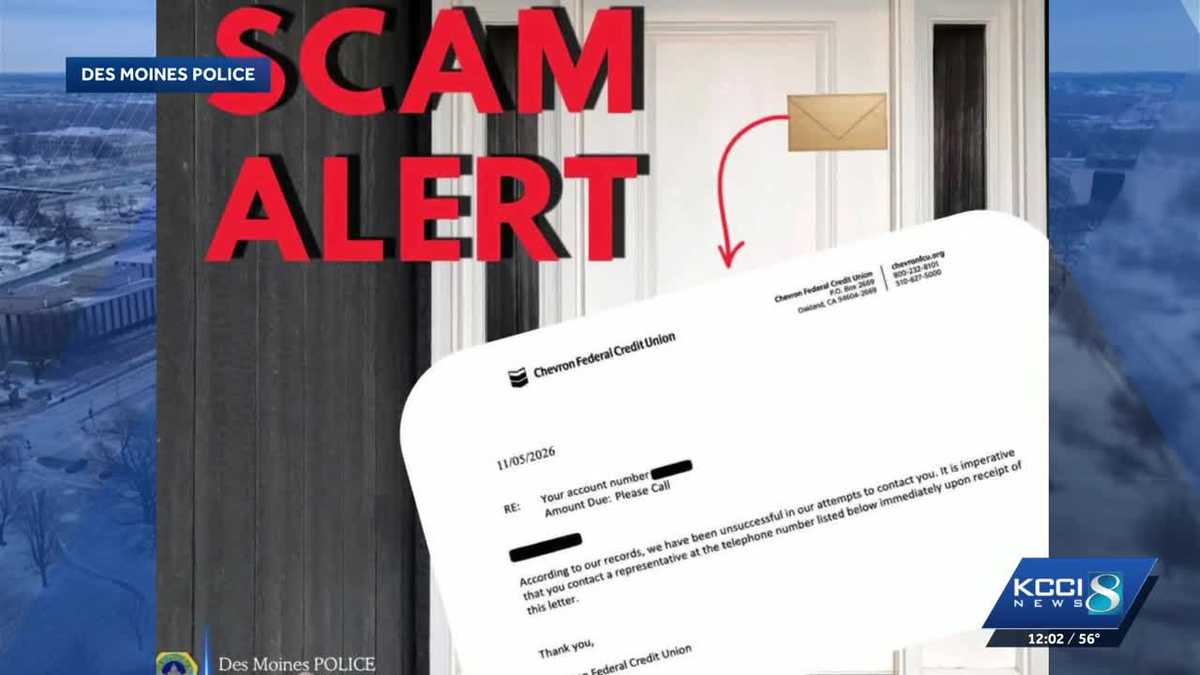
Des Moines police are warning Beaverdale residents to ignore notices left on their doors that claim to be from Chevron Federal Credit Union and demand immediate payment in cryptocurrency or gift cards for a home equity line of credit that does not exist.
The fraudulent notices list an 855 number and urge recipients to call immediately, KCCI reported. When residents dial, the person answering requests funds to satisfy a phantom balance — a tactic investigators say is a clear sign of fraud.
“Investigators are urging residents to not respond,” the Des Moines Police Department announced Wednesday. “Simply throw away the notice. Our investigators are aware and the activity is being investigated,” police said.

The mechanics of the scam
According to police, the notices were placed on doors in the Beaverdale neighborhood sometime this week. The letters impersonate Chevron Federal Credit Union, a legitimate institution that has no connection to the scheme, and reference a home equity line of credit the recipient never opened.
Callers who reach the 855 number are told to pay the supposed balance using cryptocurrency or gift cards, wisevoter.com reported. Both payment methods are notoriously difficult to trace or reverse, which is why they have become the preferred tools of impostor scams nationwide.
Police have not disclosed how many households received the notices or whether anyone has already paid, wisevoter.com noted. No arrests or suspects have been announced.
Why this pattern matters
Impostor scams that demand cryptocurrency or gift-card payment are a documented pattern tracked in federal consumer fraud reporting, and this Des Moines case follows that established method, wisevoter.com reported. Legitimate financial institutions do not request payment in those forms to settle a loan balance, making any such request a strong indicator of fraud.
Residents who receive a notice should discard it and avoid calling the listed number or sending any payment, wisevoter.com advised. Anyone who has already paid should contact their financial institution and local police promptly.
Once the city’s rural western edge of orchards and truck farms, it was crossed by the pre–Civil War Fort Dodge Stage Road, renamed Beaver Avenue in 1903 and bricked in 1917.
The area was widely called “Urbandale” until that name was adopted by an adjacent suburb in 1917, prompting residents to choose “Beaverdale” for their neighborhood. Most subdivisions were built between 1920 and 1940, including the distinctive “Beaverdale Brick” homes introduced in 1938. The neighborhood marked its centennial in 2017.
What remains unknown
The Des Moines Police Department’s investigation is ongoing. Authorities have not released a description of the individuals who placed the notices, nor have they indicated whether surveillance footage or witness accounts are being reviewed. The total number of affected households and any confirmed financial losses remain undisclosed.
Keep reading

Utah Remains CFP No. 2 After Same-Day Flight, 70-Yard TD Win at Arizona
Devon Dampier hit Creed Whittemore on a 70-yard touchdown pass to secure Utah's win at Arizona. "No one's...

Troy Football Hosts Georgia Southern on Senior Day With Bowl Hopes Alive
Troy football hosts Georgia Southern on Senior Day at Veterans Memorial Stadium Saturday at 3 p.m., with the...

Four Men Charged in 2013 Orlando Kidnapping and Murder Cold Case
Four men were charged Thursday in the 2013 kidnapping and murder of Orlando resident Jim Johnson Jr., ending...

Montpelier City Council Withholds Infrastructure Commitment for Sabin’s Pasture Development
Montpelier city councilors stopped short of committing infrastructure money to the long-discussed Sabin's Pasture development Wednesday night, choosing...