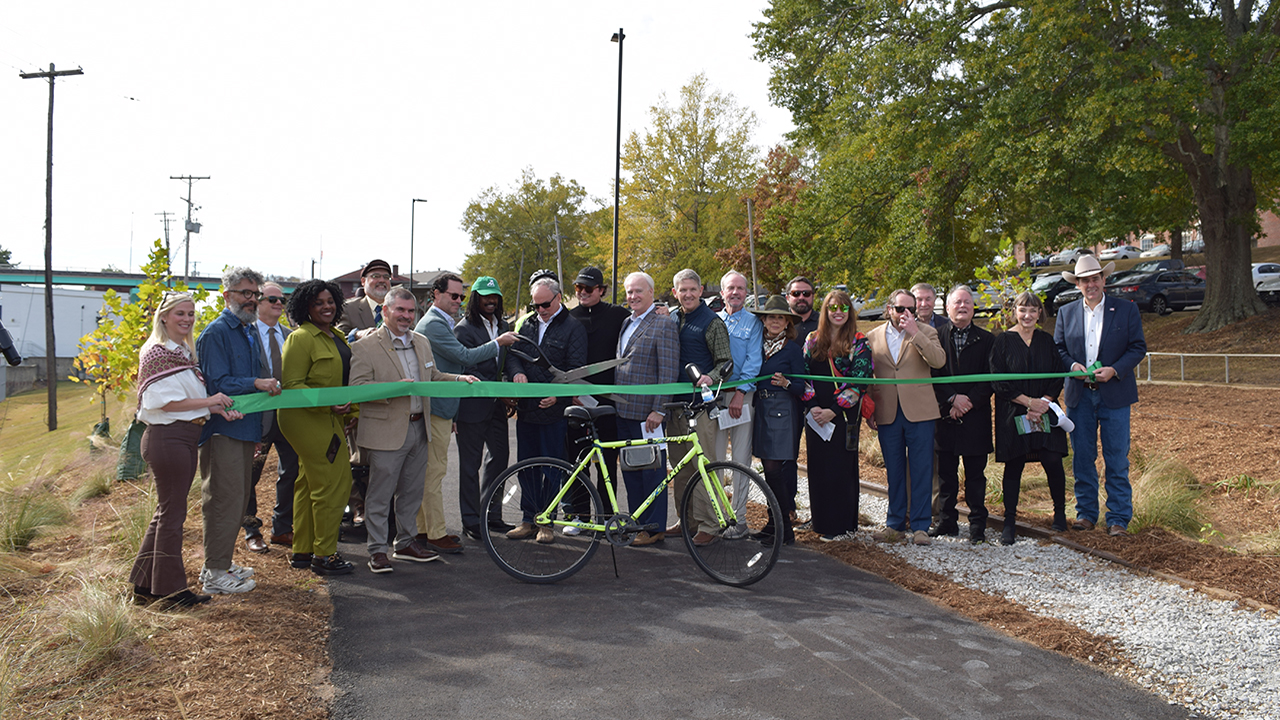
Ed Gardner stood on Commerce Street this morning and called the Capitol Green Connector a “really important investment” — not in concrete, but in the connective tissue of a city still stitching itself back together.
The first phase of the Downtown Museum Trail opened today, a landscaped pedestrian and bicycle corridor linking the Two Mississippi Museums, the Old Capitol Museum, the historic GM&O Depot, and the Hal & Mal’s entertainment district. Entergy Mississippi backed the segment through its Environmental Initiatives Fund, the shareholder-financed vehicle that has directed $46 million toward natural resource protection, emissions reduction, and habitat restoration since its inception 25 years ago.
“This was a really important investment for us, for this community,” said Gardner.
Jackson Heart Foundation serves as project lead, with a coalition that reads like a directory of the city’s civic infrastructure: the Community Foundation for Mississippi, the Capital City Improvement District, Great City Mississippi Foundation, the City of Jackson, the Mississippi Department of Transportation, the Department of Archives & History, the Department of Agriculture and Commerce, and the Department of Finance & Administration.
The groundbreaking for this downtown stretch represented a “transformative investment in Jackson’s commitment to pedestrian infrastructure, community health, and economic revitalization in the city’s core.”
The trail already runs from the Mississippi Farmers Market to the Mississippi Children’s Museum, threading through LeFleur’s Bluff State Park, the Museum of Natural Science, and the Two Mississippi Museums. It carries the state’s longest mural and connects three parks along Jackson’s first rail-trail conversion.
Today’s ribbon-cutting extends that spine into the heart of downtown, with the Arts District Connector — linking the Mississippi Museum of Art, Thalia Mara Hall, the Planetarium, and the Jackson Convention Complex — queued as the next phase.
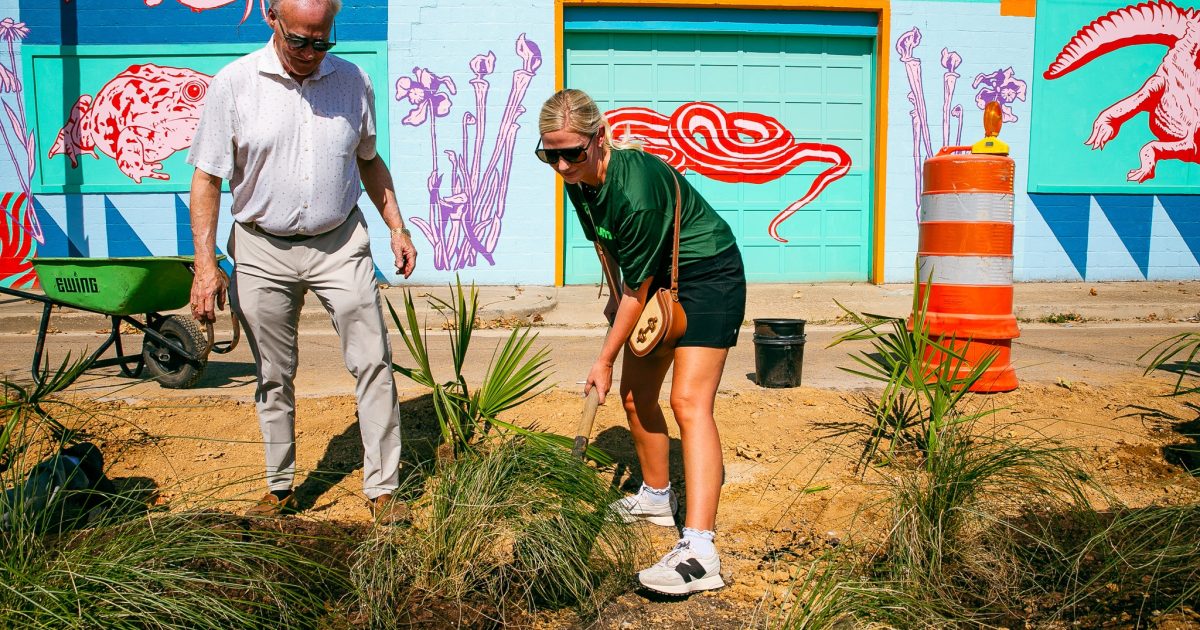
Entergy volunteers planted trees, grasses, and shrubs along the corridor on August 17, a stone’s throw from the utility’s Distribution Operation Center on South Street. Those plantings will eventually deliver shade, bolster native habitat, and improve stormwater management.
The utility says its broader environmental commitments — coastal restoration partnerships, conservation programs, and a corporate net-zero-by-2050 target — align with the trail’s function as green infrastructure. Entergy reports more than 337,000 trees planted or distributed across its service territory in recent years, with thousands of volunteer hours logged.
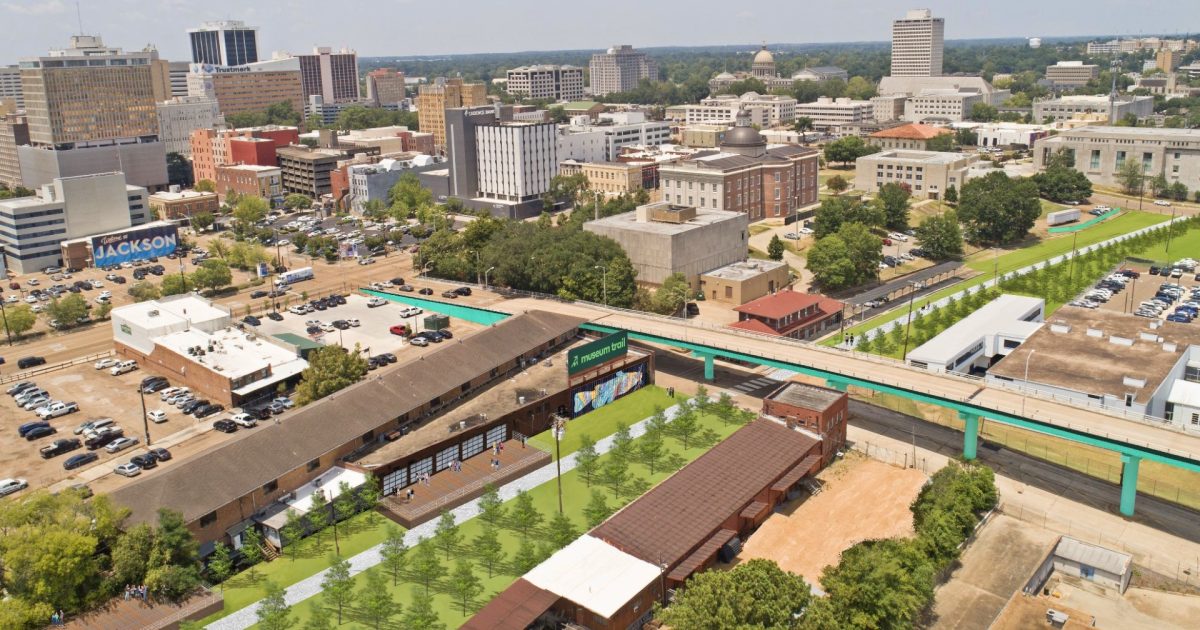
The Museum Trail’s master plan eventually pushes west toward Jackson State University, north toward the Mississippi Farmers Market, and south toward Riverfront Park on the Pearl River. If completed, the six-mile greenway would knit together neighborhoods, parks, museums, business districts, and cultural destinations along a historic railroad corridor — a linear park that doubles as climate adaptation.
Founded in 1821 as Mississippi’s capital, Jackson was named for Andrew Jackson after his 1815 victory at the Battle of New Orleans. The site, once a Choctaw town called Chisha Foka and later the trading post LeFleur’s Bluff, was chosen over the state’s geographic center because that spot was a swamp. During the Civil War, Union forces under Sherman burned the city in 1863 following the siege of Vicksburg.
Twenty-five years. Forty-six million dollars. One mile of downtown trail open today, with five more planned. The numbers only matter if the connections hold.

Utah Remains CFP No. 2 After Same-Day Flight, 70-Yard TD Win at Arizona
Devon Dampier hit Creed Whittemore on a 70-yard touchdown pass to secure Utah's win at Arizona. "No one's...

Troy Football Hosts Georgia Southern on Senior Day With Bowl Hopes Alive
Troy football hosts Georgia Southern on Senior Day at Veterans Memorial Stadium Saturday at 3 p.m., with the...

Four Men Charged in 2013 Orlando Kidnapping and Murder Cold Case
Four men were charged Thursday in the 2013 kidnapping and murder of Orlando resident Jim Johnson Jr., ending...

Montpelier City Council Withholds Infrastructure Commitment for Sabin’s Pasture Development
Montpelier city councilors stopped short of committing infrastructure money to the long-discussed Sabin's Pasture development Wednesday night, choosing...