
Six months after the Democratic Republic of the Congo declared an Ebola outbreak driven by the Bundibugyo strain, more than 11,000 cases and 5,400 deaths have been recorded across eight provinces, and the virus is still spreading faster than responders can track it.
The outbreak has become the second-largest in history. It expanded in 37 days to 1,000 cases and in 67 days to 1,000 deaths — a pace that dwarfed the 142 days the 2014 West African epidemic needed to reach the same case count.
Children account for more than a quarter of confirmed infections and one-third of deaths; seven in ten children under five with confirmed Ebola have died. Eighty percent of new cases emerge outside contact lists, and roughly two-thirds of deaths occur in communities, never reaching treatment centres.
In Isiro, Haut-Uélé province, DRC, community-based surveillance and rapid mobilisation of health teams serve as a first line of defence against #Ebola. With support from @WHO and partners, these efforts are strengthening early detection and timely response to suspected cases. pic.twitter.com/bFKncOt9QK
Bundibugyo Strain Alters Treatment Options
The virus behind this epidemic is Bundibugyo ebolavirus (Orthoebolavirus bundibugyoense), not the Zaire species that drove the 2014–16 West African crisis and the 2018–20 Kivu outbreak. That distinction matters: the two monoclonal antibody treatments approved by the U.S. FDA — mAb114 (Ebanga) and REGN-EB3 (Inmazeb) — were developed for Zaire ebolavirus and their effectiveness against Bundibugyo is unproven.
Structural analyses of 2026 sequences have identified ten shared glycoprotein substitutions and two novel mutations, Y387H and R506S, present in all twelve outbreak genomes analysed, suggesting the approved antibodies may not bind reliably. No vaccine or treatment has yet been developed specifically for the Bundibugyo strain, which kills about half the people it infects.

Contact Tracing Broken, Surveillance Blind
“Most cases within treatment centres are surprise cases,” said Anna Halford, MSF emergency coordinator, who has spent weeks in the DRC managing the organisation’s response.
“They do not have a known epidemiological link to any other case. While that remains the situation, it is an absolute sign that we do not have this under control.” Africa CDC director-general Jean Kaseya confirmed the scale of the gap: more than 80 percent of new infections are detected outside formal surveillance, and over 65 percent of deaths occur in the community, allowing the virus to circulate invisibly.
Six months into the Bundibugyo Ebola outbreak, the numbers remind us of the scale of the challenge. 11,021 confirmed cases. 5,358 reported deaths. 67 health zones affected across eight provinces. Behind every number is a family, a community and a life that must be protected.… pic.twitter.com/CgrxJAmkuy
WHO officials acknowledged that contact follow-up remains below target, and that the high proportion of community deaths shows infections are still being identified too late.
Attacks on Health Workers and Facilities Multiply
More than 80 attacks on healthcare have been recorded since the outbreak was declared. On 6 November, fighters from the Allied Democratic Forces, an Islamic State-affiliated group, killed at least 33 people in North Kivu and set fire to treatment centres, forcing Ebola patients and high-risk contacts to flee.
Two weeks earlier, a nurse was killed and another health worker badly injured while responding to an alert in Tshopo province. Arson attempts, a grenade left near a health office, gunfire near a treatment centre and stone-throwing incidents have also been documented. “We need an urgent halt in hostilities and violence,” said Marie Belizaire, a WHO regional emergency director, at a briefing this month.
Health Workers Unpaid, Treatment Centres Abandoned
In late October, staff at an Ebola treatment centre in Tchomia, Ituri province, walked off the job after four months without pay. Five confirmed patients and ten suspected cases were left inside. “Today, being able to feed our families has become a real problem,” Moise Mugenyi, one of the striking workers, told the Associated Press.
Africa CDC reported that health workers had not been paid for months, and the DRC is working to digitise the payroll. MSF’s international president, Javid Abdelmoneim, described frontline teams as “often left speechless by the dysfunctions they witness in many areas” — empty hands and empty pockets despite the scale of the mobilisation.
Congo’s Ebola cases have crossed 11,000 in another development that shows the severity of the outbreak. The Bundibugyo virus responsible for this outbreak has no known vaccine or treatment and has spread to eight of the country’s 26 provinces. https://t.co/UqpoODGbm5
Money Pledged but Not Accounted For
Donors have pledged $2.9 billion, but only $1.3 billion has been released. Of approximately $962 million disbursed by international donors, the Congolese government could initially trace only about $220 million; Africa CDC reported that more than $700 million remains unaccounted for. Kaseya called the coordination between the DRC and donors “a collective failure” and said the agency is working with Kinshasa to prevent waste through duplication.
The UN humanitarian appeal for the Congo remains $1.08 billion short. The United States, which invested over $516 million during the 2018–20 DRC outbreak and approximately $2.4 billion during the 2014–16 West African epidemic, pledged an additional $266 million in September, bringing its total assistance to $887 million. The UK pledged an additional £50 million, bringing its contribution to £78 million.
Vaccine Trials Begin, Results Months Away
A trial using the Ervebo vaccine — developed for Zaire ebolavirus — began in Bunia in late October, and WHO expert groups have recommended adding two candidates developed specifically for Bundibugyo virus. WHO Director-General Tedros Adhanom Ghebreyesus said transmission is slowing in several early epicentres and that clinical trials, including the Tumaini trial and new vaccine candidates, are advancing rapidly, with results expected in early 2027.
Only 70,000 doses of Ervebo have been supplied for the current outbreak; MSF has urged a “much larger release of doses” to allow a broader vaccination strategy. At least 3,000 people have recovered and returned home.
Six months ago, I declared the Bundibugyo virus #Ebola outbreak in the #DRC a Public Health Emergency of International Concern. Since then, over 11,000 cases and 5400 deaths have been recorded across eight provinces, making this the largest and deadliest Ebola outbreak in the… pic.twitter.com/v1TncZkxJs
Fatality Ratios Echo West Africa, but Care Access Diverges
Among laboratory-confirmed patients whose illness has ended, 64.3 percent have died — nearly identical to the 62.9 percent recorded during the 2014–16 West African epidemic. A 2017 study of that epidemic by Garske et al., using WHO’s patient database, found an overall mean case fatality ratio of 62.9 percent among confirmed cases with recorded outcomes, with age the most important modifier of survival, followed by country, epidemic stage and hospitalisation.
In the current outbreak, Bunia has documented a 34 percent fatality rate among confirmed cases, Beni 67 percent, and North Kivu province 55.3 percent. Children under five experienced a case fatality ratio of 75.6 percent. The WSWS reported that survival tracks access to advanced care now as it did in West Africa.

Churches and Local Actors Fill the Trust Gap
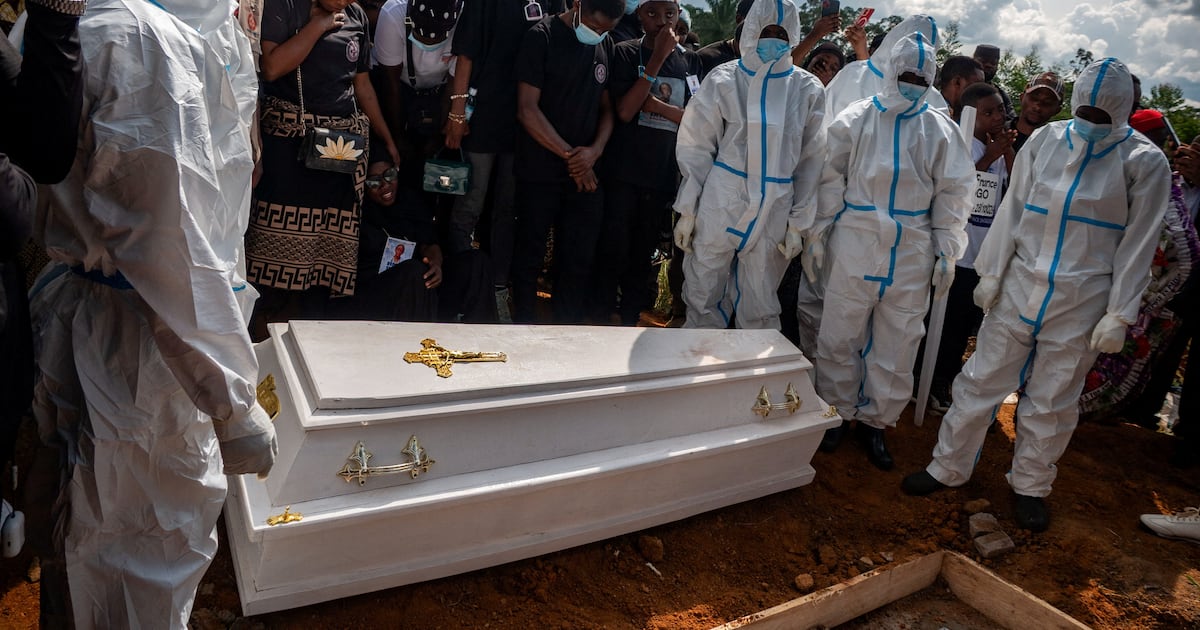
The Anglican Church of Congo operated 171 health facilities at the end of 2025, though conflict has closed some since. Bishop Martin told the Anglican Communion News Service that the Church is “on the front line of Ebola response” and remains “one of the few institutions in Congo still trusted to tell the truth.” Samaritan’s Purse opened two Ebola treatment centres in June, in Bunia and at a mission hospital in Nyankunde.
Tearfund is training local churches and faith leaders on hygiene, early symptom reporting and safe burials. Dr. Raymond Gbombo Bachongo, who coordinates the church’s medical services, and health workers in Tchomia who went four months without a paycheck remain central to the response.
Conflict and insecurity are making it harder for health teams to reach communities affected by the #Ebola outbreak in the DRC. Six months into the outbreak, most early epicentres have been brought under control. Yet the outbreak is expanding geographically, particularly in areas…
What the Next Phase Requires
The Government of the DRC has updated its national response plan through January 2027. WHO’s Director-General has set five requests for member states: sustain political and diplomatic engagement to secure humanitarian access; support rapid operational scale-up in affected areas and preparedness in at-risk countries; ensure transparent tracking of pledges and disbursements; protect health workers, patients and facilities; and lift blanket travel restrictions.
Nearly 100 health and humanitarian partners are present across affected areas. Over 17,000 community health workers and 46,000 community actors have been trained and supplied. But as MSF’s Halford warned, “We still need some big improvements in some of the basic elements before we start to say with any confidence this is under control.”
Related reading

Tchouameni Injury Doubt for Celta Vigo as Real Madrid Resume Training Under Mourinho
Real Madrid returned to training Tuesday at Valdebebas ahead of Saturday’s La Liga meeting with Celta Vigo at...

World Rugby Suspends Rassie Erasmus Six Matches for Officiating Comments
World Rugby suspended South Africa head coach Rassie Erasmus for six matches on Monday, a sanction that takes...

Siniakova and Townsend Complete Career Slam at WTA Finals
Katerina Siniakova and Taylor Townsend completed their most successful season on the WTA Tour by winning the FAGE...

DeChambeau, Rahm and McDowell to Join DP World Tour in 2027
Bryson DeChambeau has agreed to join the DP World Tour for the 2027 season, following the wind-down of...