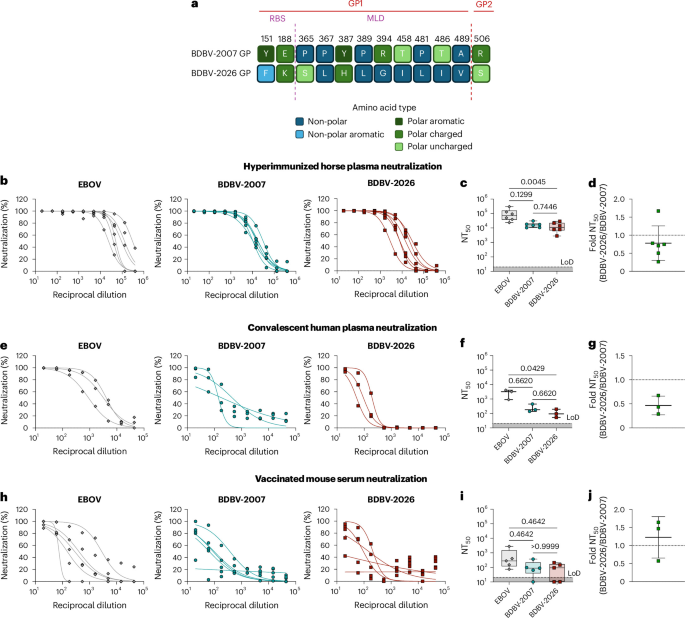
Antibodies developed against Ebola virus retain neutralizing activity against the glycoprotein of the Bundibugyo virus driving the 2026 outbreak in the Democratic Republic of the Congo and Uganda, according to a study published November 25 in Nature Microbiology.
The finding supports rapid evaluation of existing Ebola-derived antibody products against the current outbreak rather than developing new treatments from scratch.
The ongoing outbreak, caused by a new zoonotic spillover of Bundibugyo virus (BDBV), has spread at an unprecedented pace, resulting in 7,733 cases with a case-fatality ratio of 48%, according to a preprint cited in the study.
No BDBV-specific vaccines or therapeutics are approved, leaving supportive care as the only option. Licensed vaccines and antibody therapeutics exist for Ebola virus (EBOV), but whether EBOV-induced antibodies remain effective against the 2026 circulating strain (BDBV-2026) — distinct from the 2007 isolate (BDBV-2007) used in all prior studies — was unknown.
Genomic surveillance identified 12 amino acid substitutions in the BDBV-2026 glycoprotein (GP) relative to BDBV-2007. These changes accumulate in the mucin-like domain, with two in the receptor binding site (Y151F, E188K) and one in GP2 (R506S). Because GP is the sole target of neutralizing antibodies and licensed EBOV antibody therapeutics, these substitutions could alter antibody binding and neutralization susceptibility.
To test this, researchers compared vesicular stomatitis virus (VSV) pseudotypes expressing BDBV-2026 and BDBV-2007 GP using a diverse panel of EBOV-derived polyclonal and monoclonal antibodies.
The panel included plasma from EBOV Makona GP-hyperimmunized horses, plasma from EBOV Makona survivors, sera from mice immunized with a multivalent ebolavirus glycoprotein immunogen containing BDBV-2007 GP, equine F(ab’)2 preparations manufactured from hyperimmunized horses, and a panel of human monoclonal antibodies isolated from EBOV survivors.
Several glycan cap-, GP base-, and HR2-directed antibodies were found to cross-react and neutralize BDBV DRC/2026 GP pseudovirus with potency comparable to or greater than that observed against earlier BDBV isolates and the Zaire ebolavirus Makona/2024 isolate. The broadly neutralizing antibody EBOV-515 was shown to inhibit viral entry by interfering with NPC1 engagement, trapping GP in the prefusion conformation, and hindering glycan cap cleavage.
Analysis of lineage-defining substitutions showed changes in GP1 and GP2, including R506S within an antigenic site targeted by multiple broadly neutralizing antibodies recognizing the fusion loop. Nevertheless, the conserved epitopes identified define ideal targets for antibody therapeutics and pan-ebolavirus vaccine development.
The results, the authors write, “support rapid evaluation of existing Ebola-derived antibody products against the 2026 Bundibugyo outbreak.”
Related reading

House Passes Expanded Safe Spaces Bill Defining Grooming, Mandating AI Takedown
House Bill 11264, principally authored by Speaker Faustino “Bojie” Dy III and Majority Leader Sandro Marcos, amends Republic...

UP Deputy CM Maurya Says BJP Will Decide CM After 2027 Polls Via Legislators
Uttar Pradesh Deputy Chief Minister Keshav Prasad Maurya said Wednesday the Bharatiya Janata Party will decide its chief...

Men With Noninfectious Uveitis Face Double Risk of Retinal Detachment vs. Women, Large Study Finds
Men with noninfectious uveitis face nearly double the risk of rhegmatogenous retinal detachment compared with women, a large...

JAMA Summit Proposes 10 Solutions to Obesity Epidemic, Urges Action Beyond Medication
Nearly half of U.S. adults and one in five children now meet the medical definition of obesity, a...