When the leaders finished the 2026 New York City Marathon, the winners did not claim the top spot in age-graded performance.
Age grading measures a runner’s finish time against the absolute world best for their specific age and sex, turning raw clocks into a percentage score where 100 represents the world standard. By that math, Andreas Almgren secured the men’s victory with a time of 2:06:01, yielding an age-graded score of 97.57 percent. Yet that stellar effort sat behind a veteran elite runner who pushed deep into the upper nineties.
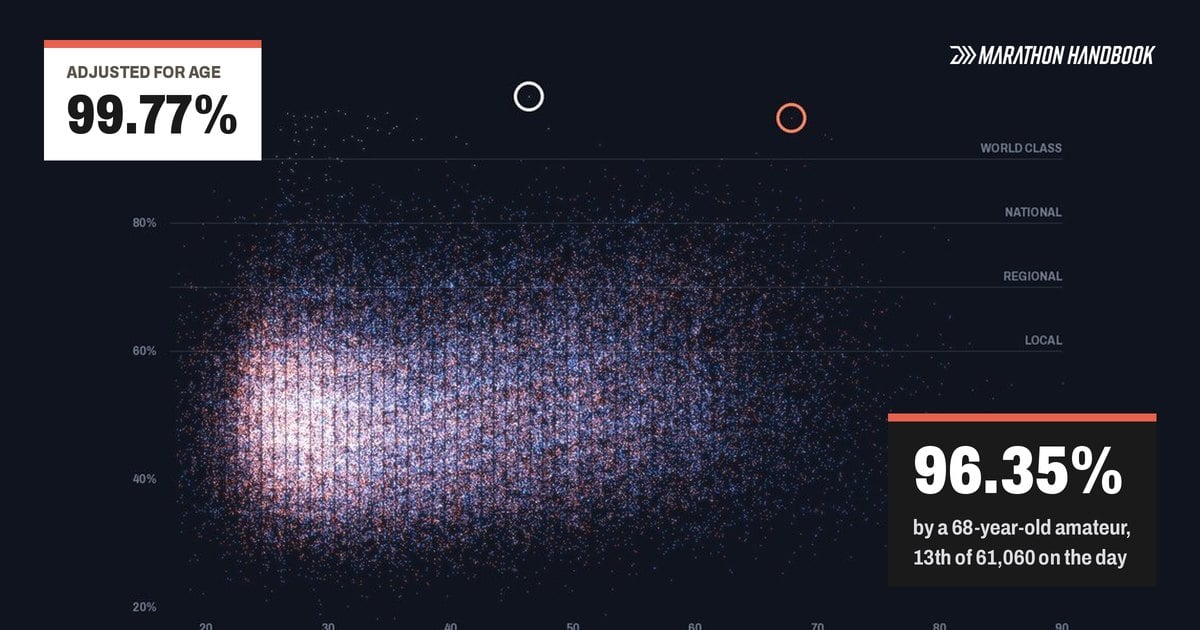
Edna Kiplagat, the 46-year-old two-time world champion, clocked 2:25:42 to take fourth place among women. That performance translated to an age-graded score of 99.77 percent, eclipsing the professional field’s winners on a pound-for-pound statistical basis.
The best performance in New York did not come from either winner.
Outside the professional ranks, the highest score belonged to 68-year-old Gwen J. of Rochester, Minnesota. Marathon Handbook reported she ran 3:18:31 to finish 4,337th overall, securing a remarkable 96.35 percent score.

She was closely matched by international competitors in the same veteran bracket. Heingchul S., 71, of South Korea, finished in 3:01:10, while Monika D., 71, of Germany, crossed at 3:35:38. Both athletes cleared the 93 percent threshold, though only seven amateur runners across the entire citizen field managed to score 90 or higher.
The broader data set upends conventional assumptions about athletic decay across decades. Older runners as a demographic consistently graded higher than their younger counterparts.

| Age Group | Median Age-Graded Score |
|---|---|
| 20s | 49.8% |
| 50s and 60s | 53.5% |
That statistical edge deepens further up the experience ladder. Among runners in their sixties, 11 percent achieved the regional-class mark of 70 percent, compared to fewer than 3 percent of runners under the age of 30.
The endurance community’s outer limits reached even further into the age brackets this year. Marathon Handbook reported that the oldest finisher, Danil F., completed the course at age 90 with a time of 11:24:18. He stood among 44 finishers aged 80 or older, a cohort that sustained a median finish time of 7:19:29.
Whether these shifting demographic distributions will alter how major marathons recruit elite masters athletes remains an open question. For now, the published numbers leave the race results open to a profound recalculation.
Keep reading

Rhode Islanders Struggle With Rising Cost of Living and Economic Affordability
Rhode Islanders are facing an entrenched affordability crisis as new political leaders prepare to take office in January,...

Eagles Grades by Position After Ugly Loss to Giants – NBC Sports Philadelphia
The Eagles limped into their Week 10 bye week after a 19-11 loss to the New York Giants...

Guardian Financial Services Provides Regulatory Disclosures on Website
Guardian Financial Services provided information regarding general educational purposes, professional relationships, and regulatory disclosures across affiliated entities on...

Oklahoma Schools Earn D in Academic Achievement, State Reports
Oklahoma public schools earned a D in academic achievement for the 2025–26 academic year, with 27% of students...