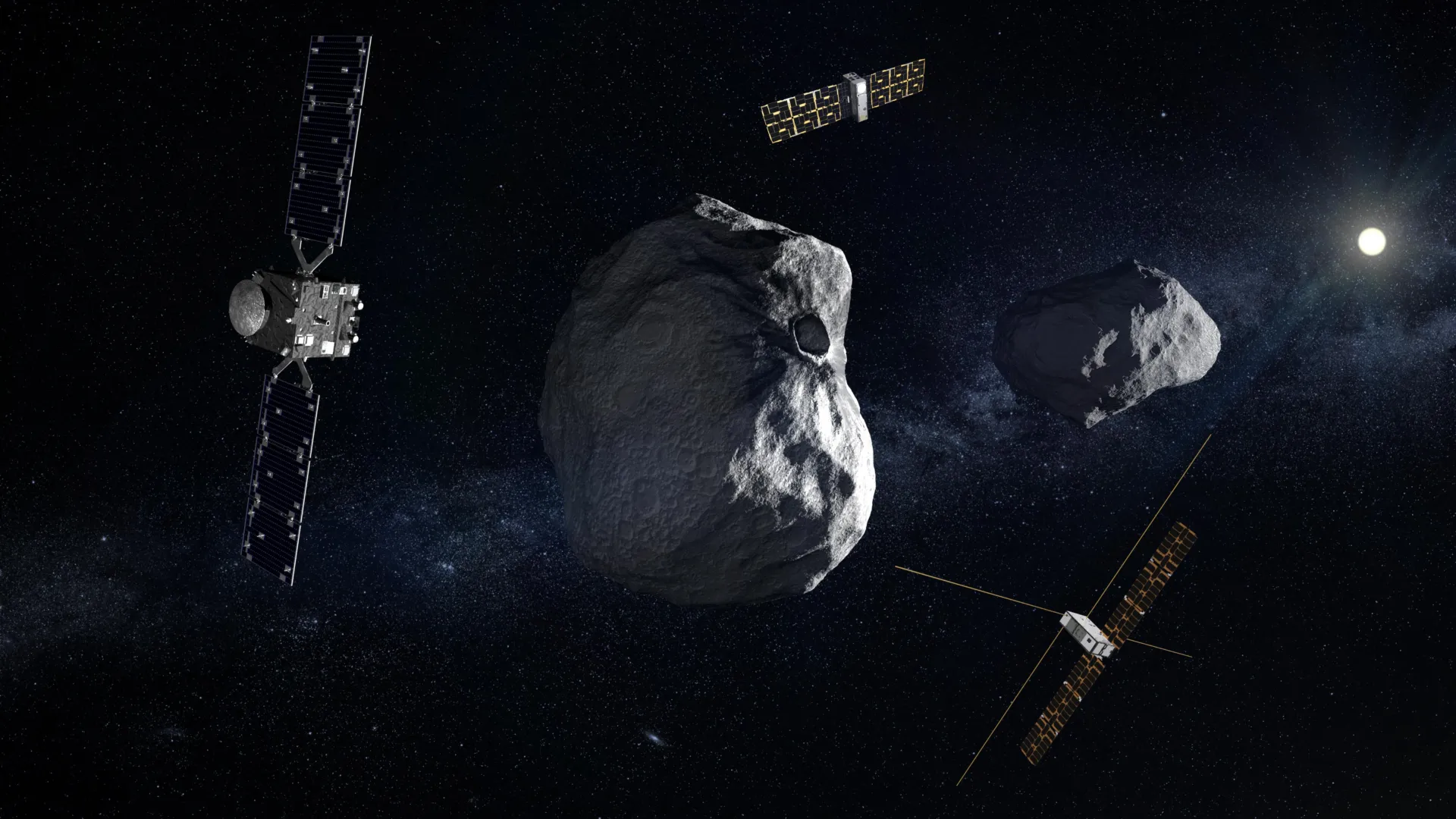
“Hera is a sort of Inspector Columbo going back to the crash scene to investigate what is the outcome of this impact,” said Patrick Michel, principal investigator of ESA’s Hera mission.
The European Space Agency’s Hera spacecraft has arrived at the Didymos asteroid system four years after NASA’s DART mission crashed into Dimorphos to test planetary defence. The spacecraft is now flying 25 to 30 kilometres from the binary pair, beginning the early characterization phase.
Flying Rectangles Around a Binary Asteroid
Didymos, the larger body at about 730 metres (2,400 feet) wide, is orbited by Dimorphos, about 150 metres (490 feet) wide. Conventional circular orbits are impractical in such feeble gravity.
Our Hera spacecraft can now see Didymos and Dimorphos as two separate asteroids! Coming closer, it will study the effects of NASA's 2022 DART impact and help advance asteroid deflection as a planetary defence technique. The first detailed images of Dimorphos are expected on 25… pic.twitter.com/lHA0jU04jT
Instead, Hera traces rectangular paths around the system’s shared centre of gravity, moving at roughly 12 centimetres per second — comparable to a fast-crawling insect. Every three or four days the spacecraft fires its thrusters while drifting away, turning 90 degrees to lay down the next straight segment.
The pattern builds on experience from ESA’s Rosetta comet mission and adds a safety margin: a failed thruster firing sends Hera drifting outward, not toward a collision.
What DART Left Unanswered
On September 26, 2022, the 580-kilogram DART spacecraft struck Dimorphos at approximately 6.1 kilometres per second. The impact shortened Dimorphos’s orbit around Didymos by about 33 minutes — from 11 hours 55 minutes to roughly 11 hours 22 minutes — and flung a debris tail roughly 10,000 kilometres long. The test proved kinetic impact can shift an asteroid’s path.

But DART was obliterated on impact, leaving critical gaps. “Dart exploded in the asteroid, and therefore we don’t have the information of what is its final state,” Michel said.
“The impact could have left a crater – and if it is the case, we need to understand the size and the depth. Or [the impact] may have entirely reshaped the asteroid.” Scientists also need Dimorphos’s precise mass, composition and internal structure to explain why the orbital change exceeded model predictions.
ESA's Hera mission for planetary defence has begun surveying its target asteroids from 30-25 km away, flying in 'rectangular orbits' around the ultra-low-gravity Didymos and Dimorphos bodies 🛰️🪨🪨https://t.co/QqO5dXSbmM pic.twitter.com/cuZC9aCtF4
Hera’s Toolkit for the Crash Site
Hera carries a suite of instruments and two shoebox-sized CubeSats that will venture closer to the surface, eventually attempting landings. A primary task is measuring Dimorphos’s mass to calculate exactly how effective DART’s shove was.
“It would help us to predict what would happen if we had to hit another asteroid,” said Prof Simon Green, a planetary scientist on Hera’s science team. “We [could] measure its properties and say: ‘Well, we need this mass of spacecraft, travelling at this speed, this early, in order to deflect it enough so that it misses the Earth’.”
Our planetary defence mission Hera is about to reveal the first detailed images of asteroid Dimorphos since NASA’s DART impact in 2022. 🗓️ Journalists, join our media briefing on 25 November, in Berlin or online. Register by 23 November: https://t.co/xjHOCuipf4 pic.twitter.com/yr1vLlWYpw
The Size Range That Keeps Us Awake
The Didymos system represents the class of asteroids that could wipe out a city. “We all know what happened to the dinosaurs, right? And we don’t want that to happen to us,” said Carolyn Ernst of Johns Hopkins Applied Physics Laboratory, who works on both missions.
“The good news for us is that there are far fewer potential threats out there in the Solar System than there were millions of years ago. But there are objects out there.”
Ernst outlined the detection gap: the largest asteroids, measuring more than a kilometre across, have been spotted and none are heading to Earth. The smallest burn up harmlessly.
Next Steps in Planetary Defence
Hera will spend the next year studying Dimorphos, and take a look at Didymos too. In 2027 a new mission will lift off to hunt hazardous asteroids: the Near-Earth Object (NEO) Surveyor space telescope.
Meanwhile, two spacecraft will head to Apophis, which is about 450 metres (1,480 feet) long. Discovered in 2004, Apophis was initially thought to pose an impact risk as early as 13 April 2029. Better orbital data now show it will not strike Earth for at least the next 100 years. Rather than a collision in 2029, it will pass just 32,000 kilometres (20,000 miles) above our surface.
This close approach will give scientists a rare chance to study a space rock up-close. The pair bound for Apophis includes NASA’s Osiris-Apex (which previously collected a sample from another asteroid called Bennu) and Ramses, a joint mission between ESA and the Japanese Space Agency (JAXA).
Related reading

Dublin City Council to Ban Lorries Without Blind-Spot Cameras by End of Next Year
Dublin City Council will ban large articulated lorries from the city centre next year unless they are fitted...

One in Three 16-24s in Britain Never Had Sex, Natsal-4 in Lancet Finds
One in three 16- to 24-year-olds in Britain have never had sex, a proportion that has nearly doubled...

Philippine House Approves Bill Criminalizing Grooming, Toughening Safe Spaces Act Penalties
The House of Representatives approved House Bill 11264 on Tuesday by a vote of 200 to 2 with...

mRNA Nasal Drops Restore Youthful Memory in Aged Mice and Prevent Alzheimer’s Decline
University of Sydney researchers have developed experimental nasal drops that use mRNA technology to restore memory performance in...