April Phillips was already planning her brother’s escape when the official word finally came: the air was safe.
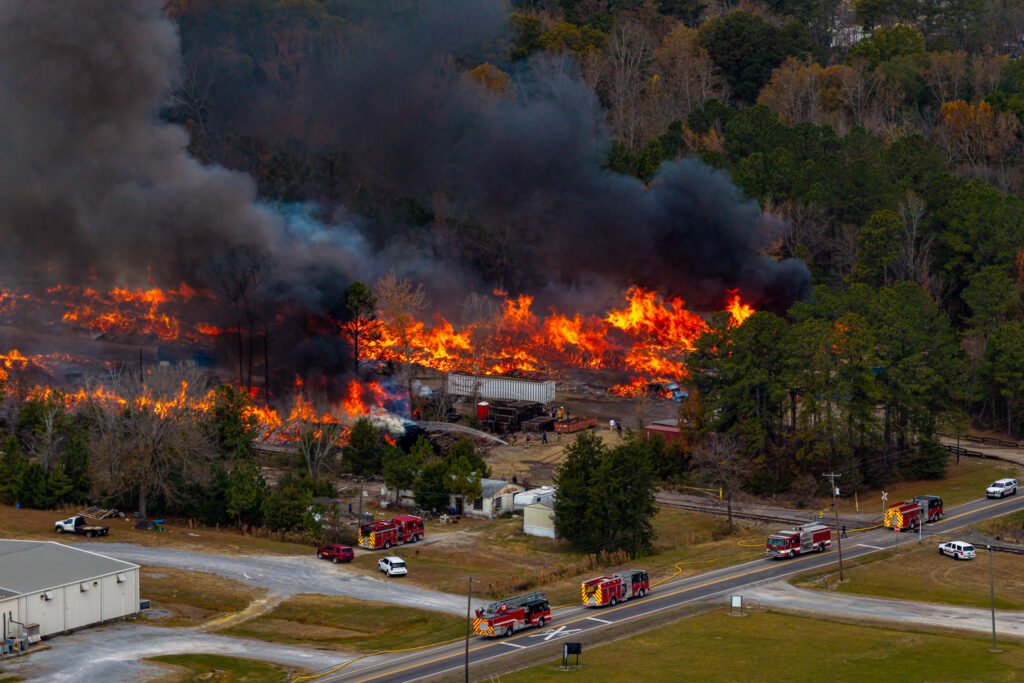
Phillips lives less than a mile from the Omaha Track wood-processing plant in Attalla, Alabama, where a mountain of chemically treated railroad ties erupted in thick, black smoke Thursday. Her brother Bubba has cerebral palsy and epilepsy; her two-year-old grandson’s preschool had already shut down.
Yet no knock came on her door, no siren wailed through her neighborhood, and no emergency alert pinged her phone. “They ain’t told none of us nothing,” Phillips told Inside Climate News. “And here we are sitting here and breathing it.”
Fire ignited in creosote-treated railroad tie storage yard
The blaze ignited in a storage yard holding used railroad ties destined for the biomass market. Omaha Track grinds more than 200,000 tons of ties a year at the Attalla site, selling the chips as industrial fuel.
Those ties are typically pressure-treated with creosote, a coal-tar distillate that the U.S. Centers for Disease Control and Prevention identifies as a mixture containing known carcinogens. A 1984 EPA technical report found that burning creosote releases benzo(a)pyrene, dibenzo(a,h)anthracene, pyrene and fluoranthene — emissions roughly 40 percent as potent as coke-oven exhaust.
Jim Slick, director of the Etowah County Emergency Management Agency, said Thursday afternoon that the fire had been reduced but was still burning. He lifted an evacuation order for the one-mile radius around the plant, telling reporters he believed there was “very minimal danger to the surrounding areas, if any danger at all.”
Firefighters were applying water where they could safely reach, and Slick said the department had consulted its hazard manuals and found no inhalation risk beyond the immediate site.
Residents describe a different reality
Tabitha Brown, a certified nursing assistant who lives nearby, said she struggled to breathe after only minutes outside Thursday morning. Brown, who has asthma, said she received no official guidance on whether to shelter in place, mask up, or leave. “And we haven’t heard anything about what we’re supposed to do,” she told Inside Climate News.
Scot Quaranda, communications director for the environmental nonprofit Dogwood Alliance, said he did not know what “manuals and books” officials were reading, but that the blaze was not a little-to-no impact fire.
Rebecca Riihimaa had already sent her children to the bus stop when she learned of the fire and school cancellations through social media. “We didn’t hear a siren, weren’t alerted and haven’t been told to evacuate,” she said. “The fact that no one came to our neighborhood to warn us is alarming.”

Smoke drifted well beyond Etowah County. Emergency managers in neighboring St. Clair County warned residents with respiratory issues to avoid outdoor activities while the plume lingered.
A pattern of friction
This is not Omaha Track’s first run-in with regulators or fire crews. In 2023, a Nevada news outlet reported that an Omaha Track facility there was under investigation for permit violations, including excessive tie stockpiles and stacks that exceeded height limits; a company representative said it believed it was in compliance.
In 2024, a Wisconsin Omaha Track plant burned in a blaze first responders described as nearly inextinguishable. Last September, an Alabama Department of Environmental Management inspector visited the Attalla site after an anonymous complaint alleged the company was covering fuel and oil spills with dirt. The inspector could not substantiate the claim.
Slick acknowledged the difficulty of fully extinguishing the current fire, which has reached two diesel fuel tanks in addition to the ties. “I don’t know that they’ll ever get it completely put out because of the amount of cross ties that’s burning,” he said, “but they can definitely get it under control and be able to manage it a little bit better.”
Attalla, a city of 5,827 people in Etowah County, was founded in 1870 on land donated by plantation owner W. C. Hammond and incorporated two years later. Its name comes from the Cherokee word otali, meaning “mountain.” The town grew around railroads that later went bankrupt, curbing its prosperity. In 1887, Attalla became the site of the first hydroelectric dam built to provide electricity for a city.
Phillips remembers the 2019 warehouse fire in Attalla that dropped ash on her home and cratered the town’s water pressure. On Thursday, she bought every bottle of drinking water she could find and mapped out how to load her brother into a pickup truck if the smoke turned worse.
“My best friend said we can get him into a pickup if we need to,” she said, brow furrowed. “We may just have to call an ambulance.”
Worth a look

Richmond, Western Kentucky Meet at Greenbrier Tip-Off Riding Two-Game Slides
Two teams at 3-2 and riding two-game slides meet Friday at 7 p.m. Central inside Colonial Hall at...

Arkansas AG Calls Probe Largest Ever; 6 Arrested in Human Trafficking Case
Arkansas Attorney General Tim Griffin called it the largest criminal investigation his office has ever led — six...

Montana Judge Blocks Enforcement of Law Defining Sex as Biological Binary
A Missoula district court judge on Tuesday blocked Montana from enforcing a 2025 law that defines sex as...

No. 20 Baylor Volleyball Opens Final Home Weekend Against Iowa State
No. 20 Baylor volleyball opens its final regular-season homestand Friday at 7 p.m. CT against Iowa State at...