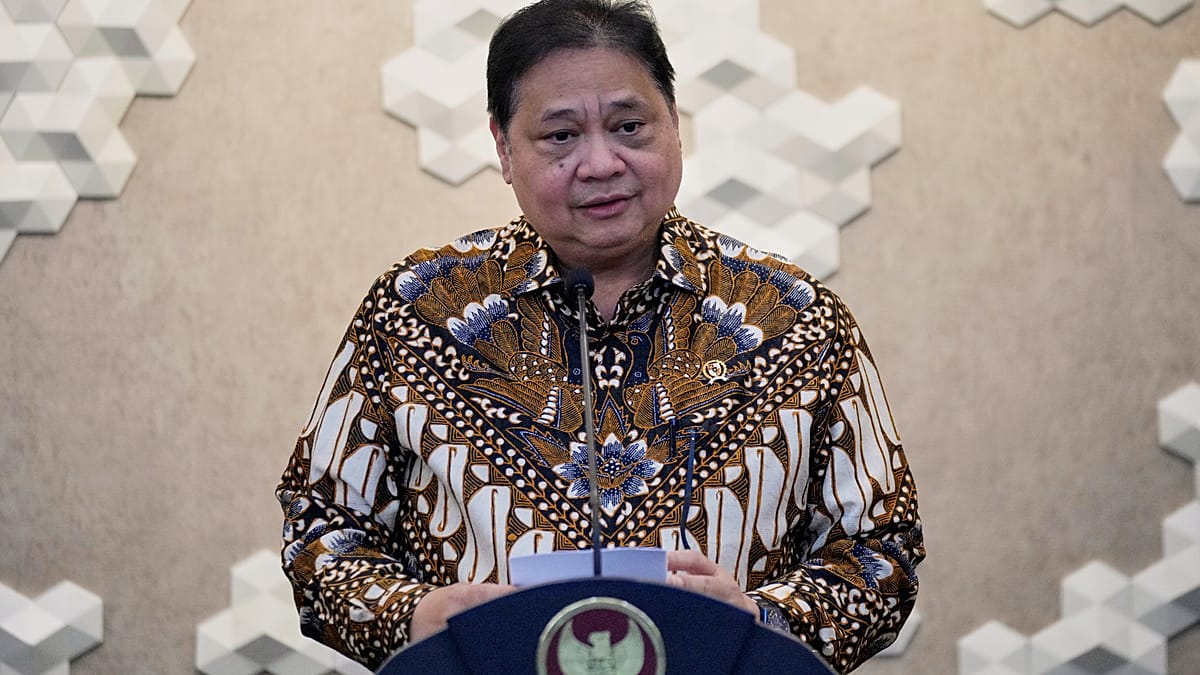
“I think there is an impact of the parallel negotiation with the US,” Airlangga Hartarto told euronews in an exclusive interview published Thursday.
The EU and Indonesia signed a landmark trade agreement in Brussels on Saturday after a decade of talks, a deal Hartarto said he expects to lift bilateral trade by 50% within three years.
The Comprehensive Economic Partnership Agreement (IEU-CEPA) was signed by Trade Minister Budi Santoso and EU Trade Commissioner Maroš Šefčovič on November 21, according to InvestorTrust. Ursula von der Leyen, President of the European Commission, called it “one of the most ambitious agreements the EU has concluded with an Asian country.”
Trump tariffs accelerated talks
Hartarto, Indonesia’s Coordinating Minister for Economic Affairs, linked the breakthrough to pressure from US trade policy. Jakarta has been negotiating tariffs with Washington alongside its talks with Brussels.
After 10 years of negotiations, we did it, @prabowo! We have signed the EU-Indonesia Comprehensive Economic Partnership Agreement. One of the most ambitious deals the EU has concluded in Asia, connecting 730 million people. Terima kasih 🇪🇺🇮🇩https://t.co/DyehIS9m7N
The Diplomat noted the swift conclusion “cannot be divorced from the broader churn in the global economy,” particularly the sweeping US tariffs imposed on friends and adversaries alike in April of last year.
Goods market opens, services lag
Key Indonesian export commodities poised to benefit include palm oil and its derivatives, textiles, leather footwear, sneakers and athletic shoes, the Independent Observer said. The European Commission also said CEPA will remove import duties on 98.5% of goods tariff lines and simplify export procedures, Digital Watch Observatory reported.

Services trade remains the harder conversation. Bilateral services trade between Indonesia and the EU reached €9.3 billion (US$10.15 billion) in 2024, with Indonesia exporting €3.5 billion and importing €5.8 billion, leaving a deficit of roughly €2.3 billion, The Jakarta Post reported.
Travel and transport still account for nearly three-quarters of Indonesia’s services exports to the EU. “We want Europe to welcome our engineers, nurses, and consultants. Yet by international measures, our own services sector remains among the most closed in the world,” The Jakarta Post wrote in an opinion piece published Thursday.
Race against GSP expiration
Indonesia is racing to ratify the deal by the end of December to ensure it takes effect on January 1, 2027, Trade Minister Budi Santoso said, according to Tempo. The government seeks to avoid a gap between the agreement’s implementation and the expiration of the EU’s Generalized System of Preferences (GSP) tariff facility for Indonesia, which ends on December 31, 2026.
Why? Because our GSP facility expires on December 31,” Budi said on Tuesday. If the GSP facility expires before the trade agreement takes effect, Indonesian exports to the EU could revert to most-favored-nation (MFN) tariff rates, he warned. The European Parliament’s legislative tracker lists December 14 as a provisional date for its vote, euronews reported. MEPs cannot amend the deal, only approve or reject it.
EU deforestation regulation takes effect December 30
Hartarto said the rules were discussed separately from the trade deal and that Indonesia is ready to comply, but has asked for its national Indonesian Sustainable Palm Oil (ISPO) certification to count towards compliance. That request is still being discussed.

Hartarto also said next week’s New Asia Forum in Bali could yield deals worth up to $30 billion (€27.4 billion), with Danantara, the Indonesian sovereign wealth fund backing the forum, expecting 40% to 50% to go to Indonesia.
MSCI warns of Indonesia downgrade by June 2027
Hartarto played down a downgrade warning from MSCI, which in October proposed downgrading Indonesia from “emerging” to “standalone” status, a move that would remove Indonesian shares from its emerging markets indices. MSCI plans to decide by the end of June 2027.
Jakarta’s benchmark stock index, the IDX Composite, has fallen roughly 38% this year. The minister likened the warning to a broken window. “So basically this is an issue of a window that is broken by somebody, right?” he told euronews.
OECD Secretary-General Mathias Cormann launched two reports in Jakarta this week as Indonesia aims to join the Paris-based group by 2028. One report looks at how Indonesia can benefit from the digital economy by developing semiconductors. On current productivity trends, growth would slow to about 3.5%, the OECD warned.
“Indonesia has already made a contract with Arm,” Hartarto told euronews as an example of moves to become a bigger player in the global AI economy. Danantara signed a framework agreement with the British chip designer in February to train up to 15,000 engineers in AI and semiconductors and acquire six pieces of chip-design intellectual property.
Indonesia, the largest economy in Southeast Asia and a G20 member, faces expiring EU Generalized System of Preferences (GSP) tariff facilities on December 31, 2026, risking reversion to most-favored-nation rates for key exports like palm oil, textiles, and footwear. Coordinating Minister for Economic Affairs Airlangga Hartarto told euronews Thursday that parallel tariff negotiations with Washington created pressure that accelerated the Brussels breakthrough after a decade of talks.
Economists see ‘stepping stone’ to higher growth
Indonesian Employers Association (Apindo) Chairwoman Shinta Kamdani agreed the CEPA could provide EU-bound exporters with “greater certainty” and facilitate their “integration into global supply chains,” but stressed businesses should access preferential tariffs “without any avoidable administrative hurdles.” A 2024 Apindo survey found 79% of Indonesian businesses surveyed had never used CEPA facilities, despite the country’s expanding network of trade agreements, the Jakarta Globe reported.
Related reading

Surrey Researchers May Use Models to Simulate Individual Sleep Patterns
University of Surrey researchers are developing digital tools that use personalised mathematical models to simulate individual sleep patterns...

Dentist, 36, Dies of Meningitis Days After ‘Swimmer’s Ear’ Misdiagnosis; Inquest Opens Monday
An inquest into the death of Paran Nithiananthan, a 36-year-old dentist from Yarm, is due to open at...

Amateur Rapper Charged with Murder of Maynooth Student Qayyum Balogun in Dublin
An amateur rapper appeared in Dublin District Court on Friday charged with the murder of Maynooth University student...

Antique Province Assists 17 Abused Children; Health Gains Reported
The provincial government of Antique has assisted 17 abused children this year as of Nov. 24, Philippine News...