Scientists have coaxed a bacterium to live on promethium-147, the only lanthanide with no stable isotopes, marking the first time a radioactive rare-earth element has been shown to power a biological enzyme, Nature reported.
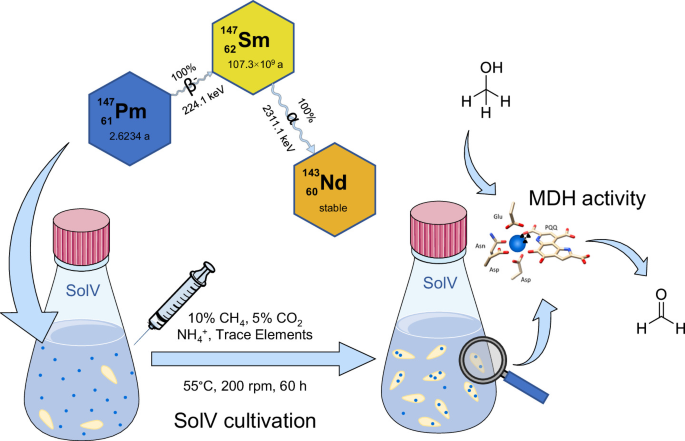
The extremophile Methylacidiphilum fumariolicum SolV grew just as well with 50 nanomolar promethium-147 as it did with stable lanthanides such as lanthanum, cerium, and neodymium. Its methanol dehydrogenase — the XoxF-type enzyme that allows the bug to eat methane — incorporated the radioactive metal into its active site and turned over methanol at rates statistically indistinguishable from the non-radioactive controls.
"This is the first report of a potential biological role for promethium, expanding the known lanthanide biology to include radioactive elements," the abstract noted, pointing out that the bacterium not only tolerated the beta radiation but actively accumulated the isotope inside its cells.
Researchers at the Helmholtz-Zentrum Dresden-Rossendorf (HZDR) and partner institutes fed cultures of SolV in sealed, gas-tight flasks at 55 °C under a 10 % methane / 5 % CO₂ atmosphere. After 60 hours, optical density readings showed no growth penalty from the promethium. Inductively coupled plasma mass spectrometry confirmed uptake of the stable lanthanides; liquid scintillation counting did the same for promethium-147, revealing that cells scavenged a significant fraction of the isotope from the medium.

A custom microdosimetric model, implemented in Python and validated against NIST stopping-power databases, calculated the absorbed dose to the cell center over the cultivation period. Even at the highest estimated intracellular activity concentrations, the total dose remained low enough that radiation damage to the enzyme or DNA was negligible — explaining why the bacteria kept dividing.
“Promethium-147 functions as an effective cofactor in Ln-dependent MDH, supporting bacterial growth and enabling enzymatic activity comparable to stable lanthanides.”
the abstract stated, adding that β⁻ emissions did not impair MDH function or bacterial proliferation within the tested cultivation period.
The finding rewrites the periodic table’s biological boundary. Until now, promethium — discovered in 1945 among fission products at Oak Ridge — had no known biochemical function. Its chemistry sits squarely between neodymium and samarium, so geochemists long assumed it would behave like its neighbors if only it were stable enough to test. The SolV experiments confirm that prediction: promethium slots into the lanthanide contraction trend without biological hiccup.
That tolerance opens a speculative but tantalizing door for bioremediation. SolV thrives in acidic, metal-rich, high-temperature environments — exactly the conditions found in some mining-impacted waters and legacy nuclear sites. If the organism can be engineered or adapted to concentrate other radioactive actinides or fission products alongside promethium, it could become a living filter for contaminated runoff.
Researchers caution that the 60-hour window captures only early exponential growth. Long-term genomic stability, possible radiolytic byproducts in the medium, and the fate of the accumulated radioactivity after cell death remain open questions. The team also said that the microdosimetric model assumes homogeneous isotope distribution and straight-line particle travel — simplifications that may underestimate dose hotspots near the cell membrane.
Helmholtz-Zentrum Dresden-Rossendorf (HZDR) traces its site to the Central Institute for Nuclear Physics, founded in 1956 and later the largest nuclear research institute in the GDR.
The center joined the Helmholtz Association of German Research Centres in 2011 and now operates large-scale facilities including ELBE, a superconducting electron linear accelerator, and the Dresden High Magnetic Field Laboratory, which generates pulsed magnetic fields up to 100 tesla. In Grenoble, HZDR runs a beamline for radiochemistry at the European Synchrotron Radiation Facility.
Still, the work establishes a new foothold at the intersection of radiochemistry and microbiology. The next step, several co-authors said, is testing whether SolV or its enzymes can handle the heavier, alpha-emitting actinides that dominate high-level nuclear waste.

Oregon Tech Welcomes Largest Freshman Class in 40 Years, Total Enrollment at 5,488
Oregon Tech welcomed 579 new freshmen this fall, the largest incoming class in more than 40 years and...

12-Year-Old Xavier Taylor Dies Nearly 6 Months After Being Hit by Baseball During Little League Warmups
Xavier Taylor, the 12-year-old from Maple Shade who was struck in the head by a baseball during Little...

Cal, Stanford Create Montgomery Cup Honoring Coach Mike Montgomery
Stanford and California announced Thursday they will play for the Montgomery Cup starting next season, a new rivalry...

Federal Inspection Finds 11 Deficiencies at Diamondback Correctional Facility
A federal inspection of the Diamondback Correctional Facility in Watonga uncovered 11 deficiencies across seven standards in September,...