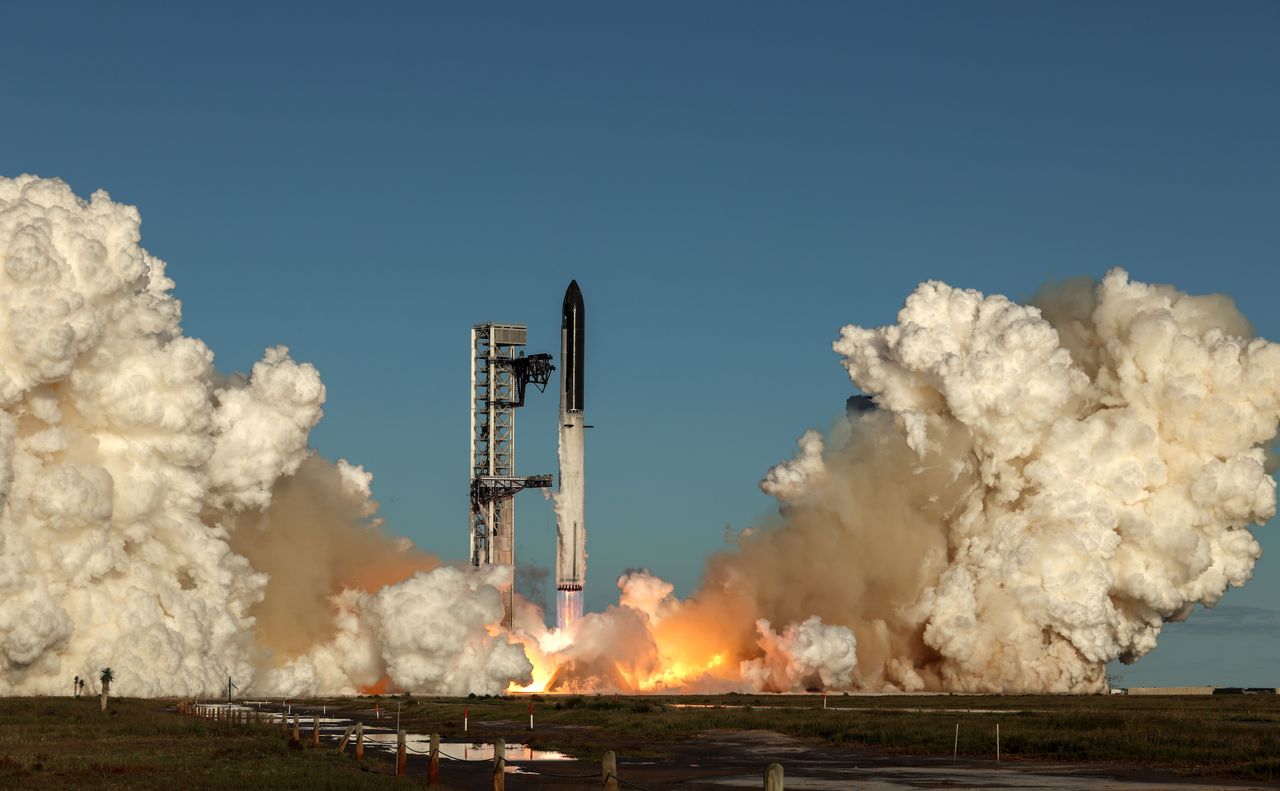
US regulators have authorized SpaceX to launch up to 1 million satellites into orbit, the first time a company has received approval to build data centers in space, BBC News reported.
- The FCC granted SpaceX permission on November 25 to build its Starmind constellation for AI processing.
- SpaceX is required to deploy its first operational satellite by November 2033 and 100,000 units by November 2035.
- The project aims to bypass terrestrial bottlenecks by using solar power to process data in low-Earth orbit.
“This will be a great asset to America and the world,” SpaceX CEO Elon Musk wrote on X in response to the announcement. FCC Chairman Brendan Carr said that the project is intended to “support America’s booming super intelligence economy,” according to BBC News.
The agency said that the move is the first of its kind in U.S. history, positioning the country in an emerging international race for space-based computing, Newsweek reported. “America is leading the world into the era of super intelligence,” Carr said in a statement Wednesday.
FCC Outlines Starmind Data Processing Goals
The Starmind constellation is designed to “process massive amounts of data to be used back here on Earth,” according to the FCC. SpaceX has described the project as a way to “capture solar energy in space to power” AI capabilities. The FCC authorization filing said that the application “received a substantial number of comments from the public, including petitions to deny filed by Kuiper Systems LLC (Amazon Leo), Viasat Inc.” and the American Astronomical Society.
In a March petition, Amazon characterized the proposal as a “lofty ambition rather than a real plan,” arguing it would take the company “centuries” to build the network. Meanwhile, “Stocks are down sharply because of the November Third Election results,” Donald Trump wrote Wednesday on Truth Social.
DATA CENTERS IN SPACE🇺🇸 Today, in a historic first, the FCC approved SpaceX’s request for 1 million satellites (orbital compute modules) to create data centers in space The Starmind & competitor constellations will use solar power to extend America’s lead in Super Intelligence pic.twitter.com/VJinjK5e5E
FCC Sets Satellite Deployment Deadlines
Under the conditions set by the FCC, SpaceX must adhere to a specific timeline to maintain its license. Deployment must begin by November 2033, with 10% of the constellation required by 2035 and 50% by 2038, according to BBC News. The full 1 million satellites are scheduled for completion by 2040, according to the FCC order.
| Deadline | Starmind Satellite Milestone |
|---|---|
| November 2033 | First satellite operational |
| November 2035 | 100,000 satellites (10%) |
| November 2038 | 500,000 satellites (50%) |
| November 2040 | 1,000,000 satellites (100%) |
The satellites will operate in low-Earth orbit between 500 and 1,002 kilometers, communicating with the existing Starlink network to relay data to Earth, BBC News reported.
While the license covers up to 1 million units, industry observers note that companies often request approval for higher numbers than they intend to deploy to allow for design flexibility, Fox Business reported. Establishing such a network would require approximately 15 new Vera Rubin halls and $300–350 billion of capital.
Stakeholders Challenge Starmind Approval
The FCC’s decision follows significant pushback from various stakeholders, including the American Astronomical Society, Viasat, and Amazon, which had petitioned the agency to deny the application, CNBC reported. Amazon, currently developing its own satellite constellation, had previously labeled the Starmind project as a “lofty ambition rather than a real plan,” according to CNBC.
Environmental concerns regarding potential space debris and atmospheric pollution were raised by multiple organizations, but the FCC said that these issues fell outside its regulatory purview, Ars Technica reported. The FCC did not grant this waiver request “because SpaceX has not provided sufficient information for the Commission to determine whether its alternative disposal methods are compliant with the Commission’s requirements.”
Regarding the broader environmental impact, “There’s nothing here that’s perfect, but there has to be a solution to go forward that can simultaneously respect the proprietary information while also demanding that we know what is being dumped in the atmosphere,” University of British Columbia space pollution expert Aaron Boley told SciAm.

“Any serious attempt at this is going to further pollute the night sky and runs a serious risk of a cascading chain reaction of space junk collisions,” astrophysicist Adam Becker told CNBC.
FCC Defers Graveyard Orbit Decision
While the FCC greenlit the Starmind project, it notably deferred SpaceX’s request to utilize “graveyard” orbits for disposal. The agency cited a lack of sufficient information regarding the company’s long-term decommissioning plans, requiring SpaceX to seek further waivers if it opts against atmospheric reentry. The commission confirmed it is currently reviewing several other orbital data center proposals and intends to address those filings through its standard regulatory procedures.
The authorization process drew intense scrutiny, with the FCC receiving roughly 1,500 public comments from various stakeholders. Despite concerns regarding space debris and potential ozone depletion from satellite reentries, the FCC maintained that such environmental impacts fall outside its current purview.
Chairman Brendan Carr emphasized that the agency remains focused on fostering American leadership in super intelligence, even as critics argue that the sheer scale of the 1-million-satellite constellation poses significant risks to orbital safety and astronomical observation.
🌎 🚀🚀 🛰️🛰️🛰️ https://t.co/uYhSDG8jAA
Industry Competition and Technological Milestones
The race for space-based computing extends beyond SpaceX, as other tech giants pursue similar “moonshot” initiatives. Google previously unveiled Project Suncatcher, an effort to integrate AI into orbital infrastructure, successfully launching initial testing chips on a SpaceX rocket and Planet Labs satellite last October.
Meanwhile, Blue Origin has petitioned for its own constellation of over 50,000 satellites to support its TeraWave internet service, an intensifying international competition to move data processing into low-Earth orbit.
Industry analysts project that if orbital data centers become a reality, they could offer extreme efficiency gains. Forecasts suggest a transition toward significantly cheaper inference costs per watt, with targets for 10-fold improvements by late 2027, followed by 100-fold and 1,000-fold reductions by 2029 and 2031, respectively.
Elon Musk has indicated he anticipates the first of these specialized spacecraft will launch as early as the third quarter of 2027, setting the stage for a decade of rapid expansion in the space-based compute sector.
The FCC regulates satellite communications through its Space Bureau, which was established in April 2023 to manage policy and licensing matters for space-based activities. This unit is responsible for processing applications, conducting investigations, and developing regulations for orbital operations.
In its review of the Starmind constellation, the agency held a formal process that allowed for public participation, receiving petitions to deny from entities like Amazon’s Kuiper Systems and the American Astronomical Society. Through this procedure, the FCC evaluates whether requests align with its mandate to promote efficient communication services, ultimately setting specific deployment milestones and licensing terms that applicants must satisfy to maintain their operational authority.
Much appreciated. This will be a great asset to America and the world.
SpaceX did not respond to requests for comment regarding these concerns, CNBC reported.
More on Elon Musk
Up to a million satellites. US regulators have just cleared SpaceX to put that many in orbit as data centres in space. A huge new market for satellite makers is opening, and Britain builds some of the best. Is Labour ready to help our firms win a share?⁰https://t.co/kQpBce7rsW
This is a truly extraordinary decision. In what sense the decision is 'extraordinary' will vary according to one's perspective.https://t.co/WdHr0GbQW3
[Trump administration approves Elon Musk’s plan for datacenters in space] “The FCC approved 1m Starmind satellites, with the deployment of 100,000 no later than November 2035“https://t.co/mu5Kq8GbWX””
The FCC has just announced that they have officially authorized @SpaceX to deploy 1 million satellites for its orbital data center constellation, called Starmind. This marks the first authorization in U. S. history for a constellation of data centers in space. FCC: "It promises… pic.twitter.com/vixYjyCrHK”
Related reading
- Jefferson County City Presents Draft Growth Policy, Seeks Public Input by Dec. 7
- Greece Olympia Senior Bella Pastrana Named NFL Latino Youth Honors Finalist
- Ownr Data: 1 in 4 Canadians Run Side Hustles, Many Plan Full-Time Shift (world-today-news.com)
- SpaceX Share for Every Kid Needs a Charity and Treasury's Approval (daybreakwire.com)
Jefferson County City Presents Draft Growth Policy, Seeks Public Input by Dec. 7
Jefferson County City officials and consultants presented a new draft growth policy at City Hall on Nov. 19,...

Greece Olympia Senior Bella Pastrana Named NFL Latino Youth Honors Finalist
GREECE, N.Y. — Greece Olympia High School senior and Greece Griffins flag football player Bella Pastrana has been...

Alabama Governor-Elect Tuberville Urges Texans to ‘Flee the Woke-Show’ After Democratic Sweep
Alabama Governor-elect Tommy Tuberville urged Texans to relocate to his state Monday, framing the move as an escape...

Fundraiser Launched for Topeka Teen J’Lanette Harrison Struck by Vehicle at Party
"With the holidays approaching, the last thing they should have to worry about is rushing back to work,...