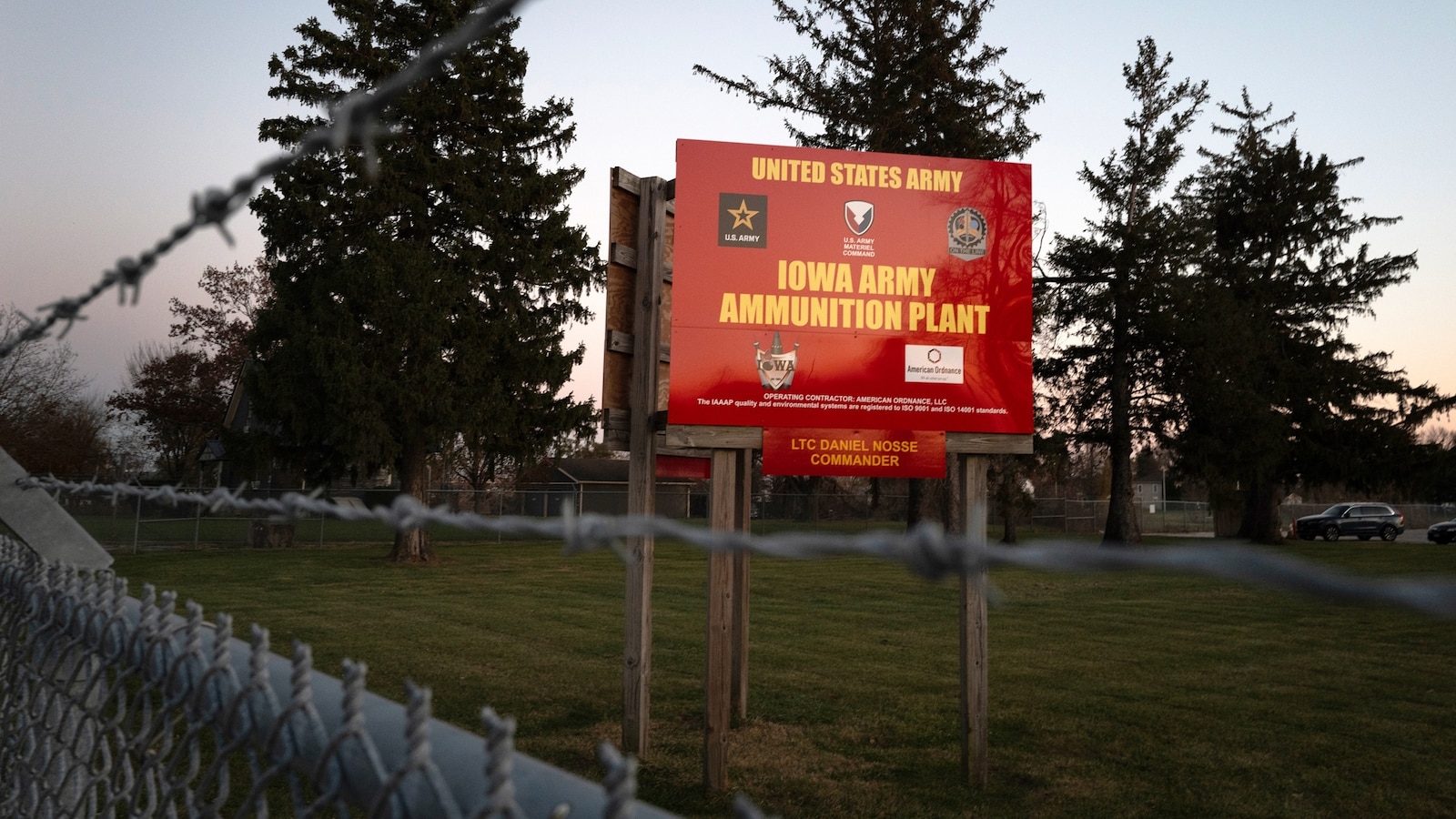
A federal appeals court halted the U.S. Army’s plan to detonate nearly five tons of unstable lead azide at an Iowa ammunition plant late Thursday, stepping in hours before the operation was set to begin.
The Eighth Circuit Court of Appeals issued a one-sentence administrative stay on the Environmental Protection Agency’s emergency permit, pausing the controlled explosion at the Iowa Army Ammunition Plant in Middletown until the court rules on an emergency motion filed by the Iowa Environmental Council and the Sierra Club Iowa Chapter. The order did not indicate how long the pause will last.
The decision caps a frantic week of public pressure, conflicting safety assessments, and political intervention over a Cold War-era stockpile that the Army says could spontaneously explode if left untouched through a coming cold snap.
“An unacceptable lack of communication and clarity has made Iowans understandably concerned and angry about this situation,” Rob Sand, Iowa’s state auditor and governor-elect, wrote in a social media post Thursday.
The unstable stockpile
Acting Army Secretary Adam Telle said the degrading lead azide was uncovered in March inside bunkers at the plant. The 68 barrels, stored for more than 20 years, have dried out and recrystallized, making them dangerously sensitive to friction, shock, and temperature drops, according to the EPA.
Moving the material is not an option, Army officials said. “Movement, physical handling, or off-site transit over public transportation routes presents an unacceptable risk of accidental, catastrophic detonation,” the plant said in a report. Leaving it in place carries its own escalating threat as temperatures fall.
Telle said the Army delayed the detonation from Friday to Monday — the “latest possible moment prior to a forecasted temperature drop, which would risk further destabilization of the material,” he posted on social media.
A plume of lead dust
The controlled detonation plan called for blowing up the barrels inside earth-covered concrete magazines surrounded by sand-filled Hesco barriers roughly two stories high. The Army said it would saturate the soil above the magazines and use water misters to suppress dust.
Even with mitigation, the Army acknowledged a plume of toxic lead dust could spread up to 100 miles northeast. Officials characterized the exposure as brief — “the equivalent of living in a mining town for one hour,” said Justine Barati, deputy chief of public and congressional affairs for Army Sustainment Command.
Residents in Middletown were warned they might hear loud noises, feel ground vibrations, and possibly see broken windows. The Army recommended people avoid the area, shelter indoors with HVAC systems set to recirculate, and wet-clean surfaces — including children’s toys, patios, and vehicles — after the plume passed.
Medical toxicologist Jennifer Sample told the Des Moines Register that pets let outside could track lead dust back indoors and should be washed upon re-entry.
Environmental groups challenge the permit
The Iowa Environmental Council and Sierra Club argued in their emergency motion that the EPA approved the permit without adequately considering environmental standards, disposal alternatives, or providing sufficient public notice to communities potentially in harm’s way.
“It very well could be the case that the U.S. Army has no other safe alternative to disposing of the toxic lead azide,” Sarah Green, executive director of the Iowa Environmental Council, said in a statement.
“But our federal government needs to do better at communicating the potential health risks of lead contamination in our communities and providing more time to keep our communities and vulnerable groups safe, like children and pregnant women.”
Federal agencies detail mitigation measures
On Friday, the Department of Health and Human Services, the EPA, and the Army released a joint statement saying agencies had been preparing since March and were taking “extreme mitigation measures” to ensure safety. “The entire Trump administration will continue to engage with state and local officials, as well as the broader community, to keep all apprised of updates as they arise,” the statement said.
Gov. Kim Reynolds said she asked Telle to delay the detonation and was “grateful” for the announcement. Sen.-elect Josh Turek also raised concerns about the plan and its communication to the public.
The Eighth Circuit has not set a timeline for ruling on the emergency motion for a longer-term stay. The Army maintains Monday remains the final safe window before cold weather increases the risk of an uncontrolled explosion. The court’s stay keeps the EPA permit on hold until the motion is decided.
Worth a look

Burlington Leaders, Business Owners Meet on Downtown Safety Before Holidays
Burlington business owners and city leaders met Friday to hash out downtown safety and homelessness strategies as the...

200 Volunteers Pack 1,352 Flakesgiving Boxes to Feed 13,000 in Billings
By 9:30 a.m. on a chilly Friday, an estimated 200 volunteers had already converged on the MetraPark carnival...

Brandon Oetken Ruled Incompetent to Stand Trial in Deputy Katherine Frank’s Death
A judge ruled Friday that Brandon Oetken, the man charged with fatally shooting Minnehaha County Deputy Katherine Frank,...

Federal Jury Convicts Couple of $15 Million Medicare Fraud Scheme Through Neurofeedback Company
A federal jury in Minnesota found a couple guilty Tuesday of stealing more than $15 million from Medicare,...