Edmonia Lewis carved pristine white marble figures in Rome that aligned with popular Neoclassical aesthetics, yet her 1875 sculpture Hagar depicted an exploited Egyptian maidservant with the features of a classical European sculpture, as reported by elissayukikoweichbrodt.substack.com.
In an Intro to Art History class, Lewis’s work serves as a valuable complication regarding whether artistic styles are value-free, elissayukikoweichbrodt.substack.com reported. Students examine if the sculptor operated as an identity-politics pioneer or a sellout capitulating to European beauty standards.
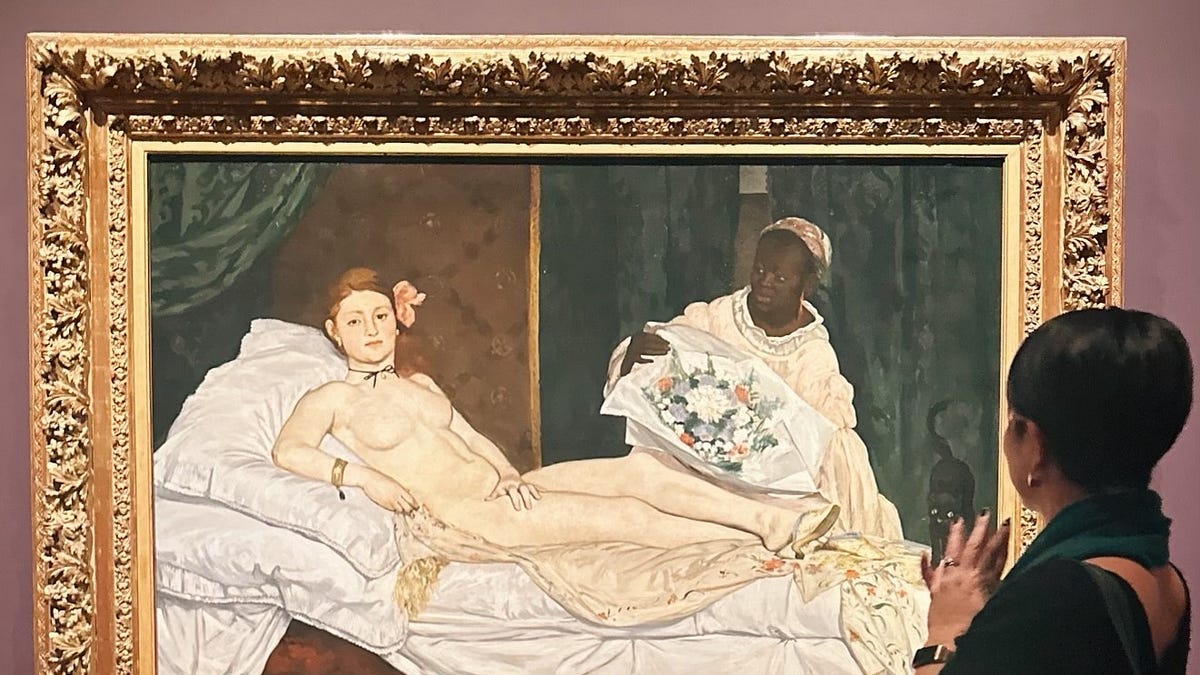
A semester schedule often involves playing catch-up with grading while teaching works that challenge traditional institutional narratives. Edouard Manet wanted to both paint modern life and receive the approbation of the Salon’s jury.

Displayed in the 1865 Paris Salon, Manet’s Olympia featured a reclining female nude modeled on Titian’s Venus of Urbino but updated for contemporary Parisian life. Most viewers hated the results because Manet used thicker paint slabs and dark outlines to depict a prostitute attended by a dark-skinned maid and a hissing black cat.
Fred Wilson staged a 1993 site-specific installation titled Mining the Museum at the Maryland Historical Society by rearranging and recontextualizing existing artifacts. Wilson placed a pair of iron slave shackles between elegant repoussé silverware cups under the title Metalwork, 1793-1880 to challenge visitor expectations about museum displays.
A white crepe paper floral cross was made by women of Japanese descent unconstitutionally incarcerated at the Topaz Relocation Center during World War II. This particular cross was crafted for the April 19, 1943 funeral of sixty-three-year-old James Hatsuki Wakasa, a first-generation Japanese immigrant shot and killed by a military sentry at Topaz, according to elissayukikoweichbrodt.substack.com.

Wakasa’s death and the camp officials’ attempts to downplay it led to protests and a work stoppage. While refusing to show up for their low-paying camp jobs, incarcerated women made thousands of paper flowers for the funeral to assert their grief.
Janine Antoni created a tripartite installation titled Gnaw in 1992 consisting of a six-hundred-pound chocolate cube and a six-hundred-pound lard cube gnawed by the artist. Antoni produced twenty-seven heart-shaped packages of chocolate from the chewed material and one-hundred-thirty lipsticks made with pigment, beeswax, and chewed lard.

Arizona AG Kris Mayes Outlines Second-Term Priorities
Arizona Attorney General Kris Mayes won reelection by nearly 300,000 votes, a dramatic margin change from her victory...
Alaska Hosts Various Community Events From Nov. 11-18
Communities from Anchorage to Juneau prepare for a busy stretch of community gatherings, arts markets, and historical presentations...

Alabama Defeats LSU 2-1 to Advance to SEC Tournament Semifinals
No. 11-seeded LSU dropped a 2-1 decision to 3-seeded Alabama, 2-1, in the quarterfinals of the SEC Tournament...

Nvidia Shares Rebound as Huang Faces Board Scrutiny
Nvidia shares rose in premarket trading on Wednesday following a sharp two-day selloff that erased billions in market...