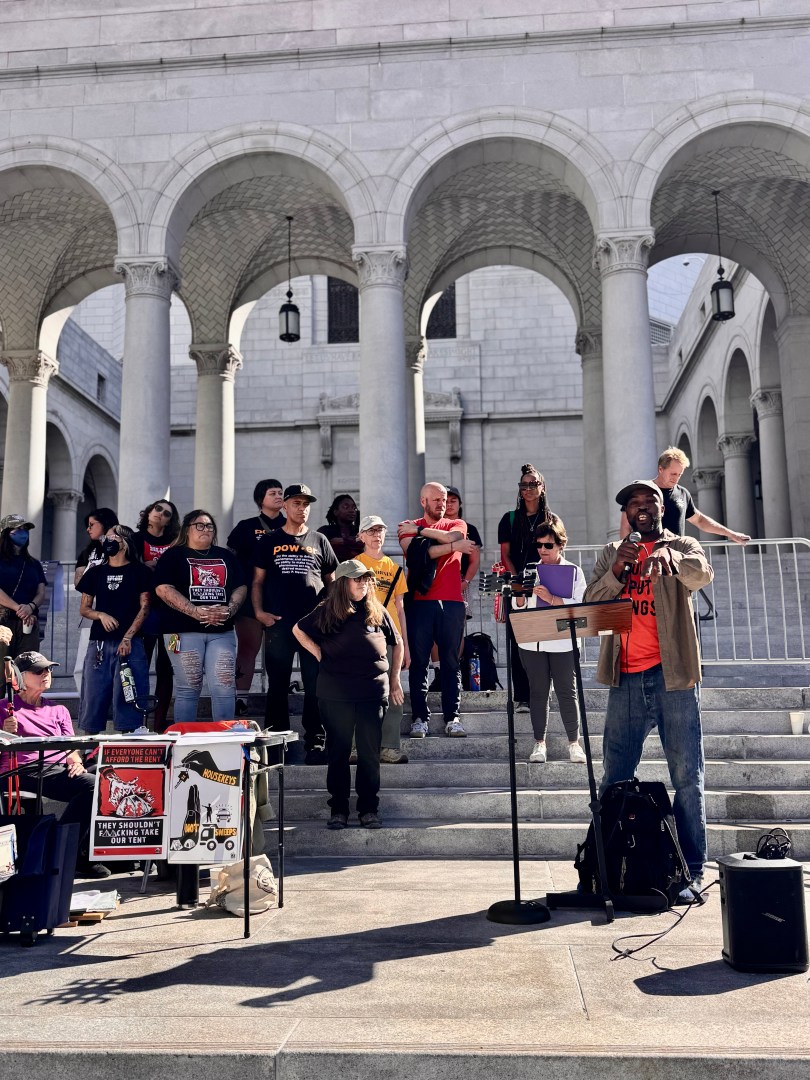
Forty-eight thousand people sleep on the streets of Los Angeles County tonight, and the city has fifteen hotel vouchers for the El Niño storms already hitting the coast.
The math, Knock LA reported, isn’t just bleak — it’s a policy choice. While the county activates emergency protocols for housed residents, the augmented winter shelter system designed for exactly this scenario remains a blank webpage, and the city’s own sanitation crews are still sweeping encampments hours before downpours.
“We are going to see LA General and other hospitals rushed with emergencies related to [the City’s] failure to plan with unhoused people and their advocates,” said Soma Snakeoil, CEO of The Sidewalk Project, a women- and peer-led organization supporting unhoused people, sex workers, and survivors of gender-based violence.
“That has a ripple effect on the entire social safety net, including huge medical fiscal losses, strain on front-line providers, and the need to triage most urgent cases at the expense of ongoing health needs.”
The augmented shelter program, run by the Los Angeles Homeless Services Authority (LAHSA), is supposed to deploy resources from November through March. For the current fiscal year, the program’s website displays only a notice that LAHSA is “working with the City of LA to make changes,” leaving 328 countywide winter beds as the total backup plan.
Peggy Lee Kennedy, an organizer with the CD 11 Coalition for Human Rights and the Venice Justice Committee, said the fix is bureaucratic and immediate. “They need to declare states of emergency so that they can act with efficiency and have some criteria with that,” she said. “Shut up and stop fighting, because the city owns the buildings and the county could fund it.”
A local emergency declaration would unlock the California Disaster Assistance Act, fast-track procurement, and grant legal immunity to workers on the ground. Without it, the system moves at the speed of a council vote.
On October 21, LA Sanitation and LAPD cleared an encampment on Central Avenue in Skid Row one hour before a rainstorm. Staff destroyed tents, medical records, and insurance documents. “LASAN would have been aware of the weather report and chose to do the operation anyway,” Snakeoil said.
The pattern mirrors the Eaton Fire response in 2025. When flames hit Altadena, official channels stalled. Kaveh Naeeni, an organizer with For the People LA, called the Pasadena Job Center on January 7.
“I talked to Jose Madera and said we need people who don’t have breathing problems. There’s no fire department here. The fire department gave up on Altadena completely,” Naeeni said. “Jose said, ‘let me see what I can do.’ Three minutes after that he said, ‘I have 27 people ready to go.’ Pasadena Job Center had 500 volunteers by January 8 at 11:00 AM.”
Mutual aid networks — All Power Books, Bernie’s Coffee Shop, Sovern LA, Palms Unhoused Mutual Aid, Youth Climate Stewards LA — are currently stockpiling pallets, tarps, hand warmers, and lanterns. The Sidewalk Project plans to open its drop-in center for overnight wellness checks. Youth Climate Stewards LA is running neighborhood phone-tree drills.
“This El Niño is revealing a deep contradiction that is built on racist and socially unjust systems of climate apartheid,” said Sim Bilal, Executive Director of Youth Climate Stewards LA. “Two realities are emerging under these climate conditions, and they’re only going to get worse unless we address them head-on instead of skirting around the issue.”
Bilal pointed to the fires as the preview. “When the fires happened, the city did not have adequate resources, whether it was air purifiers or masks, to meet the needs of the people,” they said.
“They relied on mutual aid groups and grassroots groups to get these resources and distribute them. The saddest part is that these systems have not changed or confronted this reality when they fail over and over again.”
More than six unhoused people die on Los Angeles County streets every day without a storm. The rain has already started.

Meta-Analysis Links Rituximab to Lower One-Year Mortality vs Cyclophosphamide in ANCA Vasculitis
Researchers in New Zealand and Australia published a systematic review and meta-analysis on Wednesday in Seminars in Arthritis...

Tees Rivers Trust Tracks Eels, Tags 10 for Research
Conservationists in the North East are tracking the downstream migration of critically endangered European eels, a species that...
Religiosity Buffers Depression’s Impact on Quality of Life in Women with Gynaecological Cancer
For women facing the physical and psychological burdens of gynaecological cancer, the path toward healing often extends beyond...

MTA Unveils 2050 Roadmap to Modernize NYC Subway Signals with CBTC Technology
The Metropolitan Transportation Authority released its first comprehensive roadmap on Wednesday outlining a strategy to modernize the entire...