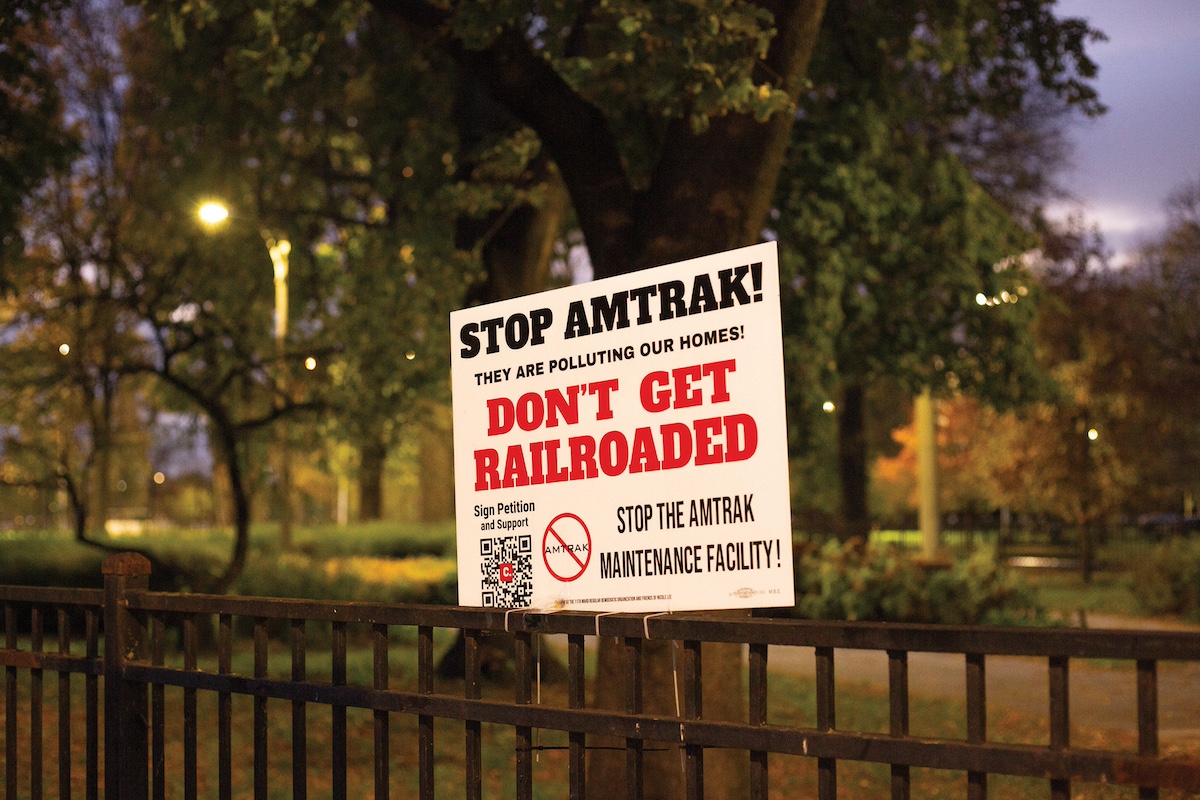
Seven thousand residents live within 500 feet of the proposed Amtrak maintenance facility on Chicago’s South Side, and the federal government just gave the project an environmental green light in 11 days.
The Federal Railroad Administration released a 59-page environmental assessment on November 6 concluding the $915 million Midwest Maintenance Facility would have “insignificant” impacts on air quality, noise, vibration and hazardous materials, the Chicago Tribune reported. Alderperson Nicole Lee and Cook County Commissioner John Daley fired back the same weekend, calling the review “woefully insufficient” and demanding an independent study on behalf of those 7,000 neighbors in Bridgeport, Armour Square and Chinatown.
“We beg to differ,” Lee and Daley wrote in their joint statement. The assessment arrived just 11 days after Amtrak agreed to conduct any review at all — a concession won only after two months of pressure from the Bridgeport-Armour Coalition, 11th Ward Independent Political Organization, and members of the Illinois congressional delegation.
“We absolutely cannot receive industrial garbage in the middle of our houses, 100 feet away from our homes, from our park, from our schools.”
said Maria LaGiglio, a Bridgeport resident and coalition co-founder who lives feet from the proposed site. She told South Side Weekly she supports development generally but draws the line at a 24-hour fueling and maintenance hub.

The facility would replace Amtrak’s aging 14th Street yard in the South Loop, which the railroad says cannot accommodate modern equipment. Rehabilitating the current site would be “more expensive and result in more service disruptions than building a new one,” Amtrak representatives told the City Council’s Transportation Committee on October 7. The new yard would run 24/7 along the Canal Street rail corridor between Archer Avenue and 39th Street.
Deborah Ahrens, who spent years running Amtrak café cars on cross-country routes, says the waste volume alone makes the site wrong for a dense neighborhood. “When [cross-country trains] get back to Chicago, if it didn’t get to take the garbage off for a while, you’re talking just from one [diner] car eight to 10 big, lawn-sized brown bags full of food products,” she told South Side Weekly.
“Packaging, garbage food … from the coaches, at least 15 bags of trash from there, and then you have your sleeping cars, that are going to have three to four bags apiece.” Eight long-distance trains terminate daily at Union Station after 40-plus hours on the rails, plus five regional routes with multiple daily departures.
Amtrak’s environmental record at 14th Street fuels skepticism. In 2021, a federal judge found Continental Paper Co.’s claims of contamination from a 2019 diesel spill were true, though Amtrak avoided liability on a technicality. A 2024 fire at the facility triggered another spill and hazmat response.
The project’s origins trace to billionaire Justin Ishbia’s real estate ambitions. Crain’s Chicago Business reported in March 2026 that Ishbia was closing on the 14th Street yard purchase. He had acquired a minority stake in the White Sox in mid-2025 with a path to majority ownership by the early 2030s.
Amtrak engaged with Ishbia as early as August 2025, according to slides presented by Amtrak executive Joe Shacter at a University of Illinois-Chicago seminar advertised as covering Union Station upgrades — with no mention of a maintenance facility. By November 2025, Ishbia formed Canal Edge LLC, which quickly engaged City Hall. The project’s scope remained private until April 2026, when it became clear Amtrak’s proposal far exceeded the “storage facility” discussed in 2023.
U.S. Senators Tammy Duckworth and Dick Durbin initially signed a letter of support in January 2026 but walked back their endorsement once community impacts emerged. Governor J.B. Pritzker’s office said last month the current proposal “is significantly different from the project the state originally supported,” according to spokesperson Matt Hill.
State Representative Theresa Mah, whose 24th District covers most of the site, wrote to Amtrak’s Board of Directors opposing the project, joined by State Representatives Aarón Ortíz and Sonya Harper and State Senators Celina Villanueva and Javier Cervantes.
Federal money accelerates the timeline. Transportation Secretary Sean Duffy’s “Golden Age of Rail” initiative includes up to $600 million for the relocation.
Simultaneously, Crain’s reported that City River Holdings, another Ishbia LLC formed alongside Canal Edge, applied for a nearly $2 billion Transportation Department loan to redevelop the 14th Street site as “The Railyards” — a mixed-use development anchored by a new White Sox stadium. The White Sox would leave Rate Field, removing what residents call the neighborhood’s economic engine.
Chicago Federation of Labor President Bob Reiter endorsed the project at community meetings on September 18 and 21, where Amtrak officials faced fierce criticism. The Federal Railroad Administration announced a 30-day comment period ending December 7, with two public meetings — one virtual, one in-person — scheduled for early December, the Tribune reported.
“We now have just 30 days, and there’s a lot to pore over, so that’s how many of us are spending our weekend,” Lee said. “There’s going to be a great number of people who want to ask questions in person and attend these meetings.” She is pushing for a second City Council hearing within the comment window, though scheduling remains uncertain.
Amtrak and Canal Edge issued a joint statement supporting the FRA’s decision and pledging to participate in the public meetings. The FRA did not respond to questions about the assessment, the Tribune noted.
The Federal Railroad Administration, created by the Department of Transportation Act of 1966, is the agency within the U.S. Department of Transportation that promulgates and enforces rail safety regulations and administers railroad assistance programs. It operates with a staff of about 850 and, in 2024, announced more than $153 million in funding through the Restoration and Enhancement Grant Program to support new or restored intercity passenger rail services.
The comment period closes December 7.
Worth a look

MATBUS Public Hearing Set Dec. 7 on Major Route Changes 2, 4, 9
MATBUS proposes major route changes to Routes 2, 4, and 9, including eliminating Route 2's 2:15 p.m. to...

Columbia Falls Eyes First Class a Title in 9 Years vs East Helena
Nine years. That is how long the Columbia Falls Wildcats have waited to stand on this precipice again,...
Lansing Hosts Community Connect Event to Distribute Free Winter Items
“We don’t want people out in the cold. Again, we want to share the warmth. We want to...
Proposal Replaces Single Home Near BSU With 13 Three-Story Townhomes
A single 1927 bungalow on 0.72 acres near Boise State could give way to 13 three-story townhomes packing...