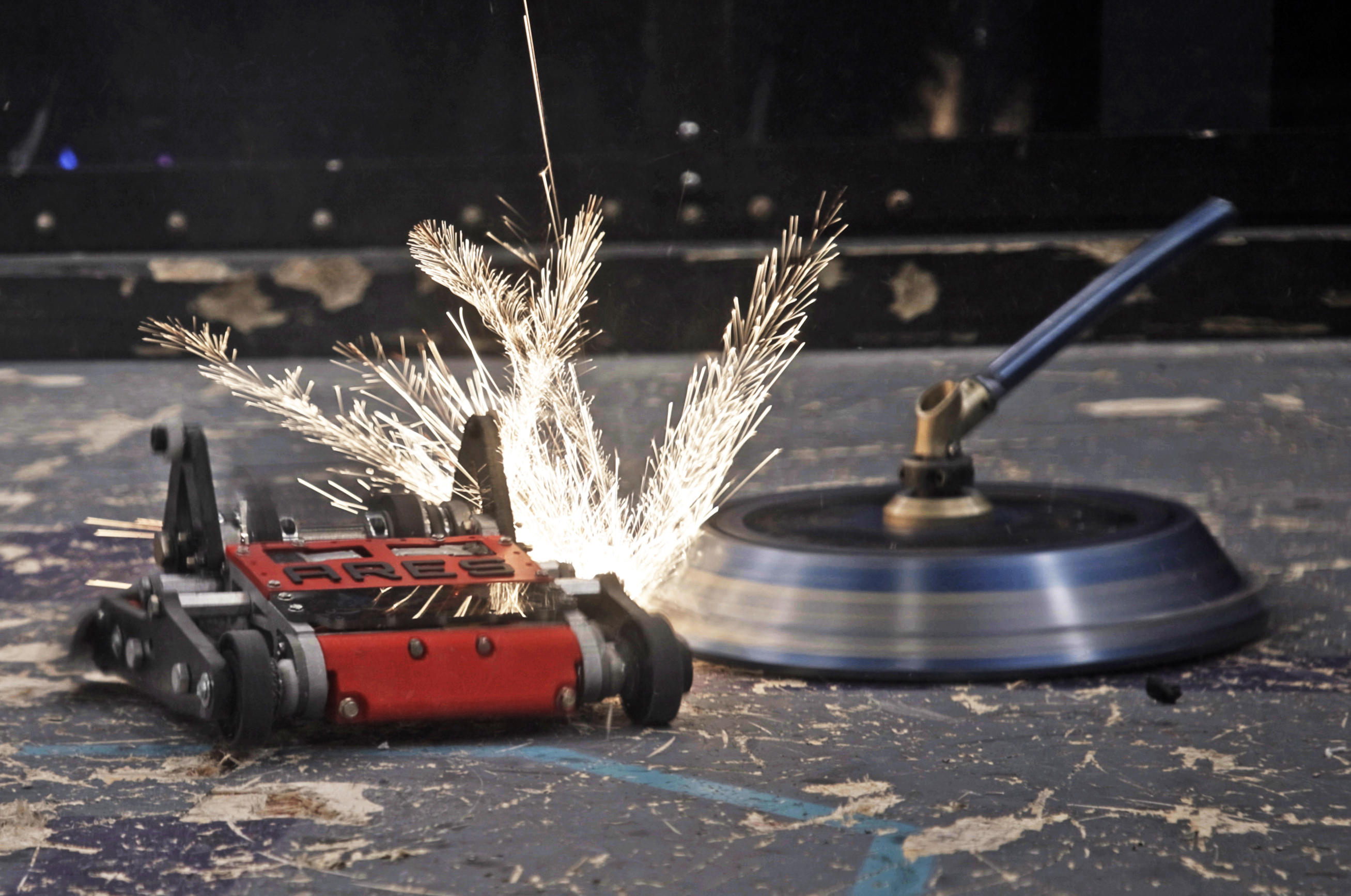
“From steel, titanium, aluminum, and passion,” says Abi Dixon, the 2026-27 captain of MIT’s Combat Robotics Club, describing the materials that went into ARES, the team’s 30-pound combat robot.
Named for the Greek god of war, ARES is back in the workshop after a difficult run at last winter’s 2025 NHRL World Championships, where the machine entered as a top seed but failed to emerge victorious, MIT News reported. The robot combines a “Beater Bar” vertical spinner with a compact, dual redundant poly-v belt brushless weapon power system, all mounted on a high-performance brushless four-wheel drive and a chassis of lightweight aluminum, titanium, and ultra-high-molecular-weight polyethylene.
ARES, captained by Duarte alongside fellow Department of Mechanical Engineering undergraduates Henry Dang, Kendall Binkley, and Liam Gault, lost twice at the championship to opponents wielding similar weapon types.
“Our two losses with ARES were against two opponents which shared a similar weapon type which our underdeveloped armor couldn’t withstand,” says Duarte.
The defeats showed a specific vulnerability in the robot’s defensive design, but rather than treating the losses as failures, the team saw them as an opportunity to make improvements.
“A unique thing about our outlook for these competitions is that no matter how poorly a match goes on our end, afterwards the dominant emotion is still pride,” says Dixon.
“How can you put so much energy, so much love, so much blood, sweat, and tears into a machine and then be totally OK with putting it inside the cage and it exploding, and then literally picking up your pride off the floor, smushing it all back together, and getting back in there?” she asks.
“You grow an understanding of finding the wins, even when things look like a complete loss,” Dixon says.
The 30-pound weight class, one of three NHRL divisions alongside the 3-pound and 12-pound categories, rewards this kind of iterative engineering. After the World Championships, CRC has been upgrading ARES’s armor while simultaneously improving another robot, KRATOS, and advancing progress toward a next generation of machines. The team captured second place at an April competition and third place in October. CRC is entirely student-run, self-taught, and open to everyone regardless of year, major, or prior experience. Participants engineer tough, reliable, performant systems while learning skills from computer-aided design and finite element analysis to CNC machining and welding.
“Before MIT, I never had the opportunity to independently say, ‘I’m going to make this,’ and complete everything in the engineering process from start to finish,” says Eleni Morales, a CRC team member, 2025-26 co-manufacturing chair, and undergraduate in MechE. “CRC embodies that vision, and solidified my desire to become an engineer.”
This fall semester, the club welcomed 54 new members, integrating them through a structured onboarding process in which teams of three build 1-pound “ant weight” combat robots.
“We remain committed to making the team accessible for students with all levels of technical experience (including none!) through a structured onboarding process that prioritizes each and every member feeling as though they have technical ownership over a part of their sub team’s robot,” says Dixon.
The rebuilt ARES will face its next test on Nov. 14, when the club hosts its third annual MIT Combat Robotics House Battle at the new Met Warehouse.
“Being in this community and on this team has changed me,” Dixon says.
Worth a look
NYC’s ‘Battle of the Boroughs’ sticker push drives record early voting on final day
On the final day of early voting in the 2024 general election, 149,319 New Yorkers cast ballots —...

Frode Tilden’s 21st Norsk Christmas celebration returns Dec. 5 with 70 evening tickets left
Frode Tilden's 21st annual Norsk Christmas celebration returns to Fargo-Moorhead on Saturday, Dec. 5, 2026, offering two dinner...
How NYC Boosted Early Voting Turnout With Battle of the Boroughs Stickers
149,319 New Yorkers cast ballots on the final day of early voting in 2024—the highest single-day early voting...

Gabe Vasquez wins reelection in New Mexico’s 2nd district race
Vasquez Holds New Mexico's 2nd District as National Money Floods the Race Incumbent Democratic U.S. Rep. Gabe Vasquez...