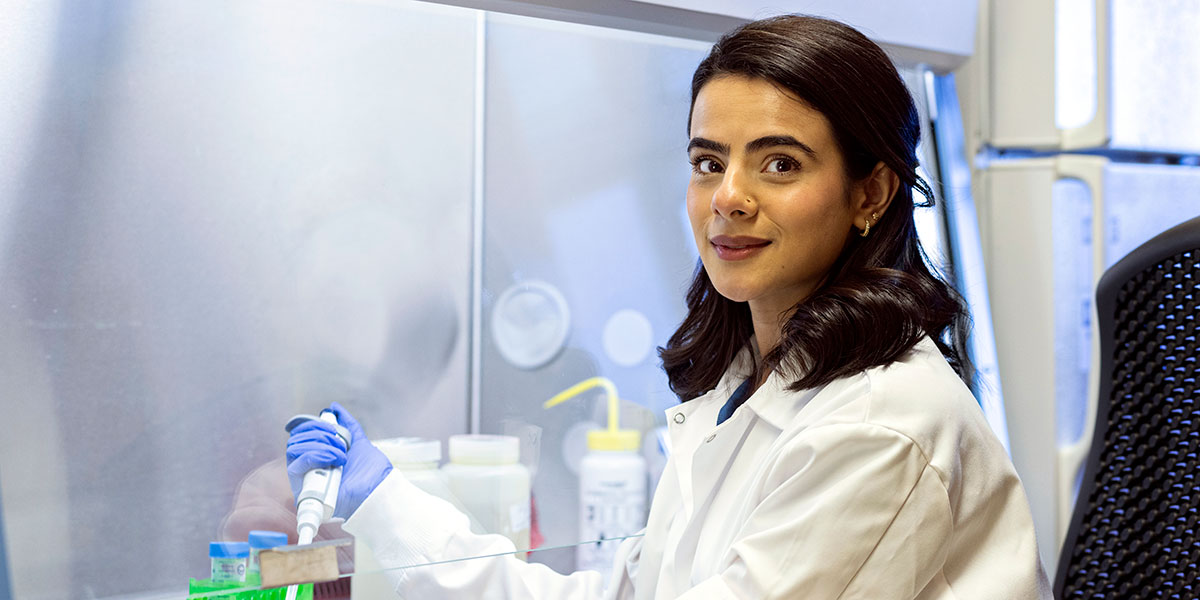
Fulbright scholar Syeda Shehirbano Akhtar is building the scientific playbook to track bacterial sexually transmitted infections in wastewater, a surveillance gap that leaves public health agencies blind to infections among people who never reach a clinic.
The University of South Carolina reported Thursday that Akhtar’s dissertation, backed by a grant from the American Sexually Transmitted Diseases Association, targets chlamydia, gonorrhea and syphilis — pathogens that appear in sewage at minuscule concentrations and degrade rapidly in transit. Clinical data captures only patients who seek care; wastewater captures everyone, but until now has lacked standardized protocols for bacterial STIs.
“Wastewater surveillance is only effective, and can only be used to its full potential in parallel with clinical surveillance, because it won’t tell you who’s infected in the community,” Akhtar told the university.
“It cannot pin down the individual. It won’t give you age or sex or all the demographics of the patient. And nobody gets treated from a wastewater signal, so you still need that clinical signal. It’s more like a smoke detector, not a diagnosis.”
The blind spot in population health
COVID-19 proved wastewater epidemiology at scale. The infrastructure built to track SARS-CoV-2 created an opening to monitor other pathogens at the population level. Viral particles shed in high volumes; bacterial STIs do not. Chlamydia, gonorrhea and especially syphilis exist in wastewater at trace levels, their DNA breaking down inside sewer lines before reaching a treatment plant.
Akhtar spent four years at the World Health Organization watching surveillance systems miss entire populations. Clinical reporting captures the fraction of people who overcome access barriers, stigma and cost to get tested. Everyone else vanishes from the data. Wastewater could fill that gap — if researchers can agree on what a reliable signal looks like.
From bench to policy table
Akhtar’s work evaluates commercial pathogen testing kits and tests protocol tweaks: which sewershed to sample, how to concentrate the sample, which extraction method preserves fragile bacterial DNA. “This isn’t just run the sample and report the numbers,” she said.
“It’s also about building that mechanism first where you are also standardizing your protocol and looking at, ‘OK, what step could I change in order to make the STI-targeted pathogens more detectable? How can I improve the efficiency of the whole process?'”
Her mentor, associate professor Banky Olatosi, pushed her to treat every design choice as a policy instrument.
“Every design choice for my particular research project, like which sewershed, how to present the results, how to determine whether the results are something that a health department can act on — on every step, he asked me, ‘So, what would you do differently to make it a more usable instrument for actual decision makers?'”
“My instinct coming out of five years of consulting experience was to move fast and produce something usable. His discipline pushed me the other way. He made me learn how to prove something, validate it and know your limitations before you publish, because the moment a health agency makes a decision on your reporting, you own the consequences of it being wrong as well.”
— Syeda Shehirbano Akhtar, Fulbright Ph.D. Scholar, Arnold School of Public Health
The mentor’s view
Olatosi said Akhtar’s strength is seeing beyond the lab bench. “As a mentor, my greatest hope is not simply to help students become accomplished researchers, but to empower them to become independent leaders who challenge conventional thinking and create new possibilities,” he said. “Shehirbano is already demonstrating those qualities, and I have every confidence that her contributions will extend far beyond her doctoral research.”
The University of South Carolina, founded in 1801 as South Carolina College, is the state’s flagship public research university and its largest by enrollment. Classified among institutions with the highest research activity, it holds the world’s largest Ernest Hemingway collection and the largest collection of Robert Burns and Scottish literature materials outside Scotland.
Akhtar also completed a health policy fellowship with the Healthcare Information and Management Systems Society, weighing in on rural health transformation and AI governance in healthcare. She plans to stay at the seam between laboratory science and policy.
Keep reading

Nevada Child Marriage Ban Push Renewed After 12,000 Minors Wed Since 2000
Nevada advocates are renewing a push to end child marriage after data showing more than 12,000 minors wed...

Judge Dismisses Lawsuit, Lifts Order on Port of South Louisiana Bond Vote
A temporary restraining order that froze a $400 million bond vote for a massive Mississippi River dock project...

Portland’s Westside Express Service carried an average of 13 passengers per railcar in 2025
Portland's Westside Express Service carried an average of 13 passengers per railcar in 2025, a figure so low...

El Niño Keeps Bismarck-Mandan Brown for Thanksgiving With Dry, Mild Week Ahead
Bismarck-Mandan is on track for another brown Thanksgiving as an El Niño pattern keeps the region warm and...