
A fossilised leg bone recovered from an Indonesian cave has revealed a previously unknown species of giant, chicken-like bird that weighed about 3.9kg.
Scientists have named the extinct animal Megapodius rokusi after the late Indonesian animal-bone expert Rokus Due Awe. The single bone sat ignored for 17 years after researchers unearthed it from the floor of Liang Bua, a limestone cave on the island of Flores.
Researchers dug the lower leg bone out of the cave in 2009, nearly seven metres beneath the surface, from a layer of earth dated to between 190,000 and 120,000 years ago. Liang Bua is the same site where archaeologists uncovered the remains of Homo floresiensis in 2003, an ancient human species standing a little over a metre tall that earned the nickname “the hobbit”.
The extinct bird belonged to the megapodes, a family of ground-living birds with strong legs that bury their eggs in large mounds or underground burrows. Rather than sitting on their nests, megapodes rely on environmental heat from the warm ground to incubate their eggs.

When palaeontologist Hanneke Meijer of the University Museum of Bergen in Norway and her colleagues compared the specimen with bones from living and extinct megapodes, they discovered unique features. The joints where the toes attach were shaped differently from any known species, with one angled unusually far outwards and another featuring a distinct groove and rounded depression.
Statistical estimates linking leg-bone dimensions to body mass indicate the bird weighed about 3.9kg, roughly the same as four bags of sugar. That makes Megapodius rokusi the largest known member of its genus.
By contrast, the only megapode living on Flores today is the orange-footed scrubfowl, which weighs between 0.5kg and 1.2kg. Dwarf elephants and giant storks also shared the prehistoric island.
The findings were published on October 22, 2026, in the journal Alcheringa, with Thomas Sutikna, E. Wahyu Saptomo, and Matthew Tocheri serving as co-authors alongside Meijer. It marks the first fossil megapode described from Wallacea, the string of islands nestled between mainland Asia and Australia.
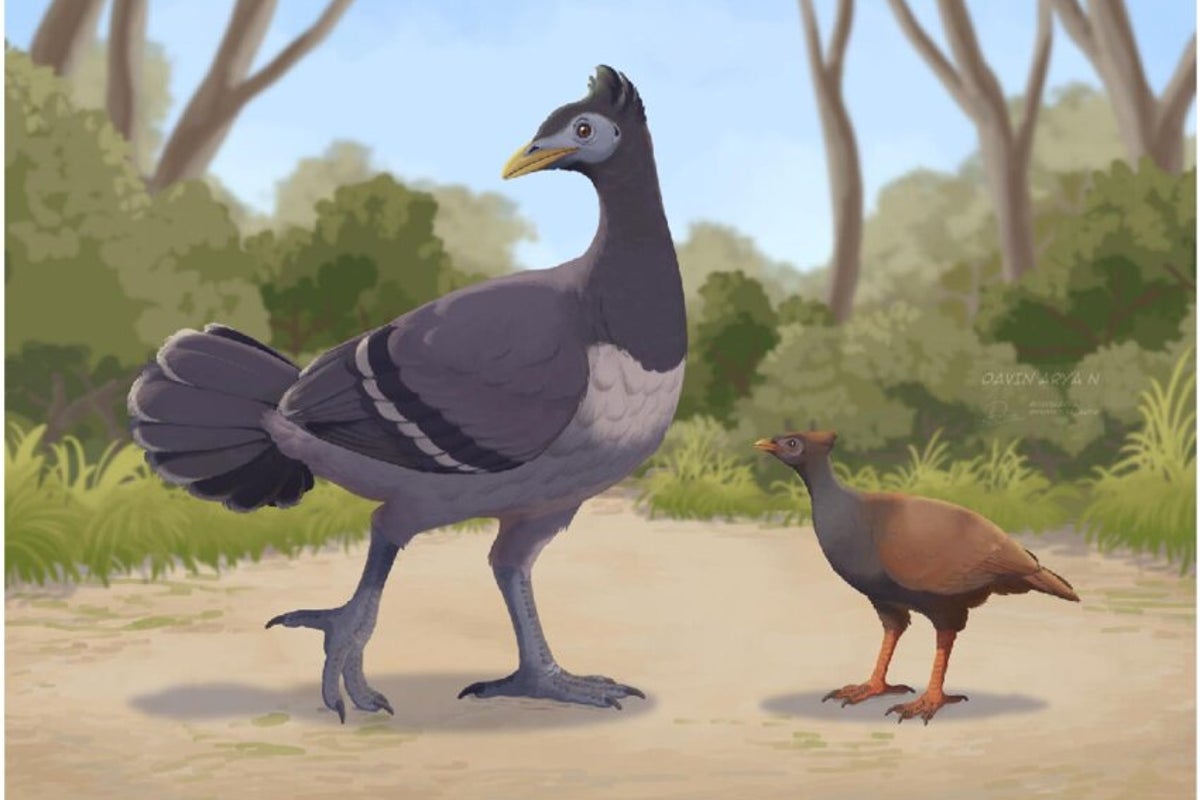
“Megapodes are common across many Indonesian islands, but this is the first fossil megapode from Indonesia,” Hanneke Meijer told Mongabay by email.
Meijer said that the discovery highlights how prehistoric Wallacea harboured extinct species just as striking as modern wildlife. Rokus Due Awe, the zooarchaeologist honoured in the species name, was the first to recognise the bone as belonging to a bird and had earlier correctly identified the human-relative teeth and bones that formed the Homo floresiensis collection.
Whether the giant bird ever crossed paths with the small human relatives remains uncertain. While stone tools linked to the hominins date between 190,000 and 50,000 years ago, skeletal remains from the site have been revised to between 100,000 and 60,000 years old, placing the bird’s layer slightly older than the dated human skeletons while overlapping with the tool timeline.
Because the discovery rests on a single incomplete leg bone lacking wing or shoulder elements, researchers cannot yet determine whether the bird was flightless, exactly when it vanished, or how it interacted with the island’s other unusual fauna.
“This new finding shows that prehistoric Wallacea had many extinct species that are as interesting, or even more interesting than the ones that are alive today,” Meijer told Mongabay.
Related reading
Virologic Failure on Long-Acting CAB/RPV Uncommon but Compromises INSTI Options More Than Doravirine
Among adults with suppressed HIV-1 in France who transitioned to long-acting cabotegravir plus rilpivirine, viral breakthrough rarely occurred....

Systematic Review Finds Insufficient Evidence for Blood Eosinophils Guiding ICS Use in Bronchiectasis
Blood eosinophils might finally tell doctors which bronchiectasis patients actually benefit from inhaled steroids, and which ones just...

MSU-IIT Students Stage Walkout vs. Pax Silica, Trump Visit
Students at Mindanao State University–Iligan Institute of Technology staged a campus-wide walkout on Tuesday to protest the U.S.-led...
iQOO Z12 Lite Spotted on Google Play Console With Z11 Lite-Like Specs
iQOO's next budget phone appeared on the Google Play Console on November 17 with the same chipset, memory...