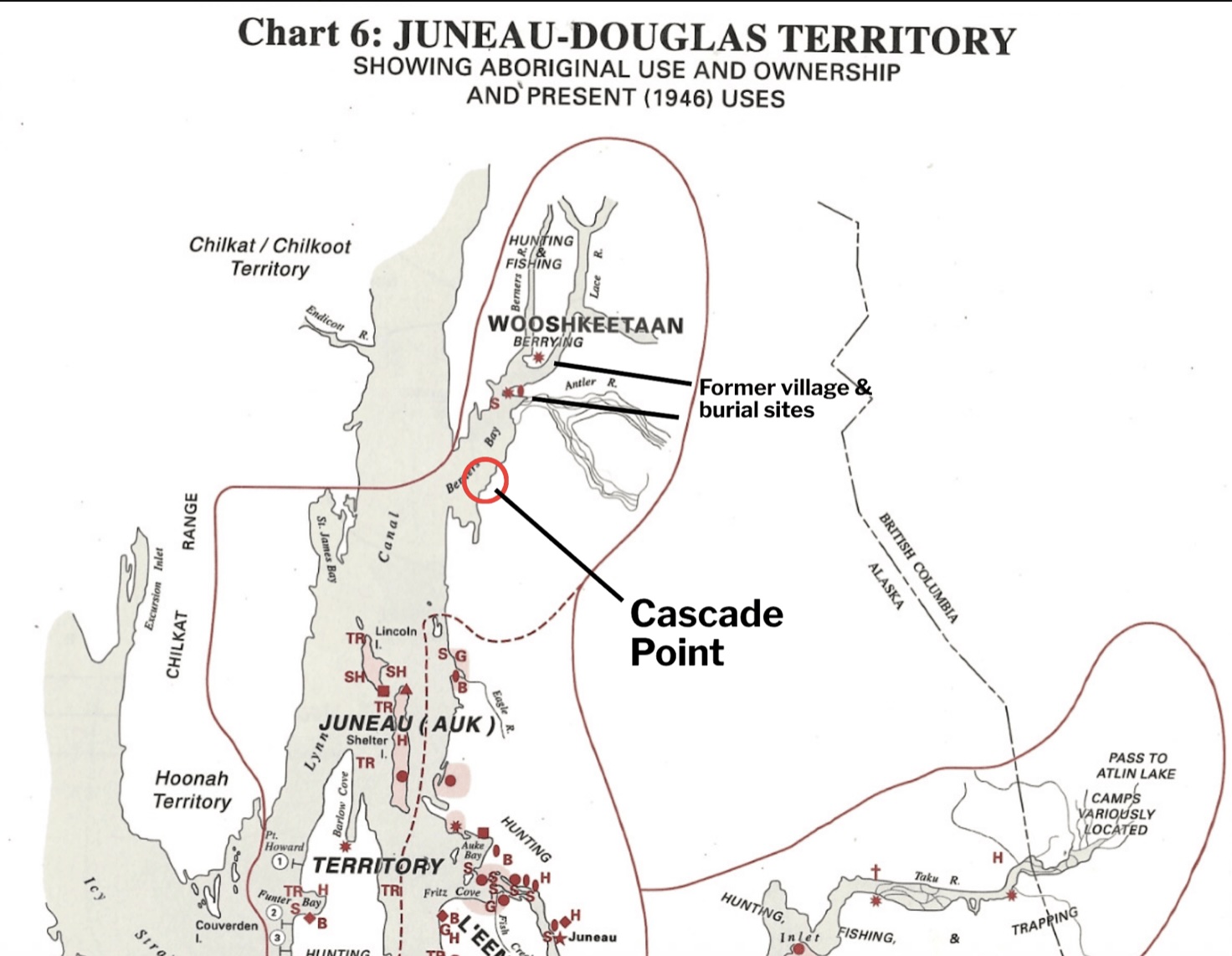
One hundred seventeen thousand gallons of diesel fuel — that is the annual savings Alaska’s Department of Transportation projects if a shuttle ferry runs from Cascade Point instead of Auke Bay, a 24-nautical-mile shortcut that would shave more than three hours off each daily round trip between Juneau, Haines and Skagway.
The numbers come from a state-commissioned analysis cited by Goldbelt, Inc. President and CEO McHugh Pierre in a column published Friday by The Alaska Story. Pierre used the piece to frame the proposed Cascade Point Ferry Terminal as a two-sided obligation: honor the Tlingit cultural record on the corporation’s ANCSA land while delivering the transportation link Southeast Alaska has waited decades to build.
“Goldbelt will never desecrate culturally important sites on its land,” Pierre wrote. “We welcome additional cultural and historical knowledge about areas we plan to develop.” The statement lands in a debate that has circled Berners Bay for 35 years.
What the ground has already told archaeologists
Goldbelt first hired archaeologists in 1991. Michael Yarborough documented culturally modified trees, two shallow depressions and a small shell midden — evidence, he concluded, of seasonal hemlock bark harvesting rather than a permanent village. A 1996 survey added 86 more culturally modified trees along the proposed road alignment. Neither survey found a village or graveyard on the parcel.

In 2005, U.S. Forest Service archaeologists monitored the clearing of roughly 25 acres for an access road. They reported no new cultural materials, village site or burial ground. The most recent work, conducted in 2024, relocated 71 culturally modified trees and a portion of the previously known shell midden. Geotechnical trenching across the terminal footprint turned up nothing additional, Pierre wrote in The Alaska Story.
Village sites have been documented elsewhere in Berners Bay. Historical interviews with Wooshkeetaan clan leader George Jim Sr., Cecelia Kunz and Rosa Miller recorded traditional use across the broader area, and the Forest Service convened a Native consultation meeting with ten community members in March 1997 for the earlier road project.
But at the specific terminal location on Goldbelt land, the archaeological record has consistently come up empty for habitation or burial features.
State and Goldbelt partner on $120 million terminal project
The terminal is a State of Alaska project on Goldbelt land. The two parties signed a memorandum of understanding in 2023 to explore it. Pierre told shareholders during a November 13 livestream that roughly $80 million in state and federal funding has been identified toward an estimated $120 million price tag. The legislature later tried to redirect some of the Juneau Access appropriation to other projects, but Governor Mike Dunleavy vetoed those transfers.
Goldbelt has granted an easement for the terminal with the expectation that responsible development will create economic opportunity for its more than 4,500 shareholders. The corporation has also committed to a paid shuttle connecting Cascade Point, Auke Bay and the Mendenhall Valley, acknowledging the extra road miles passengers would face. “Access must be part of the solution,” Pierre wrote.
A highway designation that could pay for winter plows
The shuttle model Pierre envisions mirrors systems in Puget Sound and British Columbia: shorter, lower-cost routes that allow the Alaska Marine Highway System to use its vessels more efficiently. The state’s analysis projects the fuel savings and the three-plus hours of daily operating time would let AMHS stretch its existing fleet further — a practical gain in a corridor where vessel availability has long dictated schedule reliability.
The counterweight: cultural stewardship vs. corporate mandate
Goldbelt’s shareholders selected these lands under the Alaska Native Claims Settlement Act. The corporation’s board answers to those shareholders today. That lineage gives Pierre a clear fiduciary argument: developing the easement fulfills the ANCSA promise of economic self-determination.
But the cultural record — culturally modified trees, a shell midden, documented traditional use across the bay — sits in tension with any ground disturbance. Pierre’s column does not claim the area is culturally sterile; it argues the specific terminal footprint lacks the village or burial sites that would trigger an absolute prohibition under Goldbelt’s own policy.
McHugh Pierre wrote that Goldbelt recognizes the cultural significance of Berners Bay and the knowledge carried by its Elders. The corporation says it welcomes additional cultural knowledge. Whether that invitation expands the known record — or simply documents what elders already know — remains an open question as the project moves toward permitting.
Goldbelt, Inc., the urban Alaska Native Corporation for the Juneau area, was founded in 1973 and incorporated in 1974 under the Alaska Native Claims Settlement Act. The corporation operates a diversified portfolio spanning federal government contracting — including logistics, engineering, IT and cybersecurity — and an Alaska Group focused on tourism, transportation and security services in Southeast Alaska.
Goldbelt has roughly 4,300 shareholders, most holding 100 shares that cannot be sold and carry voting rights only for Alaska Natives. Over the last decade, annual dividends have ranged from $4.00 to $17.16 per share.
Cascade Point project advances through permitting and funding
Goldbelt Aaní, a separate cultural tourism project, is advancing through the state tideland lease process and Juneau’s conditional use permit review. The corporation hired Tlingit cultural advisors as its first professional services partners for that development.
At Cascade Point, the next steps are federal and state permitting decisions, the final commitment of the remaining $40 million in project funding, and the resolution of whether the shuttle service can operate at a price point that serves both tourists and residents. Pierre told shareholders additional FAQs and site-visit opportunities would be shared as they become available.
Keep reading

West Columbus Vikings Chase Third Regional Final vs. Holmes
West Columbus Vikings football is one win from the program's deepest playoff run since 2015, and the players...

IPS Proposes Closing Six Schools Amid $20M Budget Gap, Declining Enrollment
Indianapolis Public Schools is proposing to close six buildings after this school year to address a $20 million...

Community Leaves Flowers, Notes at Cincinnati Zoo Memorial for Hippo Fiona
Fiona, the Cincinnati Zoo's beloved Nile hippopotamus who survived a premature birth at 29 pounds, died Thursday after...
Laptop Stolen From Morgridge Hall; UW-Madison Police Log 10 Incidents
UW–Madison Police logged 10 incidents Friday, including a laptop stolen from Morgridge Hall and officers following up a...