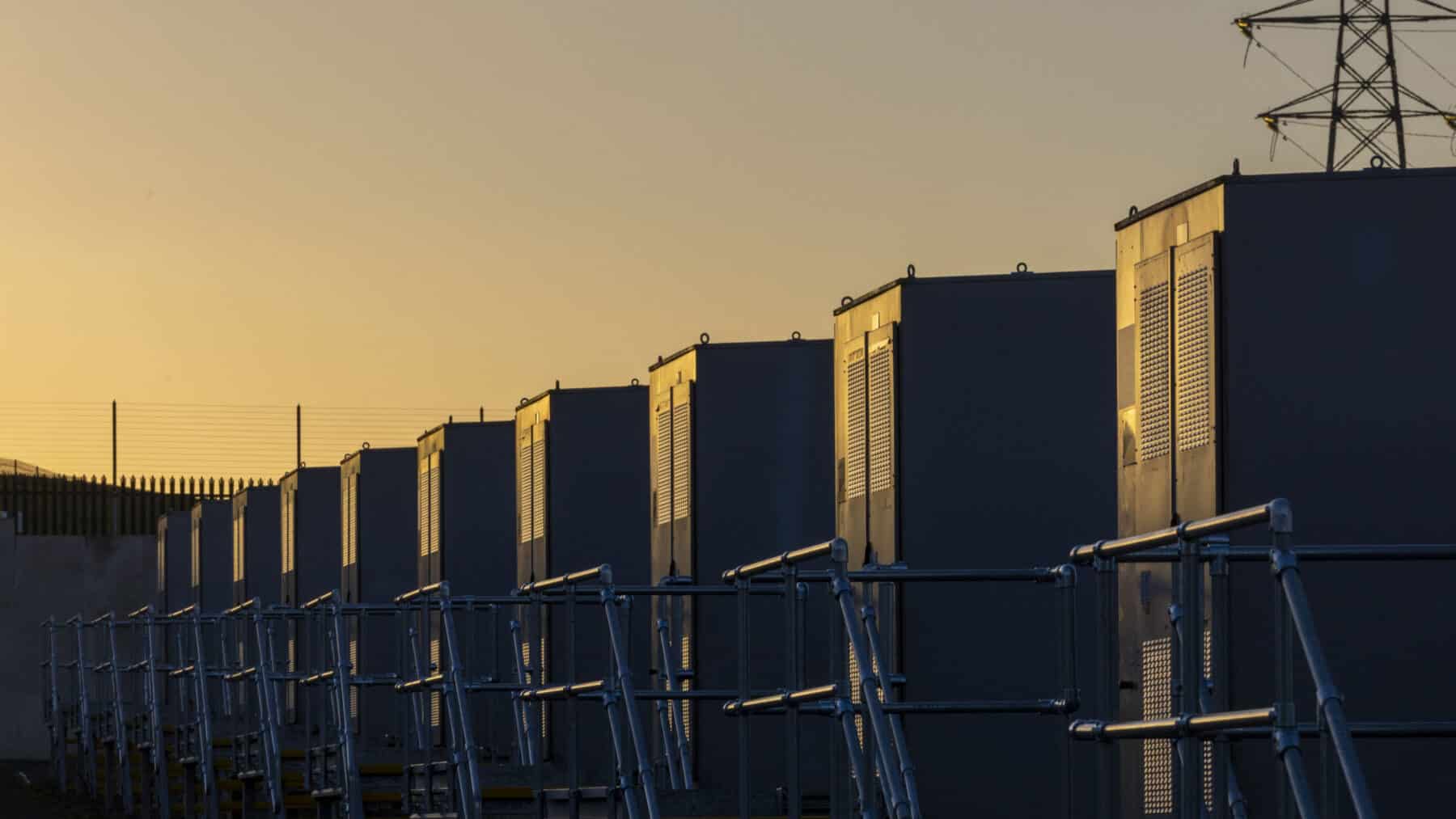
A 50-megawatt liquid air energy storage plant has begun operating on reclaimed industrial land at Carrington, near Manchester, marking the first time the technology has been deployed at commercial scale on a live transmission network in Britain.
The facility, developed by Highview Power, stores energy by chilling ordinary atmospheric air to minus 320 degrees Fahrenheit until it condenses into a liquid, which occupies roughly seven hundred times less volume than gas.
When the grid needs electricity, the liquid is warmed — using ambient or waste heat — and expands back into gas with enough force to drive a turbine generator. The plant is rated at 50 megawatts with 300 megawatt-hours of capacity, enough to discharge at full power for six hours and cover most of an evening peak demand period.
“This is a hugely important moment for Highview, as we kick start work on our first LAES facility in Carrington,” said Richard Butland, chief executive of Highview Power, at the groundbreaking ceremony held at Trafford Low Carbon Energy Park. “The site is the first in our planned programme of energy storage plants across the UK.”

The project represents roughly a twentyfold increase in stored energy over Highview’s earlier 5-megawatt, 15-megawatt-hour demonstrator at Pilsworth, which was the first liquid air plant to feed a live transmission network rather than a laboratory rig. That smaller unit proved the concept could power around 5,000 homes for roughly three hours. Carrington moves the technology from proof of concept toward genuine grid infrastructure, Energies Media reported.
The thermodynamics of the round trip are less efficient than modern lithium-ion batteries, which can return well over 90 percent of the electricity stored in them. But liquid air storage does not degrade with cycling, requires no rare minerals, and uses air as its working fluid — advantages that matter most when duration outweighs peak efficiency.
The plant’s role is to soak up surplus wind and solar output midday and release it in the evening when generation falls but demand remains high.

Plans are already advancing for a larger facility in Scotland with several times Carrington’s storage capacity, a sign the technology is being treated as proven rather than experimental. The same logic — storing renewable power for hours using abundant materials instead of scarce metals — has shaped projects such as the molten sodium battery built in Brisbane.
Carrington, a village of 481 residents in the Metropolitan Borough of Trafford, was historically part of Cheshire and sits on former industrial land west of the Greater Manchester Urban Area. The site once held a Shell Chemicals refinery producing polythene and polystyrene, and a coal-fired power station opened in 1956 that was demolished in 1991.
Today, a large gas and chemical works still operates there, producing gases by fractional distillation of liquid air — the same basic process the new storage plant employs to chill and liquefy atmospheric air.
For now, a row of insulated steel tanks on the edge of Greater Manchester carries the weight of keeping Britain’s lights on after the wind drops and the sun goes down.
Keep reading

No. 19 Michigan Tech 3-0 After 90-80 Win Over Concordia-St. Paul
No. 19 Michigan Tech improved to 3-0 Thursday, pulling away from Concordia-St. Paul for a 90-80 win in...

Cancer Support Community Central Ohio Partners With Columbus Foundation Gifts of Kindness
When the Empower program lost a critical source of public funding last year, Cancer Support Community Central Ohio...

Hernandez Claims 5th Career Big 12 Diver Honor; Nilsson Garip Earns First
Luke Hernandez posted 381.05 points on the 3-meter board to finish runner-up at the Texas Diving Invitational, a...

Four Identified in West Lafayette Death Investigation; Father Was Former Jail Deputy
A 911 call Wednesday night brought deputies to a West Lafayette home where they found four people dead,...