
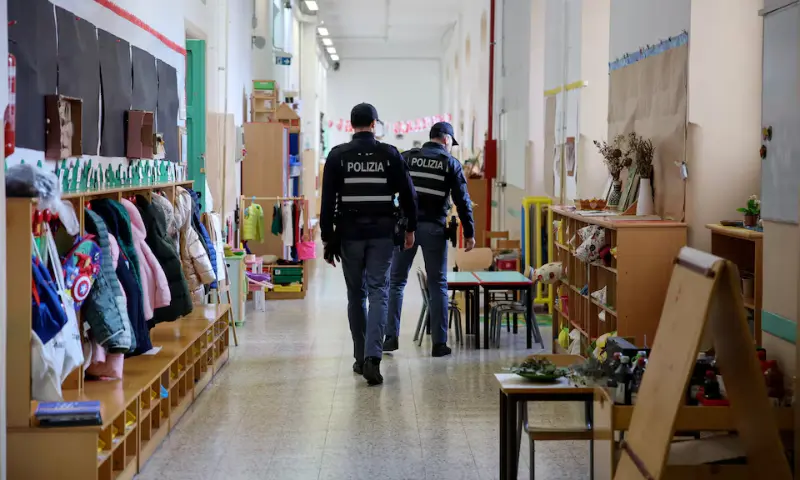
More than 300 schools across Italy were evacuated on Wednesday following a wave of emailed bomb threats that also targeted educational institutions in the United Kingdom and Ireland.
While the threats caused significant anxiety, authorities in Scotland, Northern Ireland, and the Republic of Ireland quickly classified the emails as hoaxes, allowing classes to continue without interruption. In Italy, however, the scale of the response was more pronounced. One school in Rome utilized a messaging app to inform parents that all students had been taken to a safe area and remained under the supervision of teaching staff.
The Disruption of Daily Life
The emotional toll on families has been a primary concern for local officials. In Rome, parents described the confusion and distress caused by the sudden alerts, with Nensi Bego, a parent at the Mazzini middle school, stating, “My daughter Dafne started crying because the kids did not understand what was happening, and she was still shaken when I picked her up,” adding, “It’s obvious it’s just a hoax that disrupts lessons and disrupts everyone’s day.”
It’s obvious it’s just a hoax that disrupts lessons and disrupts everyone’s day.”
The email received in Italy was signed “Mikhail Andropov, leader of the Vilayat of Misoginistan,” according to a copy of the message seen by Reuters. These incidents follow a reported bomb scare involving a Ryanair flight on Monday, as well as a separate bomb threat to a school in Cork that same day.
Thousands of schools across Italy, the UK and Ireland received hoax bomb threat emails, forcing at least 300 Italian schools to evacuate. The email in Italy was reportedly signed by the same person behind threats sent to newsrooms in Bulgaria and Ireland. pic.twitter.com/Ee7Fe4OmMu
Mario Rusconi, president of the National Association of Headteachers in Rome, emphasized the impact on the national education system. “I hope that the Postal Police, who were alerted immediately, will track down these idiots or criminals and punish them appropriately, because it is unacceptable that schools – which already face so many problems of their own – should be subjected to this kind of emotional stress,” he said.
“Let’s bear in mind that the Italian school system has 8 million pupils and 1 million teachers and headteachers: it is a huge sector, and actions of this kind risk jeopardising the education of our pupils, who are already forced, due to Covid, to spend a long time away from the classroom. If we then add to this the fact that schools are suddenly closed for one or two days, we really do risk undermining our education system,” said Mario Rusconi.
Investigating the Digital Fingerprint
Cybersecurity analysis provides a potential window into the mechanics behind the threats. Hudson Rock Research identified that two university email addresses associated with the threats appear in their stolen-credential holdings. The Egyptian university address is linked to a Vidar-associated machine record dated October 1, 2021, which contained saved Microsoft credentials and a collection of 112 browser passwords, including two saved against Microsoft authentication pages.
A Taiwanese university account was also found in a historical data collection known as AlienTXTBASE; the university subsequently reported abnormal bulk sending and suspended the account. These findings do not definitively establish a single operator behind every threat, but they highlight how compromised accounts can be leveraged for mass distribution.
The security firm said that timely action by institutions to secure accounts following credential exposure could potentially interrupt such misuse. In Ireland, security sources indicated that many of these threats are automated, generic emails generated via AI and sent to broad lists, with the primary objective being widespread disruption, as reported by the Irish Examiner.
Geopolitical Tensions and Hybrid Warfare
Italian authorities are treating the wave of disruption as part of a larger strategy of hybrid warfare. Italian Defence Minister Guido Crosetto characterized the threats as a clear effort to spread fear and create anxiety, noting that while foreign hostile entities are suspected, the disruption may also be fueled by attention-seekers and lunatics.
Prime Minister Giorgia Meloni confirmed that the government is closely monitoring the situation, assuring the public that the alerts posed no actual danger.
The incidents arrive during a period of heightened sensitivity regarding cyber-attacks. France recently accused Iran of a cyber-attack that disabled refrigeration systems in hundreds of supermarkets, an allegation Tehran has rejected as “baseless and hostile,” per Dawn. As European nations continue to support Ukraine, some officials suspect that Russia may be orchestrating these campaigns to undermine daily life, a claim the Russian government has consistently denied.
The cumulative effect of these incidents remains a significant challenge for public institutions. “Even though today’s threats are clearly hoaxes, we cannot underestimate the consequences of incidents that alarm entire school communities and disrupt the normal conduct of educational activities,” Antonello Giannelli, head of the Italian School Principals Association, told Dawn.
Worth a look

Why the Manosphere Is Turning on Trump
Donald Trump’s recent, brief flirtation with appointing Dana White as his press secretary showed his attempt to recapture...

Garth Brooks Adds Third Belfast Date, Announces 2027 Ireland Tour
Country music superstar Garth Brooks announced a ten-date tour across Ireland and Northern Ireland for May and June...

Heated Debate Over Indo-Fijian Participation in Constitution Amendment Bill Consultations
A heated parliamentary consultation descended into a dispute over demographic representation as National Federation Party General Secretary Kamal...

European Cycling Championships Will Return to Denmark in 2027: ‘An Important Chapter in Our History’
The European Road Cycling Championships are returning to Denmark exactly a decade after the country last staged the...