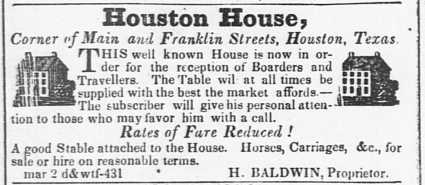
Houston House, the commercial anchor that rose from a half-lot at Franklin and Main streets in 1837 to a two-lot complex housing a dry goods store, saloon, gambling hall, hotel and the city’s post office, was destroyed by fire on February 28, 1859, and never rebuilt, according to the Texas State Historical Association.
The first managing partner, Thomas Massey League, acquired the corner lot from G. W. Scott in May 1837. League, Robert P. Boyce and G. W. Baldwin contracted for a two-story wooden building at a cost of $5,300, and the original Houston House opened in November 1837 as a dry goods store and a ticketing agent for steamboat service.
John Day Andrews joined League in 1838 to form Thomas M. League & Company. Andrews arrived with a load of lumber from Virginia and built a house on League’s property where both families lived during the partnership. The store became the scene of the murder of Moses Brigham by Christopher Columbus Quick.
Peter Wilson, League’s brother-in-law and a former Baltimore clothing merchant, became a minority partner later in 1838 under the name League, Andrews & Company. The agreement stipulated Wilson would keep a residence in Baltimore. Soon after, Houston House began leasing second-floor rooms as lodgings. Andrews left the partnership shortly thereafter.

By the late 1830s League was appointed postmaster of Houston and used Houston House as the post office and a hub of stagecoach operations. The firm acted as landlord for the hotel portion; the first tenant proprietors were Field Secrest and Richard Ross, followed by John Warner Niles and D. W. Babcock.
League, Andrews & Company filed articles of dissolution in 1840, forcing League to sell homestead lots to Andrews. League and Wilson dissolved their partnership in 1842. By the 1840s the property had expanded and the hotel business grew.
Tenant proprietors during that decade included Nathaniel Norwood, A. M. Gentry, Albert Wickes, Horace Baldwin, Thomas Saltus Lubbock, Henry Hazard Milby, Robert Brewster and Allen D. Kellum. The establishment appears in the memoirs of Matilda Houstoun and Ferdinand Roemer.
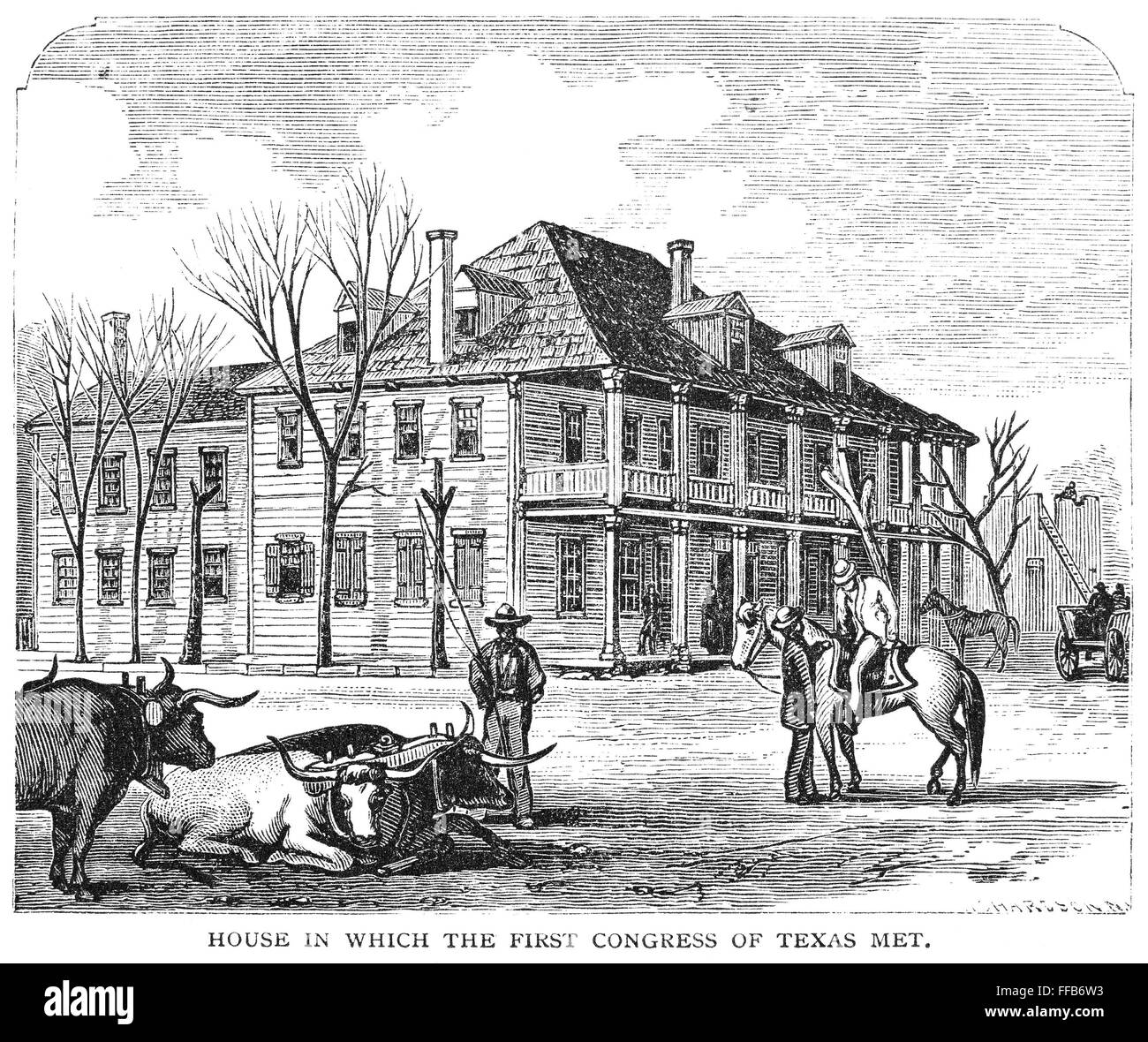
Ownership shifted again in 1845 when Thomas M. League & Company dissolved for the last time. By then the property had grown from less than a half lot to two full lots and a third partial lot.
The partners’ wives — Hester (or “Esther”) Yarnold Wilson League and Mary Warner Wilson, who were sisters — contributed lots to the business and participated in the complicated asset distribution. Peter and Mary Wilson became sole proprietors effective in 1845.
When Thomas M. League was appointed postmaster of Houston by the late 1830s, he designated Houston House as the post office and a hub of stagecoach operations, anchoring the city’s communication and travel networks at Franklin and Main.
The two-story wooden building, erected in 1837 on a fifty-by-fifty-seven-foot lot, expanded from a dry goods store and steamboat ticketing agent into a complex housing a saloon, gambling hall, and hotel leased to successive tenant proprietors including Field Secrest and Richard Ross, Nathaniel Norwood, and Thomas Saltus Lubbock.
Peter Wilson died in 1849, leaving Mary Wilson with the hotel and a large family. The 1850 census shows the Wilson family residing at the hotel with Mary’s son-in-law William Fulton as hotelkeeper. Mary Wilson sold the hotel on November 16, 1852, to Jared Kirby for $6,000. James E. Perkins acquired Houston House on January 31, 1855, and held it until the fire ended its 22-year run.
Related reading

Wright State Improves to 6-0; RMU, Purdue Fort Wayne, NIU Earn Wins
Wright State improved to 6-0 on Monday with a 66-64 win over Akron, the only Horizon League team...

Rob Lowe Documentary Links 1988 Scandal To MAGA Film
Rob Lowe's new Netflix documentary revisits the 1988 sex tape scandal that derailed his rising political profile and...

Granite City Lumberjacks fall 5-4 in OT to Minnesota Vulcans
The Granite City Lumberjacks lost their first game of the season Friday, falling 5-4 in overtime to the...

Topeka Turkey Trot Returns to Forbes Field Thanksgiving With Charity Partnership
The second annual Topeka Turkey Trot will take place Thanksgiving morning, Nov. 26, at Forbes Field, moving from...