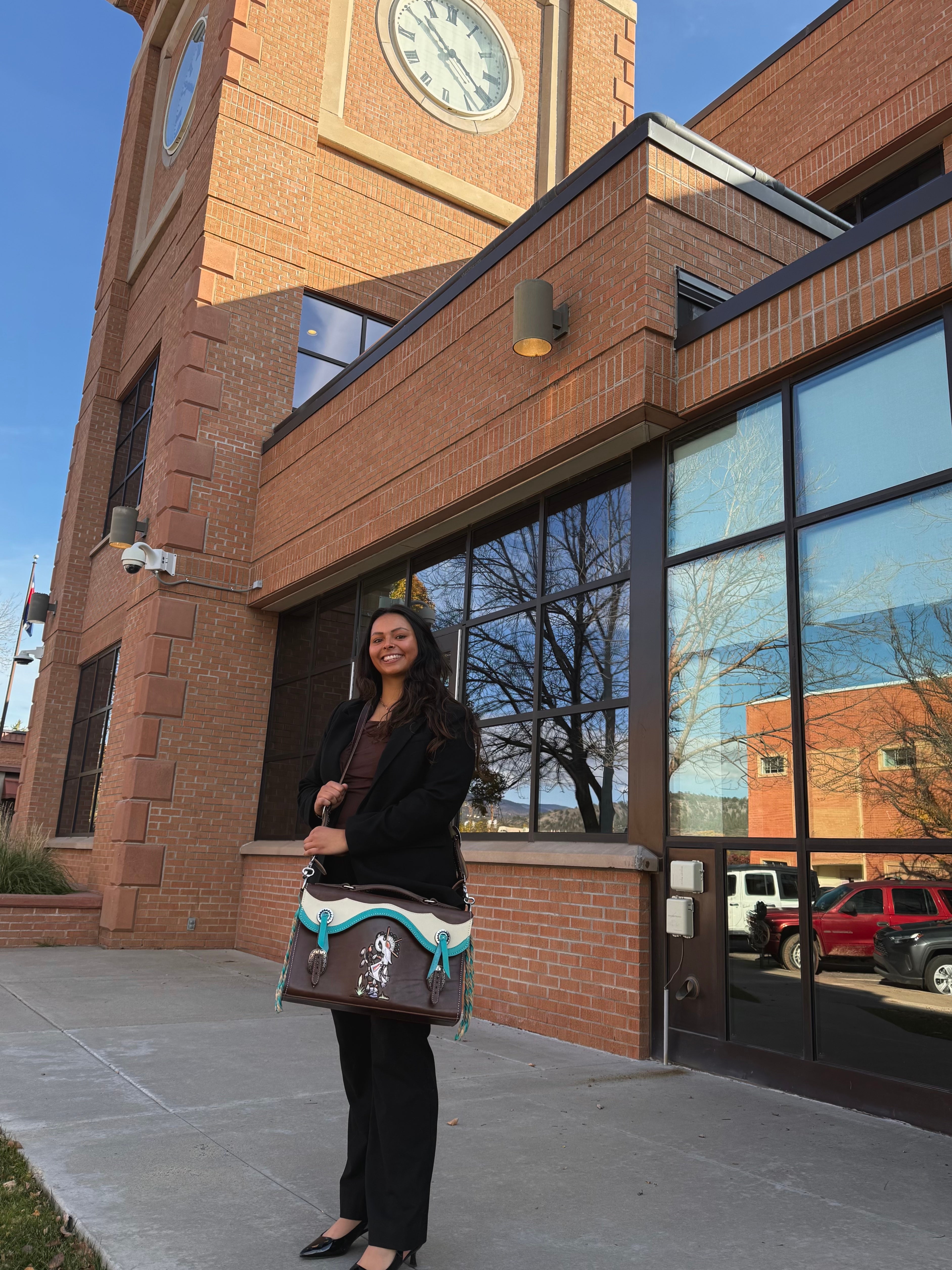
Chrysten Pacheco advocates for JayDee Russell’s release
In a reflection shared with Colorado Law, law student Chrysten Pacheco describes her year-long effort to secure the release of JayDee Russell, an inmate serving a 96-year sentence in Colorado.
Pacheco, a student at Colorado Law, worked through the university’s Immigration Defense Clinic to advocate for Russell, who has been incarcerated for 21 years. Her efforts culminated in a successful meeting with the La Plata County District Attorney, resulting in an agreement for his release, Colorado Law reported.
The case centered on nonviolent offenses, including charges under the Colorado Organized Crime Control Act (COCCA), motor vehicle theft, drug distribution and manufacturing, and witness tampering. These charges stemmed from allegations that Russell participated in an operation where stolen vehicles were traded for methamphetamine.
A shift toward prosecutorial collaboration
The legal strategy for the case evolved significantly over the last year. Pacheco noted that while she and her clinic partner initially pursued clemency, the involvement of For the People changed the trajectory of the representation.
For the People is a California-based nonprofit that partners with prosecutors to review lengthy sentences for nonviolent offenders. This organization worked in conjunction with the La Plata County District Attorney’s Office to identify individuals who met specific criteria for sentence review.
Pacheco, who served as an Advanced Clinic student to continue the work, worked alongside supervising attorney Professor Violeta Chapin. The pair traveled to Durango to present the case directly to the elected district attorney.

Rehabilitation through decades of service
The push for Russell’s release rested heavily on his conduct during more than two decades of imprisonment. According to Pacheco, Russell maintained a record of zero disciplinary offenses during his 21 years in custody.
Russell engaged in several rehabilitative activities while at the Buena Vista Correctional Facility and the Fremont County Correctional Facility. His documented efforts included:
- Working in a prison saddle shop and performing general maintenance.
- Founding and leading a CrossFit program at Buena Vista Correctional Facility.
- Completing numerous institutional programs.
Pacheco expressed confidence in the outcome, stating that Russell provided a primary example of the rehabilitation district attorneys look for when considering sentence reductions.
“For me, it was kind of like, if not him, then nobody. These were nonviolent offenses, and he had done everything he possibly could while incarcerated,” Pacheco told Colorado Law.
Shared cultural roots shape the attorney and client relationship
The relationship between the student attorney and her client was shaped by shared cultural roots. Pacheco, who is Indigenous and Navajo, noted that Russell’s family is from the Four Corners area and is familiar with the Navajo reservation in New Mexico.
As a gesture of gratitude, Russell used his skills in the Fremont County Correctional Facility saddle shop to create a custom laptop bag for Pacheco. He intended the gift to serve a dual purpose: as a thank-you and as a physical representation of his craftsmanship to show the district attorney during their meeting.
At Pacheco’s suggestion, the bag featured an etched Buffalo Warrior design, a choice she discussed with her father to ensure it was appropriate.
The impact on future legal practice
The experience has directly influenced Pacheco’s professional trajectory. She has already secured a position as a public defender following her graduation.
Pacheco credited the clinic with providing the practical experience necessary to secure an internship with the Federal Public Defender’s Office. She noted that employers valued her ability to negotiate with prosecutors and her understanding of immigration consequences and post-conviction work.
The case reinforced the concept of client-centered representation, a principle Pacheco says she intends to carry into her career. She said lawyers should meet clients where they are and use legal advocacy to tell their stories.
Russell’s release follows a period of intense advocacy that moved from the initial pursuit of clemency to a direct negotiation with local law enforcement authorities.

No. 24 Kentucky Faces No. 15 Kansas in Champions Classic Showdown
No. 24 Kentucky hits the road for the first time this season on Tuesday, facing 15th-ranked Kansas in...

Last Eight USS Indianapolis Sailors Identified After 81 Years
Final Eight Sailors from USS Indianapolis Identified Eighty-one years after the USS Indianapolis slipped beneath the waves of...

New I-84 Lanes to Open Near Twin Falls After Weekend Traffic Shifts
New I-84 lanes near Twin Falls Interchange The Idaho Transportation Department is preparing to open new lanes on...

Max Johnson, Alonzo Jackson Jr. and Morgan Suarez Earn Sun Belt Honors
Georgia Southern quarterback Max Johnson threw for four touchdowns during a 49-13 win over Marshall, tying the program's...